
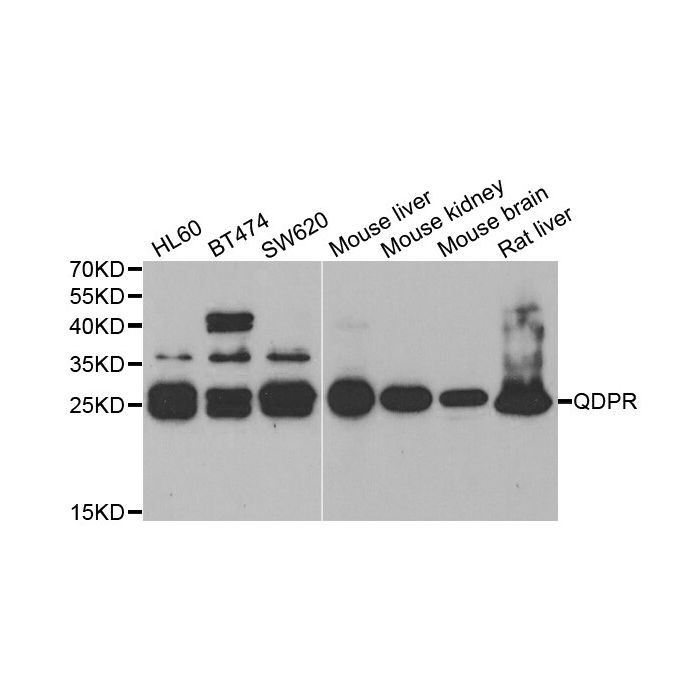
QDPR polyclonal, anti-human, mouse, rat
€388.00
In stock
SKU
BS7822
Background:
QDPR (quinoid dihydropteridine reductase), also known as DHPR (dihydropteridine reductasae) or PKU2, is a member of the short-chain dehydrogenases/reductase (SDR) family of enzymes. Functioning as a homodimer, QDPR plays an important role in the recycling of tetrahydrobiopterin (BH4), an essential cofactor for the hydroxylation of the aromatic amino acids (tryptophan, tyrosine and phenylalanine). More specifically, QDPR catalyzes the regeneration of BH4 from quinonoid dihydrobiopterin (qBH2), the product generated from the hydroxylation reactions. Mutations in the gene encoding QDPR can lead to phenylketonuria II (also called PK2 or dihydropteridine reductase deficiency), a disorder resulting from the depletion of dopamine, epinephrine and serotonin due to defective recycling of BH4. Symptoms of PK2 include hyperphenylalaninemia, axial hypotonia, truncal hypertonia, microcephaly and abnormal thermogenesis.
Alternative Name:
DHPR_HUMAN, Dihydropteridine reductase, HDHPR, HPR, Qdpr, Quinoid dihydropteridine reductase,
Application Dilution: WB: 1:500~1:2000, IF: 1:50~1:200
Specificity: QDPR polyclonal antibody detects endogenous levels of QDPR protein.
Immunogen:
Recombinant full length Human QDPR.
MW: ~ 26 kDa
Swis Prot.: P09417
Purification & Purity:
The antibody was affinity-purified from rabbit antiserum by affinity-chromatography using epitope-specific immunogen and the purity is > 95% (by SDS-PAGE).
Format:
1mg/ml in PBS with 0.1% Sodium Azide, 50% Glycerol.
Storage:
Store at 4°C short term. Aliquot and store at -20°C long term. Avoid freeze-thaw cycles.
For research use only, not for use in diagnostic procedure.
QDPR (quinoid dihydropteridine reductase), also known as DHPR (dihydropteridine reductasae) or PKU2, is a member of the short-chain dehydrogenases/reductase (SDR) family of enzymes. Functioning as a homodimer, QDPR plays an important role in the recycling of tetrahydrobiopterin (BH4), an essential cofactor for the hydroxylation of the aromatic amino acids (tryptophan, tyrosine and phenylalanine). More specifically, QDPR catalyzes the regeneration of BH4 from quinonoid dihydrobiopterin (qBH2), the product generated from the hydroxylation reactions. Mutations in the gene encoding QDPR can lead to phenylketonuria II (also called PK2 or dihydropteridine reductase deficiency), a disorder resulting from the depletion of dopamine, epinephrine and serotonin due to defective recycling of BH4. Symptoms of PK2 include hyperphenylalaninemia, axial hypotonia, truncal hypertonia, microcephaly and abnormal thermogenesis.
Alternative Name:
DHPR_HUMAN, Dihydropteridine reductase, HDHPR, HPR, Qdpr, Quinoid dihydropteridine reductase,
Application Dilution: WB: 1:500~1:2000, IF: 1:50~1:200
Specificity: QDPR polyclonal antibody detects endogenous levels of QDPR protein.
Immunogen:
Recombinant full length Human QDPR.
MW: ~ 26 kDa
Swis Prot.: P09417
Purification & Purity:
The antibody was affinity-purified from rabbit antiserum by affinity-chromatography using epitope-specific immunogen and the purity is > 95% (by SDS-PAGE).
Format:
1mg/ml in PBS with 0.1% Sodium Azide, 50% Glycerol.
Storage:
Store at 4°C short term. Aliquot and store at -20°C long term. Avoid freeze-thaw cycles.
For research use only, not for use in diagnostic procedure.
| Is Featured? | No |
|---|
Write Your Own Review