
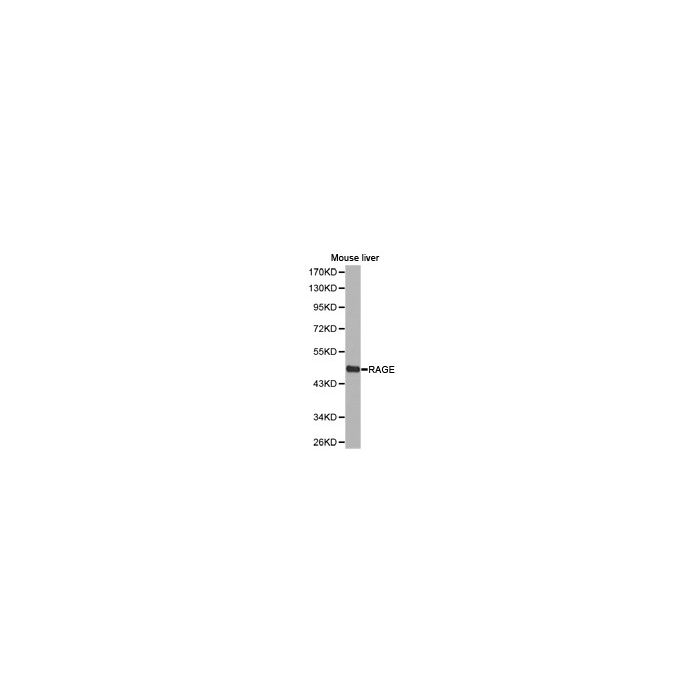
RAGE polyclonal, anti-human, mouse, rat
€388.00
In stock
SKU
BS6719
Background:
Advanced glycosylation end products of proteins (AGEs) are nonenzymatically glycosylated proteins that are associated with a variety of conditions, including diabetes and other vascular disorders, as well as amyloidosis. These proteins regulate cellular functions via specific cell surface acceptor molecules, such as RAGE (receptor for advanced glycosylation end products). RAGE is a type 1 membrane protein that is found on the surface of endothelial cells, mononuclear phagocytes and vascular smooth muscle cells. Binding of AGEs to RAGE results in the induction of cellular oxidant stress and activation of the transcription factor NFkB. Evidence suggests that the induction of oxidant stress results in the activation of an intracellular cascade involving p21 ras and MAP kinase, which leads to activation of transcription.
Alternative Name:
MAPK/MAK/MRK overlapping kinase, MOK protein kinase, Renal tumor antigen 1, Renal tumor antigen 1, Renal tumor antigen 1, RAGE, RAGE1
Application Dilution: WB: 1:500~1:2000, IHC: 1:50~1:200
Specificity: RAGE polyclonal antibody detects endogenous levels of RAGE protein.
Immunogen:
Recombinant full length Human RAGE.
MW: ~ 48 kDa
Swis Prot.: Q9UQ07
Purification & Purity:
The antibody was affinity-purified from rabbit antiserum by affinity-chromatography using epitope-specific immunogen and the purity is > 95% (by SDS-PAGE).
Format:
1mg/ml in PBS with 0.1% Sodium Azide, 50% Glycerol.
Storage:
Store at 4°C short term. Aliquot and store at -20°C long term. Avoid freeze-thaw cycles.
For research use only, not for use in diagnostic procedure.
Advanced glycosylation end products of proteins (AGEs) are nonenzymatically glycosylated proteins that are associated with a variety of conditions, including diabetes and other vascular disorders, as well as amyloidosis. These proteins regulate cellular functions via specific cell surface acceptor molecules, such as RAGE (receptor for advanced glycosylation end products). RAGE is a type 1 membrane protein that is found on the surface of endothelial cells, mononuclear phagocytes and vascular smooth muscle cells. Binding of AGEs to RAGE results in the induction of cellular oxidant stress and activation of the transcription factor NFkB. Evidence suggests that the induction of oxidant stress results in the activation of an intracellular cascade involving p21 ras and MAP kinase, which leads to activation of transcription.
Alternative Name:
MAPK/MAK/MRK overlapping kinase, MOK protein kinase, Renal tumor antigen 1, Renal tumor antigen 1, Renal tumor antigen 1, RAGE, RAGE1
Application Dilution: WB: 1:500~1:2000, IHC: 1:50~1:200
Specificity: RAGE polyclonal antibody detects endogenous levels of RAGE protein.
Immunogen:
Recombinant full length Human RAGE.
MW: ~ 48 kDa
Swis Prot.: Q9UQ07
Purification & Purity:
The antibody was affinity-purified from rabbit antiserum by affinity-chromatography using epitope-specific immunogen and the purity is > 95% (by SDS-PAGE).
Format:
1mg/ml in PBS with 0.1% Sodium Azide, 50% Glycerol.
Storage:
Store at 4°C short term. Aliquot and store at -20°C long term. Avoid freeze-thaw cycles.
For research use only, not for use in diagnostic procedure.
| Is Featured? | No |
|---|
Write Your Own Review