
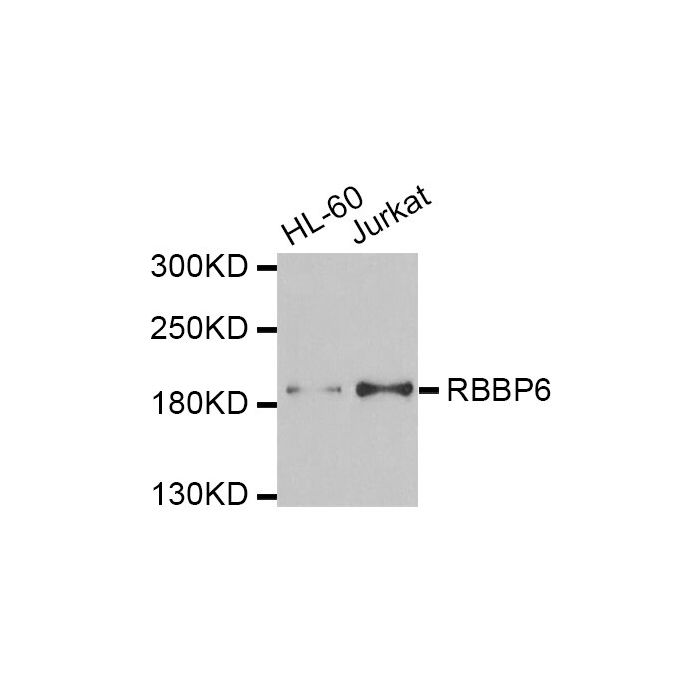
RBBP6 polyclonal, anti-human
€388.00
In stock
SKU
BS8619
Background:
Rb protein and p53 are both cell cycle checkpoint components. Evidence suggests that p53 plays a role in regulating the phosphorylation of Rb by inducing p21 transcription, thus preventing Rb phosphorylation at the G1 to S transition. Protein-protein interactions seem to be central in p53 cellular activities, as previously demonstrated with MDM2 and SV40 large T antigen. Two novel proteins have been identified by their abilities to bind to p53 and/ or Rb. Human RBQ-1 (also designated RBBP6) has been cloned as a novel protein that binds to the retinoblastoma (Rb) gene product. A related mouse protein, P2P-R, also designated PACT (for p53 associated cellular protein-testis derived), has been shown to bind to both Rb and p53. Recombinant P2P-R binds to wildtype p53 but not to mutant p53, and it can interfere with p53 specific DNA binding. RBQ-1 may be a truncated human form of the P2P-R protein.
Alternative Name:
E3 ubiquitin-protein ligase RBBP6, EC=6.3.2.-, Proliferation potential-related protein, Protein P2P-R, Retinoblastoma-binding Q protein 1, RBQ-1, Retinoblastoma-binding protein 6, p53-associated cellular protein of testis, RBBP6, P2PR, PACT, RBQ1, My038
Application Dilution: WB: 1:500~1:2000, IF: 1:50~1:200
Specificity: RBBP6 polyclonal antibody detects endogenous levels of RBBP6 protein.
Immunogen:
Recombinant full length Human RBBP6.
MW: ~ 202kDa
Swis Prot.: Q7Z6E9
Purification & Purity:
The antibody was affinity-purified from rabbit antiserum by affinity-chromatography using epitope-specific immunogen and the purity is > 95% (by SDS-PAGE).
Format:
1mg/ml in PBS with 0.1% Sodium Azide, 50% Glycerol.
Storage:
Store at 4°C short term. Aliquot and store at -20°C long term. Avoid freeze-thaw cycles.
For research use only, not for use in diagnostic procedure.
Rb protein and p53 are both cell cycle checkpoint components. Evidence suggests that p53 plays a role in regulating the phosphorylation of Rb by inducing p21 transcription, thus preventing Rb phosphorylation at the G1 to S transition. Protein-protein interactions seem to be central in p53 cellular activities, as previously demonstrated with MDM2 and SV40 large T antigen. Two novel proteins have been identified by their abilities to bind to p53 and/ or Rb. Human RBQ-1 (also designated RBBP6) has been cloned as a novel protein that binds to the retinoblastoma (Rb) gene product. A related mouse protein, P2P-R, also designated PACT (for p53 associated cellular protein-testis derived), has been shown to bind to both Rb and p53. Recombinant P2P-R binds to wildtype p53 but not to mutant p53, and it can interfere with p53 specific DNA binding. RBQ-1 may be a truncated human form of the P2P-R protein.
Alternative Name:
E3 ubiquitin-protein ligase RBBP6, EC=6.3.2.-, Proliferation potential-related protein, Protein P2P-R, Retinoblastoma-binding Q protein 1, RBQ-1, Retinoblastoma-binding protein 6, p53-associated cellular protein of testis, RBBP6, P2PR, PACT, RBQ1, My038
Application Dilution: WB: 1:500~1:2000, IF: 1:50~1:200
Specificity: RBBP6 polyclonal antibody detects endogenous levels of RBBP6 protein.
Immunogen:
Recombinant full length Human RBBP6.
MW: ~ 202kDa
Swis Prot.: Q7Z6E9
Purification & Purity:
The antibody was affinity-purified from rabbit antiserum by affinity-chromatography using epitope-specific immunogen and the purity is > 95% (by SDS-PAGE).
Format:
1mg/ml in PBS with 0.1% Sodium Azide, 50% Glycerol.
Storage:
Store at 4°C short term. Aliquot and store at -20°C long term. Avoid freeze-thaw cycles.
For research use only, not for use in diagnostic procedure.
| Is Featured? | No |
|---|
Write Your Own Review