
REG3A polyclonal, anti-human, mouse, rat
€388.00
In stock
SKU
BS6896
Background:
The regeneration (REG) family consists of secretory proteins involved in liver, pancreatic, gastric and intestinal cell proliferation or differentiation. Members of the REG family are divided into four subclasses, designated types I, II, III and IV. They have been implicated in the regulation of cell growth, tumorigenesis and the progression of cancer. Specifically, increased expression of Reg IIIa results in pancreatic inflammation and liver carcinogenesis. Reg IIIa, also de-signated pancreatitis-associated protein, localizes to the apical region of pancreatic acinar cells and is similar to the C-type lectin superfamily. The Reg IIIa protein is mainly expressed in the intestine, with lower expression detected in healthy pancreas. It is also detected in pancreatic juice as a result of pancreatic inflammation.
Alternative Name:
Regenerating islet-derived protein 3-alpha, REG-3-alpha, REG 3α, REG-3α, REG3α, Hepatointestinal pancreatic protein, HIP/PAP, Human proislet peptide, Pancreatitis-associated protein 1, Regenerating islet-derived protein III-alpha, Reg III-alpha, Regenerating islet-derived protein 3-alpha 16.5 kDa form, Regenerating islet-derived protein 3-alpha 15 kDa form, REG3A, HIP, PAP, PAP1
Application Dilution: WB: 1:500~1:2000, IHC/IF: 1:50~1:200
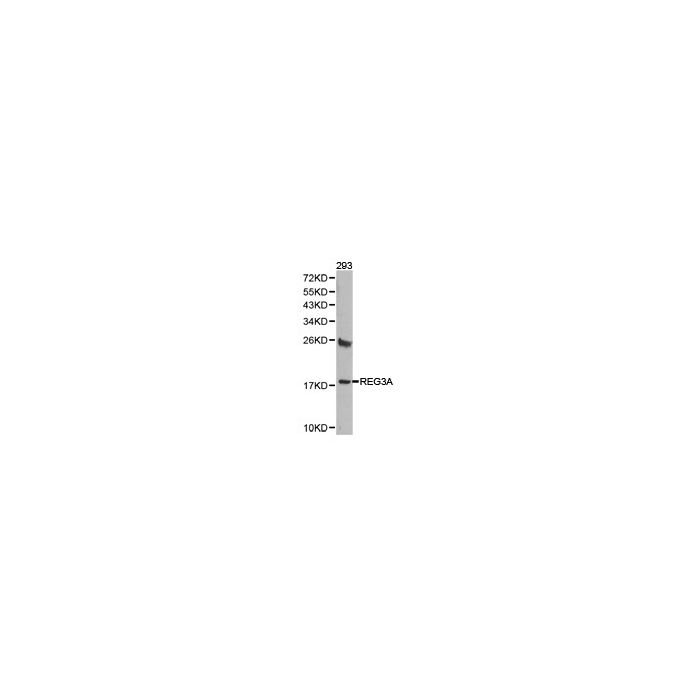
Specificity: REG3A polyclonal antibody detects endogenous levels of REG3A protein.
Immunogen:
Recombinant full length Human REG3A.
MW: ~ 19 kDa
Swis Prot.: Q06141
Purification & Purity:
The antibody was affinity-purified from rabbit antiserum by affinity-chromatography using epitope-specific immunogen and the purity is > 95% (by SDS-PAGE).
Format:
1 mg/ml in Phosphate buffered saline (PBS) with 0.05% sodium azide, approx. pH 7.2.
Storage:
Store at 4°C short term. Aliquot and store at -20°C long term. Avoid freeze-thaw cycles.
For research use only, not for use in diagnostic procedure.
The regeneration (REG) family consists of secretory proteins involved in liver, pancreatic, gastric and intestinal cell proliferation or differentiation. Members of the REG family are divided into four subclasses, designated types I, II, III and IV. They have been implicated in the regulation of cell growth, tumorigenesis and the progression of cancer. Specifically, increased expression of Reg IIIa results in pancreatic inflammation and liver carcinogenesis. Reg IIIa, also de-signated pancreatitis-associated protein, localizes to the apical region of pancreatic acinar cells and is similar to the C-type lectin superfamily. The Reg IIIa protein is mainly expressed in the intestine, with lower expression detected in healthy pancreas. It is also detected in pancreatic juice as a result of pancreatic inflammation.
Alternative Name:
Regenerating islet-derived protein 3-alpha, REG-3-alpha, REG 3α, REG-3α, REG3α, Hepatointestinal pancreatic protein, HIP/PAP, Human proislet peptide, Pancreatitis-associated protein 1, Regenerating islet-derived protein III-alpha, Reg III-alpha, Regenerating islet-derived protein 3-alpha 16.5 kDa form, Regenerating islet-derived protein 3-alpha 15 kDa form, REG3A, HIP, PAP, PAP1
Application Dilution: WB: 1:500~1:2000, IHC/IF: 1:50~1:200
Specificity: REG3A polyclonal antibody detects endogenous levels of REG3A protein.
Immunogen:
Recombinant full length Human REG3A.
MW: ~ 19 kDa
Swis Prot.: Q06141
Purification & Purity:
The antibody was affinity-purified from rabbit antiserum by affinity-chromatography using epitope-specific immunogen and the purity is > 95% (by SDS-PAGE).
Format:
1 mg/ml in Phosphate buffered saline (PBS) with 0.05% sodium azide, approx. pH 7.2.
Storage:
Store at 4°C short term. Aliquot and store at -20°C long term. Avoid freeze-thaw cycles.
For research use only, not for use in diagnostic procedure.
| Is Featured? | No |
|---|
Write Your Own Review