
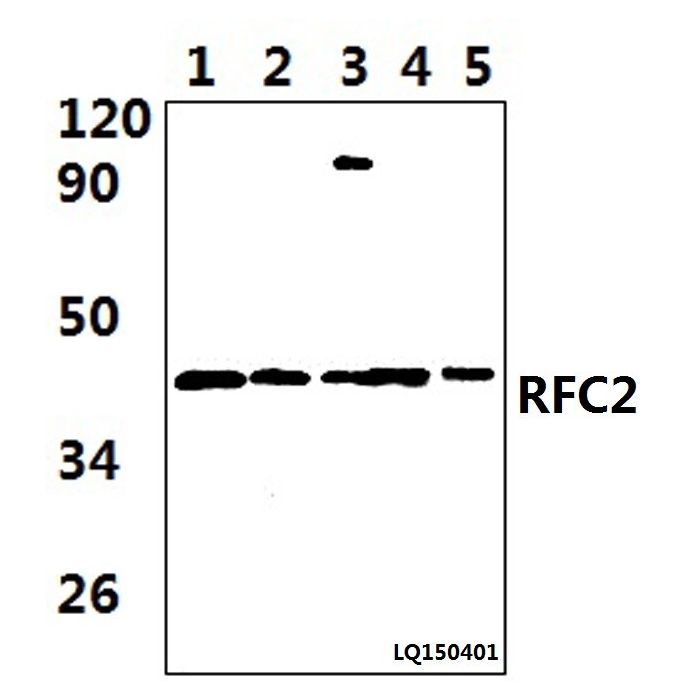
RFC2 (T165) polyclonal, anti-human, mouse, rat
€305.00
In stock
SKU
BS9272
Background:
Replication factor C (RFC) is an essential DNA polymerase accessory protein that is required for numerous aspects of DNA metabolism, including DNA replication, DNA repair and telomere metabolism. RFC is a heteropentameric complex that recognizes a primer on a template DNA, binds to a primer terminus and loads proliferating cell nuclear antigen (PCNA) onto DNA at primer-template junctions in an ATP-dependent reaction. All five of the RFC subunits share a set of related sequences (RFC boxes) that include nucleotidebinding consensus sequences. Four of the five RFC genes (RFC1, RFC2, RFC3 and RFC4) have consensus ATP-binding motifs. The small RFC proteins, RFC2, RFC3, RFC4 and RFC5, interact with Rad24, whereas the RFC1 subunit does not. RFC2, the third-largest subunit of the RFC complex, exhibits ATP binding which makes it important for both DNA replication and checkpoint function.
Alternative Name:
Replication factor C subunit 2, Activator 1 40 kDa subunit, A1 40 kDa subunit, Activator 1 subunit 2, Replication factor C 40 kDa subunit, RF-C 40 kDa subunit, RFC40, RFC2
Application Dilution: WB: 1:500~1:1000
Specificity: RFC2 (T165) polyclonal antibody detects endogenous levels of RFC2 protein.
Immunogen:
Synthetic peptide, corresponding to amino acids 150-200 of Human RFC2.
MW: ~ 39 kDa
Swis Prot.: P35250
Purification & Purity:
The antibody was affinity-purified from rabbit antiserum by affinity-chromatography using epitope-specific immunogen and the purity is > 95% (by SDS-PAGE).
Format:
1 mg/ml in Phosphate buffered saline (PBS) with 0.05% sodium azide, approx. pH 7.2.
Storage:
Store at 4°C short term. Aliquot and store at -20°C long term. Avoid freeze-thaw cycles.
For research use only, not for use in diagnostic procedure.
Replication factor C (RFC) is an essential DNA polymerase accessory protein that is required for numerous aspects of DNA metabolism, including DNA replication, DNA repair and telomere metabolism. RFC is a heteropentameric complex that recognizes a primer on a template DNA, binds to a primer terminus and loads proliferating cell nuclear antigen (PCNA) onto DNA at primer-template junctions in an ATP-dependent reaction. All five of the RFC subunits share a set of related sequences (RFC boxes) that include nucleotidebinding consensus sequences. Four of the five RFC genes (RFC1, RFC2, RFC3 and RFC4) have consensus ATP-binding motifs. The small RFC proteins, RFC2, RFC3, RFC4 and RFC5, interact with Rad24, whereas the RFC1 subunit does not. RFC2, the third-largest subunit of the RFC complex, exhibits ATP binding which makes it important for both DNA replication and checkpoint function.
Alternative Name:
Replication factor C subunit 2, Activator 1 40 kDa subunit, A1 40 kDa subunit, Activator 1 subunit 2, Replication factor C 40 kDa subunit, RF-C 40 kDa subunit, RFC40, RFC2
Application Dilution: WB: 1:500~1:1000
Specificity: RFC2 (T165) polyclonal antibody detects endogenous levels of RFC2 protein.
Immunogen:
Synthetic peptide, corresponding to amino acids 150-200 of Human RFC2.
MW: ~ 39 kDa
Swis Prot.: P35250
Purification & Purity:
The antibody was affinity-purified from rabbit antiserum by affinity-chromatography using epitope-specific immunogen and the purity is > 95% (by SDS-PAGE).
Format:
1 mg/ml in Phosphate buffered saline (PBS) with 0.05% sodium azide, approx. pH 7.2.
Storage:
Store at 4°C short term. Aliquot and store at -20°C long term. Avoid freeze-thaw cycles.
For research use only, not for use in diagnostic procedure.
| Is Featured? | No |
|---|
Write Your Own Review