
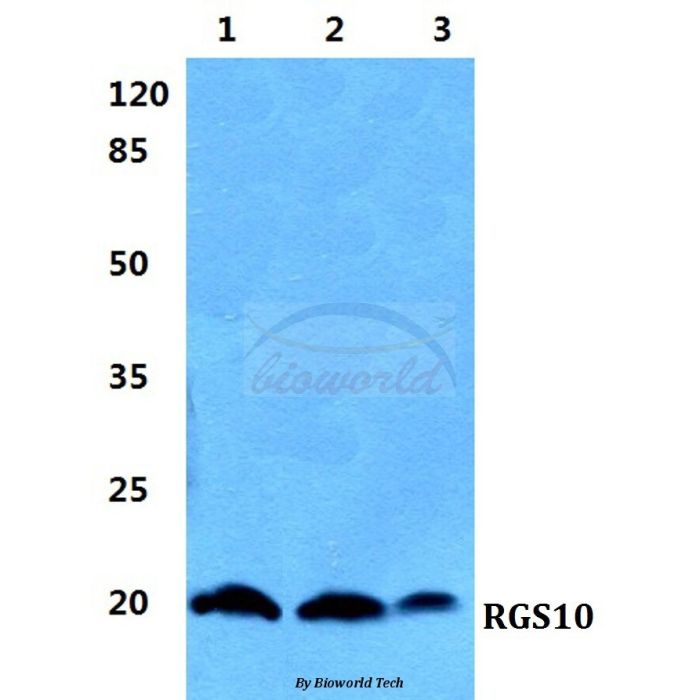
RGS10 polyclonal, anti-human, mouse, rat
€305.00
In stock
SKU
BS5895
Background:
Heterotrimeric G proteins function to relay information from cell surface receptors to intracellular effectors. In mammals, G protein α, β and γ polypeptides are encoded by at least 16, 4 and 7 genes, respectively. Most interest in G proteins has been focused on their α subunits, since these proteins bind and hydrolyze GTP and most obviously regulate the activity of the best studied effectors. Four Gα GTPase-activating proteins (GAPs) have been identified and are designated RGS1 (regulator of G protein signaling), RGS4, RGS10 and GAIP (Gα-interacting protein). Each of these proteins has been shown to deactivate specific Gα isoforms by increasing the rate at which they convert GTP to GDP. RGS1, RGS4 and GAIP bind tightly to and exhibit GAP activity towards Gα i, Gα o and Gα t, but not Gα s. RGS10 increases the GTP hydrolytic activity of several members of the Gα i sub-family, including Gα i-3, Gα z and Gα o.
Alternative Name:
Regulator of G-protein signaling 10
Application Dilution: WB: 1:500~1:1000, IHC: 1:50~1:200
Specificity: RGS10 polyclonal antibody detects endogenous levels of RGS10 protein.
Immunogen:
Synthetic peptide, corresponding to amino acids 357-402 of Human RGS10.
MW: ~ 20 kDa
Swis Prot.: O43665
Purification & Purity:
The antibody was affinity-purified from rabbit antiserum by affinity-chromatography using epitope-specific immunogen and the purity is > 95% (by SDS-PAGE).
Format:
1 mg/ml in Phosphate buffered saline (PBS) with 0.05% sodium azide, approx. pH 7.2.
Storage:
Store at 4°C short term. Aliquot and store at -20°C long term. Avoid freeze-thaw cycles.
For research use only, not for use in diagnostic procedure.
Heterotrimeric G proteins function to relay information from cell surface receptors to intracellular effectors. In mammals, G protein α, β and γ polypeptides are encoded by at least 16, 4 and 7 genes, respectively. Most interest in G proteins has been focused on their α subunits, since these proteins bind and hydrolyze GTP and most obviously regulate the activity of the best studied effectors. Four Gα GTPase-activating proteins (GAPs) have been identified and are designated RGS1 (regulator of G protein signaling), RGS4, RGS10 and GAIP (Gα-interacting protein). Each of these proteins has been shown to deactivate specific Gα isoforms by increasing the rate at which they convert GTP to GDP. RGS1, RGS4 and GAIP bind tightly to and exhibit GAP activity towards Gα i, Gα o and Gα t, but not Gα s. RGS10 increases the GTP hydrolytic activity of several members of the Gα i sub-family, including Gα i-3, Gα z and Gα o.
Alternative Name:
Regulator of G-protein signaling 10
Application Dilution: WB: 1:500~1:1000, IHC: 1:50~1:200
Specificity: RGS10 polyclonal antibody detects endogenous levels of RGS10 protein.
Immunogen:
Synthetic peptide, corresponding to amino acids 357-402 of Human RGS10.
MW: ~ 20 kDa
Swis Prot.: O43665
Purification & Purity:
The antibody was affinity-purified from rabbit antiserum by affinity-chromatography using epitope-specific immunogen and the purity is > 95% (by SDS-PAGE).
Format:
1 mg/ml in Phosphate buffered saline (PBS) with 0.05% sodium azide, approx. pH 7.2.
Storage:
Store at 4°C short term. Aliquot and store at -20°C long term. Avoid freeze-thaw cycles.
For research use only, not for use in diagnostic procedure.
| Is Featured? | No |
|---|
Write Your Own Review