
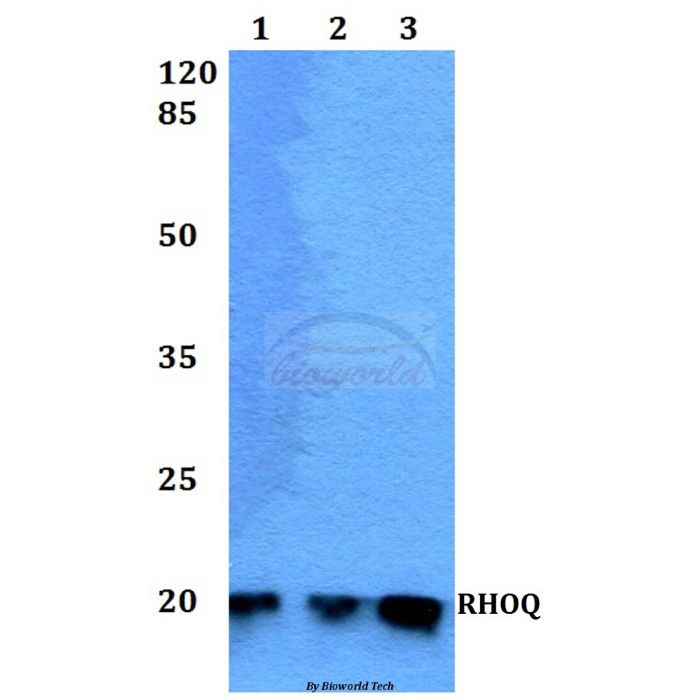
RHOQ polyclonal, anti-human, mouse, rat
€305.00
In stock
SKU
BS60235
Background:
tc10 is a small GTP-binding protein that is induced during nerve injury, where it cooperates with other Rho family members to facilitate nerve regeneration and, in particular, neurite elongation. tc10 is located predominantly in the plasma membrane, a property that depends both on its post-translational prenylation and on its ability to bind and hydrolyze GTP. tc10 colocalizes to actin filaments and interacts with the actin-binding and filament-forming protein, profilin. tc10 functions to regulate cellular signaling to the actin cytoskeleton and processes associated with cell growth. tc10 also interacts with a similar subset of effectors for Cdc42 and is regulated differentially by p50Rho GTPase-activating protein. Activated tc10 interacts with a variety of putative Rho family effectors, stimulates JNK, and induces filopodial formation.
Alternative Name:
Rho-related GTP-binding protein RhoQ, Ras-like protein TC10, Ras-like protein family member 7A, RHOQ, ARHQ, RASL7A, TC10
Application Dilution: WB: 1:500~1:1000
Specificity: RHOQ polyclonal antibody detects endogenous levels of RHOQ protein.
Immunogen:
A synthetic peptide corresponding to residues in Human RHOQ.
MW: ~ 20 kDa
Swis Prot.: P17081
Purification & Purity:
The antibody was affinity-purified from rabbit antiserum by affinity-chromatography using epitope-specific immunogen and the purity is > 95% (by SDS-PAGE).
Format:
1 mg/ml in Phosphate buffered saline (PBS) with 0.05% sodium azide, approx. pH 7.2.
Storage:
Store at 4°C short term. Aliquot and store at -20°C long term. Avoid freeze-thaw cycles.
For research use only, not for use in diagnostic procedure.
tc10 is a small GTP-binding protein that is induced during nerve injury, where it cooperates with other Rho family members to facilitate nerve regeneration and, in particular, neurite elongation. tc10 is located predominantly in the plasma membrane, a property that depends both on its post-translational prenylation and on its ability to bind and hydrolyze GTP. tc10 colocalizes to actin filaments and interacts with the actin-binding and filament-forming protein, profilin. tc10 functions to regulate cellular signaling to the actin cytoskeleton and processes associated with cell growth. tc10 also interacts with a similar subset of effectors for Cdc42 and is regulated differentially by p50Rho GTPase-activating protein. Activated tc10 interacts with a variety of putative Rho family effectors, stimulates JNK, and induces filopodial formation.
Alternative Name:
Rho-related GTP-binding protein RhoQ, Ras-like protein TC10, Ras-like protein family member 7A, RHOQ, ARHQ, RASL7A, TC10
Application Dilution: WB: 1:500~1:1000
Specificity: RHOQ polyclonal antibody detects endogenous levels of RHOQ protein.
Immunogen:
A synthetic peptide corresponding to residues in Human RHOQ.
MW: ~ 20 kDa
Swis Prot.: P17081
Purification & Purity:
The antibody was affinity-purified from rabbit antiserum by affinity-chromatography using epitope-specific immunogen and the purity is > 95% (by SDS-PAGE).
Format:
1 mg/ml in Phosphate buffered saline (PBS) with 0.05% sodium azide, approx. pH 7.2.
Storage:
Store at 4°C short term. Aliquot and store at -20°C long term. Avoid freeze-thaw cycles.
For research use only, not for use in diagnostic procedure.
| Is Featured? | No |
|---|
Write Your Own Review