
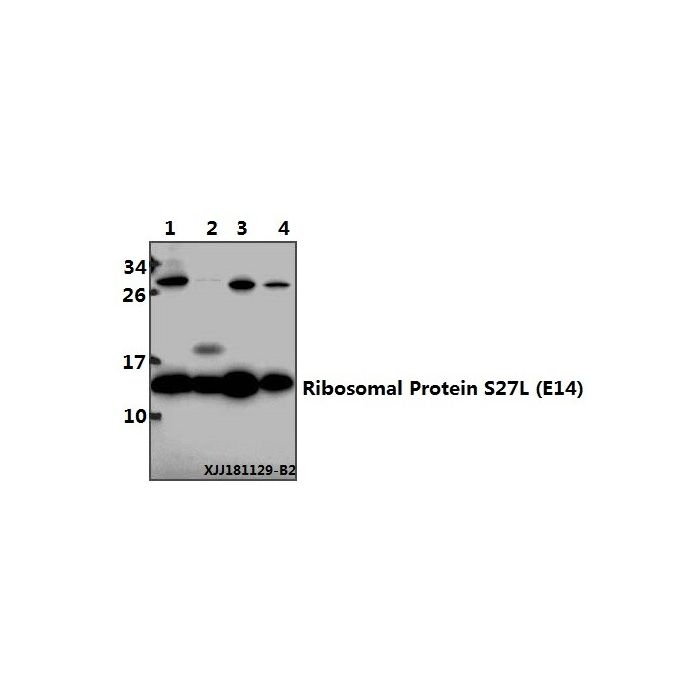
Ribosomal Protein S27L (E14) polyclonal antibody, anti-human, mouse, rat
€305.00
In stock
SKU
BS9514
Catalog Number: BS9514
Size: 100 µl
Other Size: 50 µl
Isotype: rabbit IgG
Applications: WB
Questions? Contact us!
Size: 100 µl
Other Size: 50 µl
Isotype: rabbit IgG
Applications: WB
Questions? Contact us!
Background:
One way that growth factors and mitogens effectively promote sustained cell growth and proliferation is by upregulating mRNA translation. Growth factors and mitogens induce the activation of p70 S6 kinase and the subsequent phosphorylation of the S6 ribosomal protein. Phosphorylation of S6 ribosomal protein correlates with an increase in translation of mRNA transcripts that contain an oligopyrimidine tract in their 5' untranslated regions. These particular mRNA transcripts (5'TOP) encode proteins involved in cell cycle progression, as well as ribosomal proteins and elongation factors necessary for translation. Important S6 ribosomal protein phosphorylation sites include several residues (Ser235, Ser236, Ser240, and Ser244) located within a small, carboxy-terminal region of the S6 protein
Alternative Name:
40S ribosomal protein S27-like, Small ribosomal subunit protein eS27-like, RPS27L
Application Dilution:
WB: 1:500~1:1000
Specificity: Ribosomal Protein S27L (E14) polyclonal antibody endogenous levels of Ribosomal Protein S27L.
Immunogen:
Synthetic peptide, corresponding to amino acids 4-76 of Ribosomal Protein S27L (E14)
MW: ~ 11 kDa
Swiss-Prot: Q71UM5
Purification & Purity:
The antibody was affinity-purified from rabbit antiserum by affinity-chromatography using epitope-specific immunogen and the purity is > 95% (by SDS-PAGE).
Format:
Rabbit IgG, 1mg/ml in PBS with 0.02% sodium azide, 50% glycerol, pH7.2
Storage:
Store at 4°C short term. Aliquot and store at -20°C long term. Avoid freeze-thaw cycles.
For research use only, not for use in diagnostic procedure.
One way that growth factors and mitogens effectively promote sustained cell growth and proliferation is by upregulating mRNA translation. Growth factors and mitogens induce the activation of p70 S6 kinase and the subsequent phosphorylation of the S6 ribosomal protein. Phosphorylation of S6 ribosomal protein correlates with an increase in translation of mRNA transcripts that contain an oligopyrimidine tract in their 5' untranslated regions. These particular mRNA transcripts (5'TOP) encode proteins involved in cell cycle progression, as well as ribosomal proteins and elongation factors necessary for translation. Important S6 ribosomal protein phosphorylation sites include several residues (Ser235, Ser236, Ser240, and Ser244) located within a small, carboxy-terminal region of the S6 protein
Alternative Name:
40S ribosomal protein S27-like, Small ribosomal subunit protein eS27-like, RPS27L
Application Dilution:
WB: 1:500~1:1000
Specificity: Ribosomal Protein S27L (E14) polyclonal antibody endogenous levels of Ribosomal Protein S27L.
Immunogen:
Synthetic peptide, corresponding to amino acids 4-76 of Ribosomal Protein S27L (E14)
MW: ~ 11 kDa
Swiss-Prot: Q71UM5
Purification & Purity:
The antibody was affinity-purified from rabbit antiserum by affinity-chromatography using epitope-specific immunogen and the purity is > 95% (by SDS-PAGE).
Format:
Rabbit IgG, 1mg/ml in PBS with 0.02% sodium azide, 50% glycerol, pH7.2
Storage:
Store at 4°C short term. Aliquot and store at -20°C long term. Avoid freeze-thaw cycles.
For research use only, not for use in diagnostic procedure.
| Is Featured? | No |
|---|
Write Your Own Review