
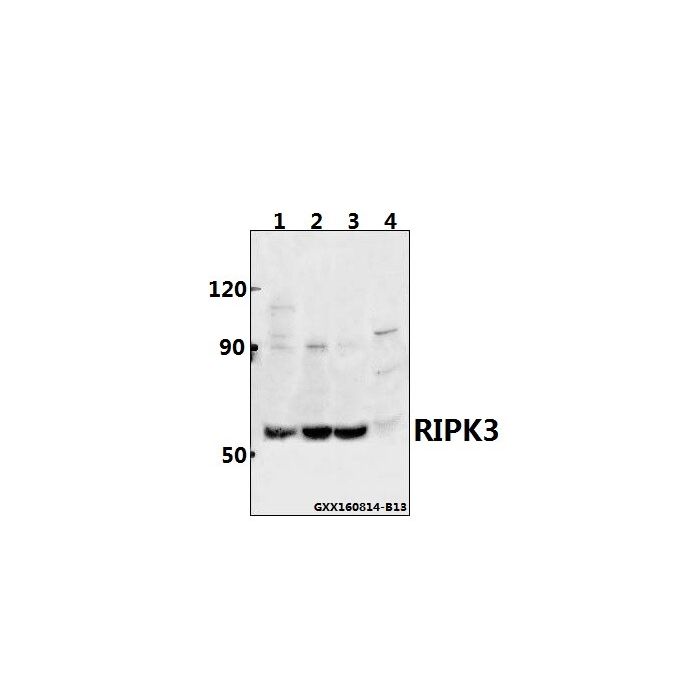
RIPK3 polyclonal, anti-human, mouse, rat
€305.00
In stock
SKU
BS60836
Background:
The death domain is a cytoplasmic domain of approximately 80 amino acids that is necessary for the transduction of apoptotic signals and is present in the apoptosis-mediating receptors TNF-R1 and FAS. Other death domain-containing, but otherwise structurally unrelated proteins have been identified on the basis of their ability to associate with the cytoplasmic domains of TNF-R1 or FAS. One of these proteins, the receptor-interacting protein 3 (RIP3), contains an N-terminal kinase domain and shares extensive homology with RIP and RIP2. However, RIP3 contains a unique C-terminal death domain, which promotes apoptosis. RIP3 can be expressed as two splice variants, RIP3∫ and RIP3©, which contain a truncated N-terminal kinase domain and a distinct and shorter C-terminus. Subsequently, expression of these splice variants downregulates RIP3-mediated apoptosis.
Alternative Name:
Receptor-interacting serine/threonine-protein kinase 3, RIP-like protein kinase 3, Receptor-interacting protein 3, RIP-3, RIPK3, RIP3
Application Dilution: WB: 1:500~1:1000
Specificity: RIPK3 polyclonal antibody detects endogenous levels of RIPK3 protein.
Immunogen:
A synthetic peptide corresponding to residues in Human RIPK3.
MW: ~ 57 kDa
Swis Prot.: Q9Y572
Purification & Purity:
The antibody was affinity-purified from rabbit antiserum by affinity-chromatography using epitope-specific immunogen and the purity is > 95% (by SDS-PAGE).
Format:
1 mg/ml in Phosphate buffered saline (PBS) with 15 mM sodium azide, approx. pH 7.2.
Storage:
Store at 4°C short term. Aliquot and store at -20°C long term. Avoid freeze-thaw cycles.
For research use only, not for use in diagnostic procedure.
The death domain is a cytoplasmic domain of approximately 80 amino acids that is necessary for the transduction of apoptotic signals and is present in the apoptosis-mediating receptors TNF-R1 and FAS. Other death domain-containing, but otherwise structurally unrelated proteins have been identified on the basis of their ability to associate with the cytoplasmic domains of TNF-R1 or FAS. One of these proteins, the receptor-interacting protein 3 (RIP3), contains an N-terminal kinase domain and shares extensive homology with RIP and RIP2. However, RIP3 contains a unique C-terminal death domain, which promotes apoptosis. RIP3 can be expressed as two splice variants, RIP3∫ and RIP3©, which contain a truncated N-terminal kinase domain and a distinct and shorter C-terminus. Subsequently, expression of these splice variants downregulates RIP3-mediated apoptosis.
Alternative Name:
Receptor-interacting serine/threonine-protein kinase 3, RIP-like protein kinase 3, Receptor-interacting protein 3, RIP-3, RIPK3, RIP3
Application Dilution: WB: 1:500~1:1000
Specificity: RIPK3 polyclonal antibody detects endogenous levels of RIPK3 protein.
Immunogen:
A synthetic peptide corresponding to residues in Human RIPK3.
MW: ~ 57 kDa
Swis Prot.: Q9Y572
Purification & Purity:
The antibody was affinity-purified from rabbit antiserum by affinity-chromatography using epitope-specific immunogen and the purity is > 95% (by SDS-PAGE).
Format:
1 mg/ml in Phosphate buffered saline (PBS) with 15 mM sodium azide, approx. pH 7.2.
Storage:
Store at 4°C short term. Aliquot and store at -20°C long term. Avoid freeze-thaw cycles.
For research use only, not for use in diagnostic procedure.
| Is Featured? | No |
|---|
Write Your Own Review