
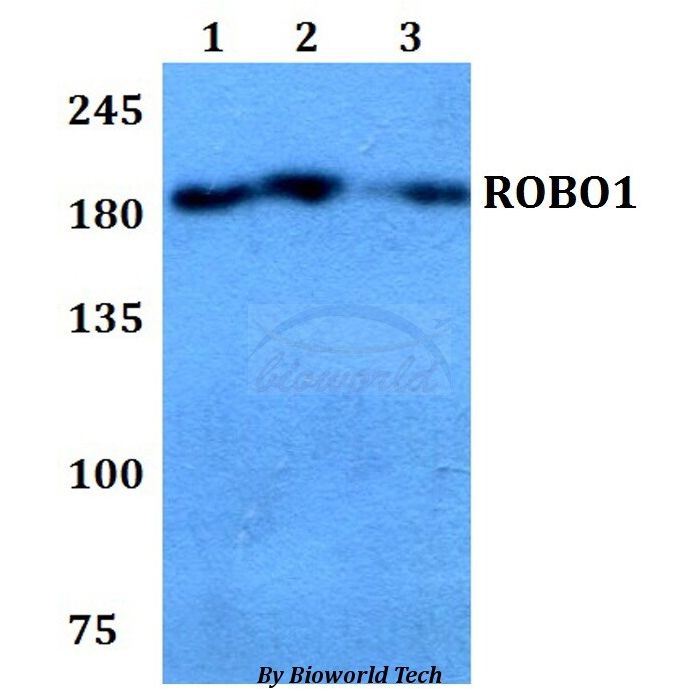
ROBO1 polyclonal, anti-human, mouse, rat
€305.00
In stock
SKU
BS60781
Background:
Specialized cells at the midline, which separates the left and right halves of the CNS, have a number of roles in directing growth cone behavior . In the vertebrate spinal cord, the insect ventral nerve cord and in C. elegans, midline cells produce guidance cues such as nectins and slit, which act as attractants and repellents, respectively . These cells may act as gatekeepers to prevent axons from crossing the midline and to induce a switch in growth cone responsiveness to guidance cues beyond the gateway . One such gatekeeper, Robo, is an axon guidance receptor that defines a novel subfamily of Ig superfamily proteins that are conserved from fruit flies to mammals . Robo acts as a receptor for the repellent Slit and functions in a cell-autonomous fashion . Non-crossing axons express high levels of Robo, whereas crossing axons express low levels of Robo before reaching the midline and high levels after they cross . Robo1 and Robo2 are two human homologs of the Drosophila protein Roundabout . Robo1 is also homologous to the C. elegans gene sax3, whereas Robo2 is homologous to the zebrafish gene astray .
Alternative Name:
Roundabout homolog 1, Deleted in U twenty twenty, H-Robo-1, ROBO1, DUTT1
Application Dilution: WB: 1:500~1:1000
Specificity: ROBO1 polyclonal antibody detects endogenous levels of ROBO1 protein.
Immunogen:
A synthetic peptide corresponding to residues in Human ROBO1
MW: ~ 181 kDa
Swis Prot.: Q9Y6N7
Purification & Purity:
The antibody was affinity-purified from rabbit antiserum by affinity-chromatography using epitope-specific immunogen and the purity is > 95% (by SDS-PAGE).
Format:
1 mg/ml in Phosphate buffered saline (PBS) with 15 mM sodium azide, approx. pH 7.2.
Storage:
Store at 4°C short term. Aliquot and store at -20°C long term. Avoid freeze-thaw cycles.
For research use only, not for use in diagnostic procedure.
Specialized cells at the midline, which separates the left and right halves of the CNS, have a number of roles in directing growth cone behavior . In the vertebrate spinal cord, the insect ventral nerve cord and in C. elegans, midline cells produce guidance cues such as nectins and slit, which act as attractants and repellents, respectively . These cells may act as gatekeepers to prevent axons from crossing the midline and to induce a switch in growth cone responsiveness to guidance cues beyond the gateway . One such gatekeeper, Robo, is an axon guidance receptor that defines a novel subfamily of Ig superfamily proteins that are conserved from fruit flies to mammals . Robo acts as a receptor for the repellent Slit and functions in a cell-autonomous fashion . Non-crossing axons express high levels of Robo, whereas crossing axons express low levels of Robo before reaching the midline and high levels after they cross . Robo1 and Robo2 are two human homologs of the Drosophila protein Roundabout . Robo1 is also homologous to the C. elegans gene sax3, whereas Robo2 is homologous to the zebrafish gene astray .
Alternative Name:
Roundabout homolog 1, Deleted in U twenty twenty, H-Robo-1, ROBO1, DUTT1
Application Dilution: WB: 1:500~1:1000
Specificity: ROBO1 polyclonal antibody detects endogenous levels of ROBO1 protein.
Immunogen:
A synthetic peptide corresponding to residues in Human ROBO1
MW: ~ 181 kDa
Swis Prot.: Q9Y6N7
Purification & Purity:
The antibody was affinity-purified from rabbit antiserum by affinity-chromatography using epitope-specific immunogen and the purity is > 95% (by SDS-PAGE).
Format:
1 mg/ml in Phosphate buffered saline (PBS) with 15 mM sodium azide, approx. pH 7.2.
Storage:
Store at 4°C short term. Aliquot and store at -20°C long term. Avoid freeze-thaw cycles.
For research use only, not for use in diagnostic procedure.
| Is Featured? | No |
|---|
Write Your Own Review