
RORγ polyclonal, anti-human, mouse, rat
€305.00
In stock
SKU
BS5915
Background:
The nuclear orphan receptors RORα and RORγ are members of the nuclear hormone receptor superfamily. This family acts by directly associating with DNA sequences known as hormone response elements (HREs) and typically binds DNA as either homo- or heterodimers. RORα and RORγ are unique in that they bind DNA as monomers. RORα has multiple isoforms that share common DNA- and putative ligand-binding domains, but differ in their aminoterminal domains, which are generated by alternative RNA processing. RORγ comprises a 560 amino acid protein that shares 50% amino acid identity with RORα and is most highly expressed in skeletal muscle. Although these proteins are considered “orphan receptors,” due to a lack of defined ligands, experimental evidence has shown that melatonin may be the natural ligand for these nuclear receptors.
Alternative Name:
Nuclear receptor ROR-gamma, Nuclear receptor RZR-gamma, Nuclear receptor subfamily 1 group F member 3, Retinoid-related orphan receptor-gamma, RORC, NR1F3, RORG, RZRG
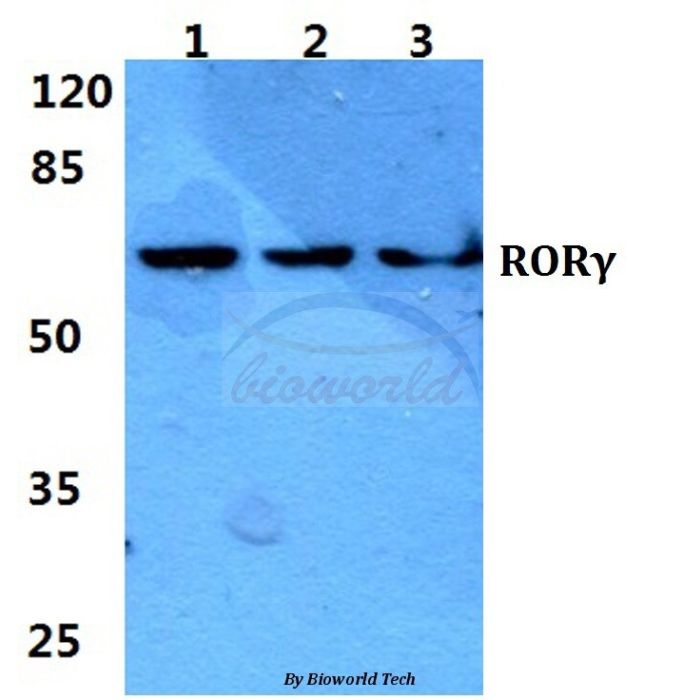
Application Dilution: WB: 1:500~1:1000
Specificity: RORγ polyclonal antibody detects endogenous levels of RORγ protein.
Immunogen:
Synthetic peptide, corresponding to amino acids 114-159 of Human RORγ.
MW: ~ 63 kDa
Swis Prot.: P51449
Purification & Purity:
The antibody was affinity-purified from rabbit antiserum by affinity-chromatography using epitope-specific immunogen and the purity is > 95% (by SDS-PAGE).
Format:
1 mg/ml in Phosphate buffered saline (PBS) with 0.05% sodium azide, approx. pH 7.2.
Storage:
Store at 4°C short term. Aliquot and store at -20°C long term. Avoid freeze-thaw cycles.
For research use only, not for use in diagnostic procedure.
The nuclear orphan receptors RORα and RORγ are members of the nuclear hormone receptor superfamily. This family acts by directly associating with DNA sequences known as hormone response elements (HREs) and typically binds DNA as either homo- or heterodimers. RORα and RORγ are unique in that they bind DNA as monomers. RORα has multiple isoforms that share common DNA- and putative ligand-binding domains, but differ in their aminoterminal domains, which are generated by alternative RNA processing. RORγ comprises a 560 amino acid protein that shares 50% amino acid identity with RORα and is most highly expressed in skeletal muscle. Although these proteins are considered “orphan receptors,” due to a lack of defined ligands, experimental evidence has shown that melatonin may be the natural ligand for these nuclear receptors.
Alternative Name:
Nuclear receptor ROR-gamma, Nuclear receptor RZR-gamma, Nuclear receptor subfamily 1 group F member 3, Retinoid-related orphan receptor-gamma, RORC, NR1F3, RORG, RZRG
Application Dilution: WB: 1:500~1:1000
Specificity: RORγ polyclonal antibody detects endogenous levels of RORγ protein.
Immunogen:
Synthetic peptide, corresponding to amino acids 114-159 of Human RORγ.
MW: ~ 63 kDa
Swis Prot.: P51449
Purification & Purity:
The antibody was affinity-purified from rabbit antiserum by affinity-chromatography using epitope-specific immunogen and the purity is > 95% (by SDS-PAGE).
Format:
1 mg/ml in Phosphate buffered saline (PBS) with 0.05% sodium azide, approx. pH 7.2.
Storage:
Store at 4°C short term. Aliquot and store at -20°C long term. Avoid freeze-thaw cycles.
For research use only, not for use in diagnostic procedure.
| Is Featured? | No |
|---|
Write Your Own Review