
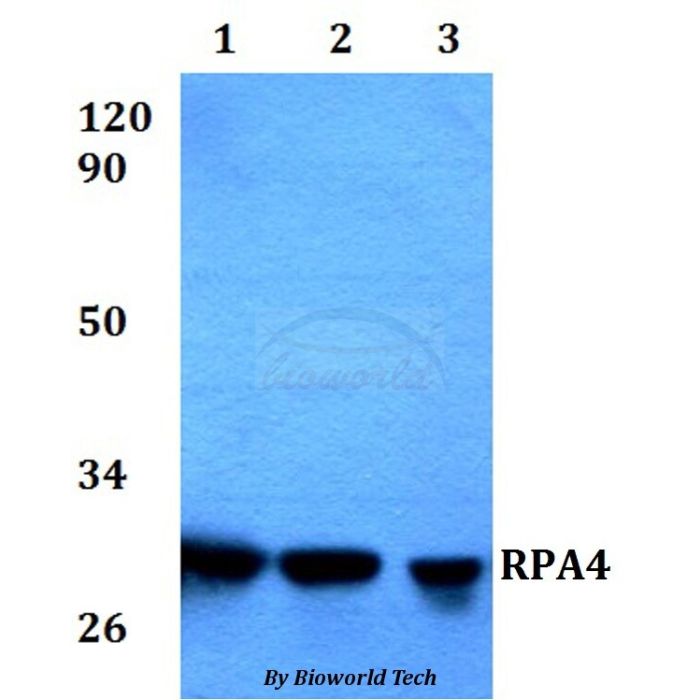
RPA4 polyclonal, anti-human, mouse, rat
€305.00
In stock
SKU
BS60574
Background:
The single-stranded-DNA-binding proteins (SSBs) are essential for DNA function in prokaryotic and eukaryotic cells, mitochondria, phages and viruses. Replication protein A (RPA), a highly conserved eukaryotic protein, is a heterotrimeric SSB consisting of three subunits that play an important role in DNA replication, recombination and repair. RPA is one of the major damage- recognition structures involved in the early stage of nucleotide excision repair and may function in telomere maintenance. The binding of human RPA (hRPA) to DNA involves molecular polarity, in which initial hRPA binding occurs on the 5' side of a ssDNA substrate and then extends in the 3' direction to create a stably bound hRPA. Widely expressed at low to intermediate levels,RPA 34 kDa subunit, which is also known as RPA4 (replication factor A protein 4), contains 261 amino acids, localizes to nucleus and is preferentially expressed in mucosa of colon and placenta.
Alternative Name:
Replication protein A 30 kDa subunit, RP-A p30, Replication factor A protein 4, RF-A protein 4, RPA4
Application Dilution: WB: 1:500~1:1000
Specificity: RPA4 polyclonal antibody detects endogenous levels of RPA4 protein.
Immunogen:
A synthetic peptide corresponding to residues in Human RPA4
MW: ~ 29 kDa
Swis Prot.: Q13156
Purification & Purity:
The antibody was affinity-purified from rabbit antiserum by affinity-chromatography using epitope-specific immunogen and the purity is > 95% (by SDS-PAGE).
Format:
1 mg/ml in Phosphate buffered saline (PBS) with 15 mM sodium azide, approx. pH 7.2.
Storage:
Store at 4°C short term. Aliquot and store at -20°C long term. Avoid freeze-thaw cycles.
For research use only, not for use in diagnostic procedure.
The single-stranded-DNA-binding proteins (SSBs) are essential for DNA function in prokaryotic and eukaryotic cells, mitochondria, phages and viruses. Replication protein A (RPA), a highly conserved eukaryotic protein, is a heterotrimeric SSB consisting of three subunits that play an important role in DNA replication, recombination and repair. RPA is one of the major damage- recognition structures involved in the early stage of nucleotide excision repair and may function in telomere maintenance. The binding of human RPA (hRPA) to DNA involves molecular polarity, in which initial hRPA binding occurs on the 5' side of a ssDNA substrate and then extends in the 3' direction to create a stably bound hRPA. Widely expressed at low to intermediate levels,RPA 34 kDa subunit, which is also known as RPA4 (replication factor A protein 4), contains 261 amino acids, localizes to nucleus and is preferentially expressed in mucosa of colon and placenta.
Alternative Name:
Replication protein A 30 kDa subunit, RP-A p30, Replication factor A protein 4, RF-A protein 4, RPA4
Application Dilution: WB: 1:500~1:1000
Specificity: RPA4 polyclonal antibody detects endogenous levels of RPA4 protein.
Immunogen:
A synthetic peptide corresponding to residues in Human RPA4
MW: ~ 29 kDa
Swis Prot.: Q13156
Purification & Purity:
The antibody was affinity-purified from rabbit antiserum by affinity-chromatography using epitope-specific immunogen and the purity is > 95% (by SDS-PAGE).
Format:
1 mg/ml in Phosphate buffered saline (PBS) with 15 mM sodium azide, approx. pH 7.2.
Storage:
Store at 4°C short term. Aliquot and store at -20°C long term. Avoid freeze-thaw cycles.
For research use only, not for use in diagnostic procedure.
| Is Featured? | No |
|---|
Write Your Own Review