
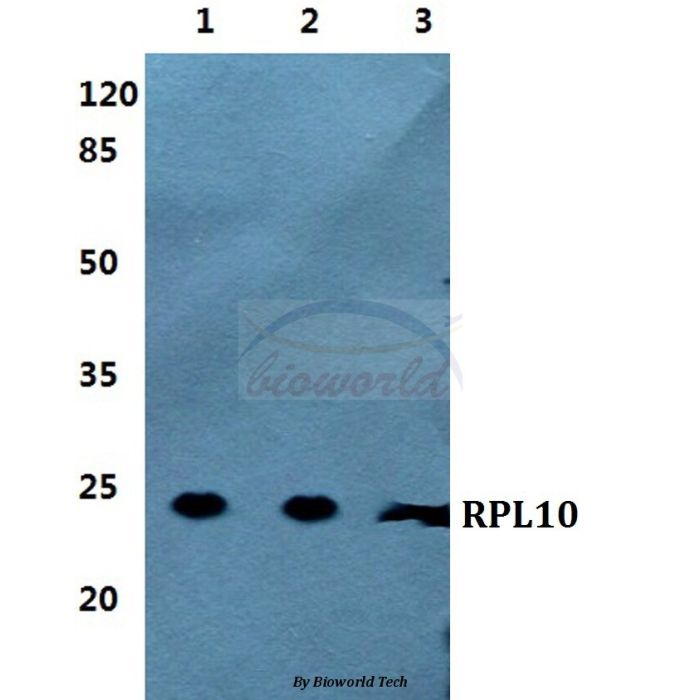
RPL10 polyclonal, anti-human, mouse, rat
€305.00
In stock
SKU
BS5873
Background:
The c-Jun protein is a major component of the transcription factor AP-1, originally shown to mediate phorbol ester tumor promoter (TPA)-induced expression of responsive genes through the TPA-response element (TRE). The Jun proteins form homo- and heterodimers which bind the TRE, while Fos proteins are active only as heterodimers with any of the Jun proteins. Fos/Jun heterodimers have a much higher affinity for the TRE than Jun homodimers. A distant member of the MAP kinase family, designated c-Jun NH2-terminal kinase (JNK1) functions to regulate c-Jun by phosphorylation at the amino terminal serine regulatory sites, Ser 63 and Ser 73). RPL10 has been described as a transcription factor that can function to bind DNA directly or alternatively can interact with c-Jun to inhibit transactivation of AP-1 promoter driven reporter vectors by Jun-Jun homodimers. RPL10 is highly conserved throughout eukaryotic evolution and is apparently a member of a multi-gene family.
Alternative Name:
60S ribosomal protein L10, Laminin receptor homolog, Protein QM, Tumor suppressor QM, DXS648E, QM
Application Dilution: WB: 1:500~1:1000
Specificity: RPL10 polyclonal antibody detects endogenous levels of RPL10 protein.
Immunogen:
Synthetic peptide, corresponding to the 157-202 of Human RPL10.
MW: ~ 25 kDa
Swis Prot.: P27635
Purification & Purity:
The antibody was affinity-purified from rabbit antiserum by affinity-chromatography using epitope-specific immunogen and the purity is > 95% (by SDS-PAGE).
Format:
1 mg/ml in Phosphate buffered saline (PBS) with 0.05% sodium azide, approx. pH 7.2.
Storage:
Store at 4°C short term. Aliquot and store at -20°C long term. Avoid freeze-thaw cycles.
For research use only, not for use in diagnostic procedure.
The c-Jun protein is a major component of the transcription factor AP-1, originally shown to mediate phorbol ester tumor promoter (TPA)-induced expression of responsive genes through the TPA-response element (TRE). The Jun proteins form homo- and heterodimers which bind the TRE, while Fos proteins are active only as heterodimers with any of the Jun proteins. Fos/Jun heterodimers have a much higher affinity for the TRE than Jun homodimers. A distant member of the MAP kinase family, designated c-Jun NH2-terminal kinase (JNK1) functions to regulate c-Jun by phosphorylation at the amino terminal serine regulatory sites, Ser 63 and Ser 73). RPL10 has been described as a transcription factor that can function to bind DNA directly or alternatively can interact with c-Jun to inhibit transactivation of AP-1 promoter driven reporter vectors by Jun-Jun homodimers. RPL10 is highly conserved throughout eukaryotic evolution and is apparently a member of a multi-gene family.
Alternative Name:
60S ribosomal protein L10, Laminin receptor homolog, Protein QM, Tumor suppressor QM, DXS648E, QM
Application Dilution: WB: 1:500~1:1000
Specificity: RPL10 polyclonal antibody detects endogenous levels of RPL10 protein.
Immunogen:
Synthetic peptide, corresponding to the 157-202 of Human RPL10.
MW: ~ 25 kDa
Swis Prot.: P27635
Purification & Purity:
The antibody was affinity-purified from rabbit antiserum by affinity-chromatography using epitope-specific immunogen and the purity is > 95% (by SDS-PAGE).
Format:
1 mg/ml in Phosphate buffered saline (PBS) with 0.05% sodium azide, approx. pH 7.2.
Storage:
Store at 4°C short term. Aliquot and store at -20°C long term. Avoid freeze-thaw cycles.
For research use only, not for use in diagnostic procedure.
| Is Featured? | No |
|---|
Write Your Own Review