
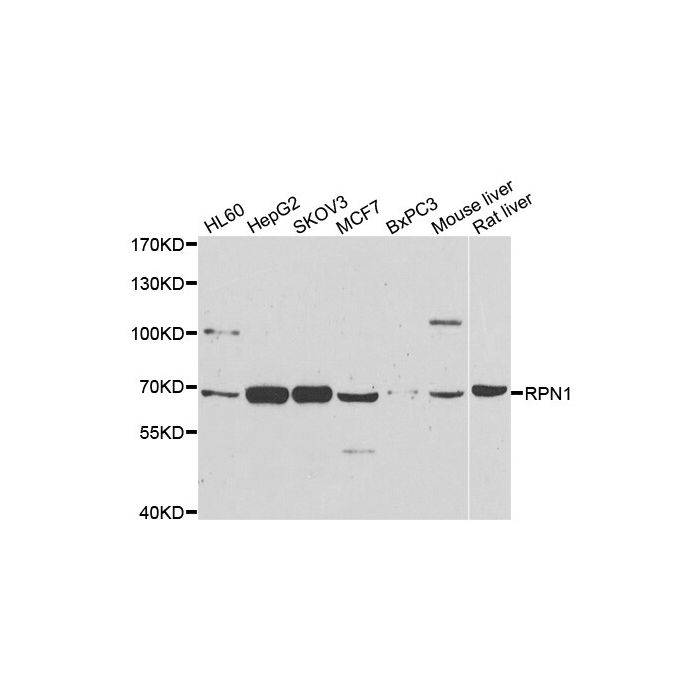
RPN1 polyclonal, anti-human, mouse, rat
€388.00
In stock
SKU
BS8389
Background:
The proteasome is a multisubunit protease responsible for degrading proteins conjugated to ubiquitin. Substrates are targeted for proteolysis by the ubiquitin pathway by the addition of a polyubiquitin chain before being degraded by the 26S proteasome. The 26S proteasome is made up of two subunits, the 20S proteolytic subunit and the 19S regulatory particle, which recognizes and unfolds ubiquitinated proteins. The ubiquitinlike domains (Ubls) of Ubiquitin-like proteins Rad23 and Dsk2 bind both polyubiquitin chains and the 19S regulatory particle (RP) of the 26S proteasome . The Ubl domain mediates the binding of Rad23 to proteasomes, which in turn promotes DNA repair and modulates protein degradation, possibly by delivering ubiquitinylated cargo to proteasomes . Rad23 binds proteasomes by directly interacting with the base subcomplex of the regulatory particle of the proteasome . A component of the base, Rpn1, specifically recognizes the UBL domain of Rad23 through its leucine-rich-repeat-like (LRR-like) domain. Rpn1, for regulatory-particle non-ATPase subunit 1, is one of the largest subunits of proteasome . Base subunit Rpn10, however, does not mediate the binding of UBL proteins to the proteasome in yeast, although it can contribute to the binding of ubiquitin chains by intact proteasomes .
Alternative Name:
Dolichyl-diphosphooligosaccharide--protein, glycosyltransferase subunit 1, Dolichyl-diphosphooligosaccharide--protein, glycosyltransferase 67 kDa subunit, Ribophorin I, RPN-I, Ribophorin-1, RPN1
Application Dilution: WB: 1:500~1:2000, IHC: 1:50~1:200
Specificity: RPN1 polyclonal antibody detects endogenous levels of RPN1 protein.
Immunogen:
Recombinant full length Human RPN1.
MW: ~ 69 kDa
Swis Prot.: P04843
Purification & Purity:
The antibody was affinity-purified from rabbit antiserum by affinity-chromatography using epitope-specific immunogen and the purity is > 95% (by SDS-PAGE).
Format:
1mg/ml in PBS with 0.1% Sodium Azide, 50% Glycerol.
Storage:
Store at 4°C short term. Aliquot and store at -20°C long term. Avoid freeze-thaw cycles.
For research use only, not for use in diagnostic procedure.
The proteasome is a multisubunit protease responsible for degrading proteins conjugated to ubiquitin. Substrates are targeted for proteolysis by the ubiquitin pathway by the addition of a polyubiquitin chain before being degraded by the 26S proteasome. The 26S proteasome is made up of two subunits, the 20S proteolytic subunit and the 19S regulatory particle, which recognizes and unfolds ubiquitinated proteins. The ubiquitinlike domains (Ubls) of Ubiquitin-like proteins Rad23 and Dsk2 bind both polyubiquitin chains and the 19S regulatory particle (RP) of the 26S proteasome . The Ubl domain mediates the binding of Rad23 to proteasomes, which in turn promotes DNA repair and modulates protein degradation, possibly by delivering ubiquitinylated cargo to proteasomes . Rad23 binds proteasomes by directly interacting with the base subcomplex of the regulatory particle of the proteasome . A component of the base, Rpn1, specifically recognizes the UBL domain of Rad23 through its leucine-rich-repeat-like (LRR-like) domain. Rpn1, for regulatory-particle non-ATPase subunit 1, is one of the largest subunits of proteasome . Base subunit Rpn10, however, does not mediate the binding of UBL proteins to the proteasome in yeast, although it can contribute to the binding of ubiquitin chains by intact proteasomes .
Alternative Name:
Dolichyl-diphosphooligosaccharide--protein, glycosyltransferase subunit 1, Dolichyl-diphosphooligosaccharide--protein, glycosyltransferase 67 kDa subunit, Ribophorin I, RPN-I, Ribophorin-1, RPN1
Application Dilution: WB: 1:500~1:2000, IHC: 1:50~1:200
Specificity: RPN1 polyclonal antibody detects endogenous levels of RPN1 protein.
Immunogen:
Recombinant full length Human RPN1.
MW: ~ 69 kDa
Swis Prot.: P04843
Purification & Purity:
The antibody was affinity-purified from rabbit antiserum by affinity-chromatography using epitope-specific immunogen and the purity is > 95% (by SDS-PAGE).
Format:
1mg/ml in PBS with 0.1% Sodium Azide, 50% Glycerol.
Storage:
Store at 4°C short term. Aliquot and store at -20°C long term. Avoid freeze-thaw cycles.
For research use only, not for use in diagnostic procedure.
| Is Featured? | No |
|---|
Write Your Own Review