
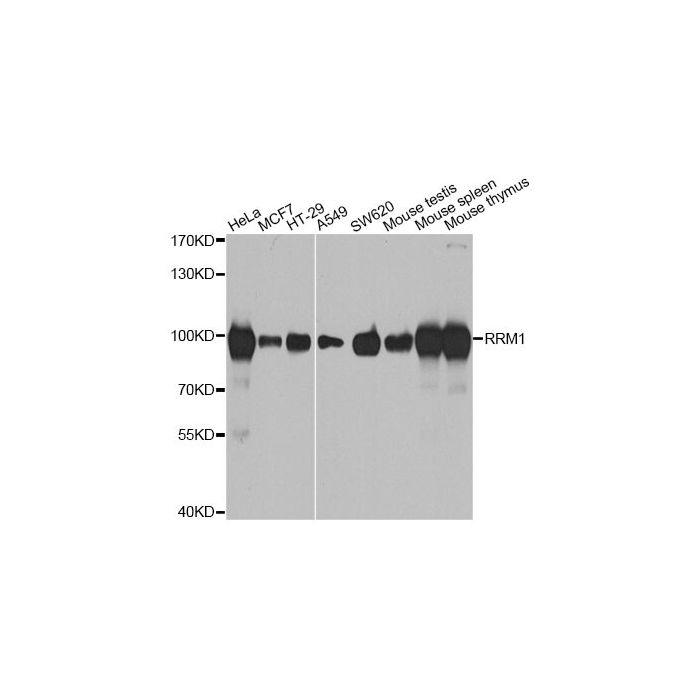
RRM1 polyclonal, anti-human, mouse
€388.00
In stock
SKU
BS6185
Background:
Provides the precursors necessary for DNA synthesis. Catalyzes the biosynthesis of deoxyribonucleotides from the corresponding ribonucleotides.Under complex allosteric control mediated by deoxynucleoside triphosphates and ATP binding to separate specificity and activation sites on the M1 subunit. The type of nucleotide bound at the specificity site determines substrate preference. It seems probable that ATP makes the enzyme reduce CDP and UDP, dGTP favors ADP reduction and dTTP favors GDP reduction. Stimulated by ATP and inhibited by dATP binding to the activity site.
Alternative Name:
R1, Ribonucleoside diphosphate reductase large subunit, Ribonucleoside diphosphate reductase M1 chain, Ribonucleoside diphosphate reductase subunit M1, Ribonucleoside-diphosphate reductase large subunit, Ribonucleoside-diphosphate reductase subunit M1, Ribonucleotide reductase large chain, Ribonucleotide reductase large subunit, Ribonucleotide reductase M1, Ribonucleotide reductase M1 polypeptide, Ribonucleotide reductase R1 subunit, RIR 1, RIR1, RIR1, RR 1, RR1, RRM 1, RRM1,
Application Dilution: WB: 1:500~1:2000, IHC: 1:50~1:200
Specificity: RRM1 polyclonal antibody detects endogenous levels of RRM1 protein.
Immunogen:
Recombinant full length Human RRM1.
MW: ~ 90 kDa
Swis Prot.: P23921
Purification & Purity:
The antibody was affinity-purified from rabbit antiserum by affinity-chromatography using epitope-specific immunogen and the purity is > 95% (by SDS-PAGE).
Format:
1mg/ml in PBS with 0.1% Sodium Azide, 50% Glycerol.
Storage:
Store at 4°C short term. Aliquot and store at -20°C long term. Avoid freeze-thaw cycles.
For research use only, not for use in diagnostic procedure.
Provides the precursors necessary for DNA synthesis. Catalyzes the biosynthesis of deoxyribonucleotides from the corresponding ribonucleotides.Under complex allosteric control mediated by deoxynucleoside triphosphates and ATP binding to separate specificity and activation sites on the M1 subunit. The type of nucleotide bound at the specificity site determines substrate preference. It seems probable that ATP makes the enzyme reduce CDP and UDP, dGTP favors ADP reduction and dTTP favors GDP reduction. Stimulated by ATP and inhibited by dATP binding to the activity site.
Alternative Name:
R1, Ribonucleoside diphosphate reductase large subunit, Ribonucleoside diphosphate reductase M1 chain, Ribonucleoside diphosphate reductase subunit M1, Ribonucleoside-diphosphate reductase large subunit, Ribonucleoside-diphosphate reductase subunit M1, Ribonucleotide reductase large chain, Ribonucleotide reductase large subunit, Ribonucleotide reductase M1, Ribonucleotide reductase M1 polypeptide, Ribonucleotide reductase R1 subunit, RIR 1, RIR1, RIR1, RR 1, RR1, RRM 1, RRM1,
Application Dilution: WB: 1:500~1:2000, IHC: 1:50~1:200
Specificity: RRM1 polyclonal antibody detects endogenous levels of RRM1 protein.
Immunogen:
Recombinant full length Human RRM1.
MW: ~ 90 kDa
Swis Prot.: P23921
Purification & Purity:
The antibody was affinity-purified from rabbit antiserum by affinity-chromatography using epitope-specific immunogen and the purity is > 95% (by SDS-PAGE).
Format:
1mg/ml in PBS with 0.1% Sodium Azide, 50% Glycerol.
Storage:
Store at 4°C short term. Aliquot and store at -20°C long term. Avoid freeze-thaw cycles.
For research use only, not for use in diagnostic procedure.
| Is Featured? | No |
|---|
Write Your Own Review