
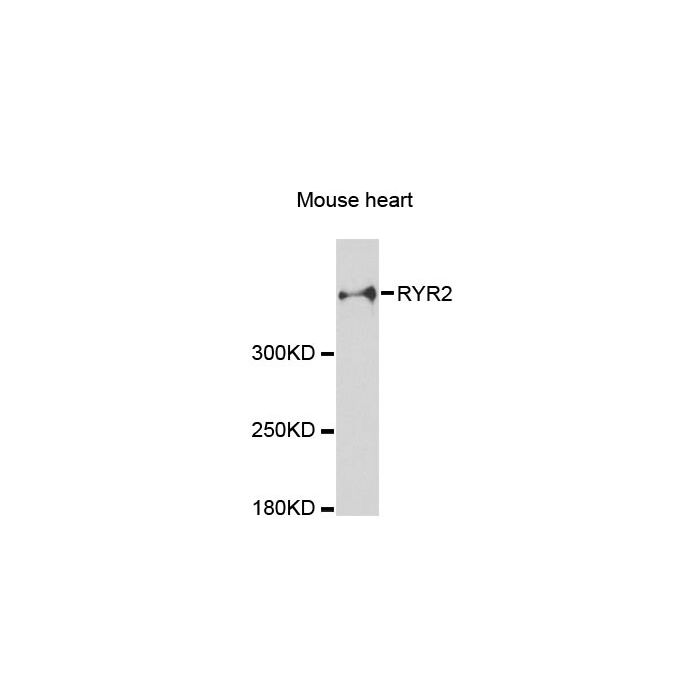
RyR2 polyclonal, anti-human, mouse, rat
€388.00
In stock
SKU
BS72313
Background:
Dihydropyridine receptor (DHPR) is a surface membrane protein critical for the excitation-contraction coupling of striated muscle. DHPR and the sarcoplasmic reticulum ryanodine receptor (RyR) are two key components of the intracellular junctions, where depolarization of the surface membrane is converted into the release of Ca2+ from internal stores. The α1-subunit of the DHPR contains a cytoplasmic loop which is thought to be involved in the interactions with RyR. Phosphorylation of the DHPR α1-subunit is also thought to play a role in the functional interaction of DHPR and RyR. Mutation in DHPR α1 results in excitation-contraction uncoupling, leading to muscular dysgenesis, a complete inactivity in developing skeletal muscles. Cells that do not express RyR also lack excitation-contraction coupling and exhibit a severalfold reduction in Ca2+ current density.
Alternative Name:
Ryanodine receptor 2, RYR-2, RyR2, hRYR-2, Cardiac muscle ryanodine receptor, Cardiac muscle ryanodine receptor-calcium release channel, Type 2 ryanodine receptor, RYR2
Application Dilution: WB: 1:500 - 1:2000
Specificity: RyR2 polyclonal antibody detects endogenous levels of RyR2 protein.
Immunogen:
A synthetic peptide of human RYR2
MW: ~ 565 kDa
Swis Prot.: Q92736
Purification & Purity:
The antibody was affinity-purified from rabbit antiserum by affinity-chromatography using epitope-specific immunogen and the purity is > 95% (by SDS-PAGE).
Format:
1mg/ml in PBS with 0.1% Sodium Azide, 50% Glycerol.
Storage:
Store at 4°C short term. Aliquot and store at -20°C long term. Avoid freeze-thaw cycles.
For research use only, not for use in diagnostic procedure.
Dihydropyridine receptor (DHPR) is a surface membrane protein critical for the excitation-contraction coupling of striated muscle. DHPR and the sarcoplasmic reticulum ryanodine receptor (RyR) are two key components of the intracellular junctions, where depolarization of the surface membrane is converted into the release of Ca2+ from internal stores. The α1-subunit of the DHPR contains a cytoplasmic loop which is thought to be involved in the interactions with RyR. Phosphorylation of the DHPR α1-subunit is also thought to play a role in the functional interaction of DHPR and RyR. Mutation in DHPR α1 results in excitation-contraction uncoupling, leading to muscular dysgenesis, a complete inactivity in developing skeletal muscles. Cells that do not express RyR also lack excitation-contraction coupling and exhibit a severalfold reduction in Ca2+ current density.
Alternative Name:
Ryanodine receptor 2, RYR-2, RyR2, hRYR-2, Cardiac muscle ryanodine receptor, Cardiac muscle ryanodine receptor-calcium release channel, Type 2 ryanodine receptor, RYR2
Application Dilution: WB: 1:500 - 1:2000
Specificity: RyR2 polyclonal antibody detects endogenous levels of RyR2 protein.
Immunogen:
A synthetic peptide of human RYR2
MW: ~ 565 kDa
Swis Prot.: Q92736
Purification & Purity:
The antibody was affinity-purified from rabbit antiserum by affinity-chromatography using epitope-specific immunogen and the purity is > 95% (by SDS-PAGE).
Format:
1mg/ml in PBS with 0.1% Sodium Azide, 50% Glycerol.
Storage:
Store at 4°C short term. Aliquot and store at -20°C long term. Avoid freeze-thaw cycles.
For research use only, not for use in diagnostic procedure.
| Is Featured? | No |
|---|
Write Your Own Review