
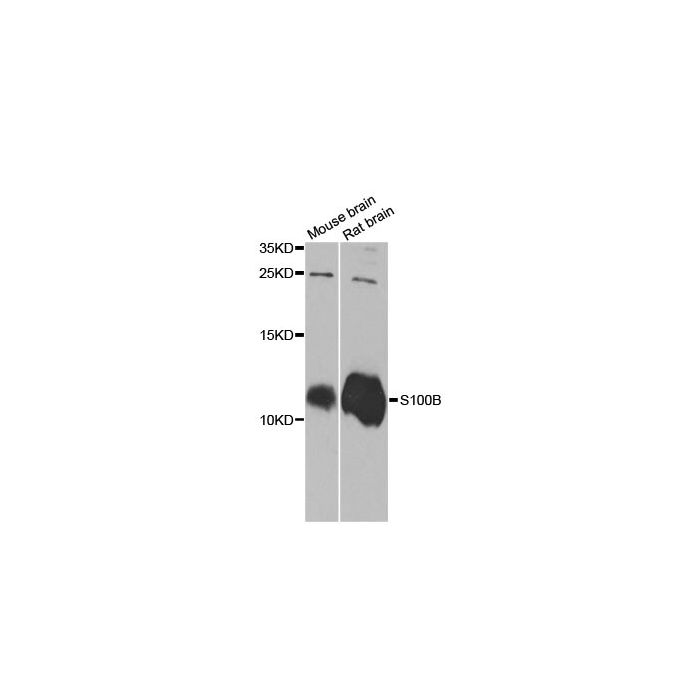
S100B polyclonal, anti-human, mouse, rat
€388.00
In stock
SKU
BS6002
Background:
S-100 α and β, calgranulins A (also designated MRP8), B (also designated MRP14) and C (S-100 like proteins), and the parvalbumin family members, including parvalbumin α and parvalbumin β (also designated oncomodulin). The S-100 protein is involved in the regulation of cellular processes such as cell cycle progression and differentiation. Research also indicates that the S-100 protein may function in the activation of Ca2+ induced Ca2+ release, inhibition of microtubule assembly and inhibition of protein kinase C mediated phosphorylation. Two S-100 subunits, sharing 60% sequence identity, have been described as S-100 α chain and S-100 β chain. Three S-100 dimeric forms have been characterized, differing in their subunit composition of either two α chains, two β chains or one α and one β chain. S-100 localizes to the cytoplasm and nuclei of astrocytes, Schwann's cells, ependymomas and astrogliomas.
Alternative Name:
Protein S100-B, S-100 protein beta chain, S-100 protein subunit beta, S100 calcium-binding protein B
Application Dilution: WB: 1:500 - 1:2000, IF: 1:50 - 1:200
Specificity: S100B polyclonal antibody detects endogenous levels of S100B protein.
Immunogen:
Recombinant full length Human S100B.
MW: ~ 10 kDa
Swis Prot.: P04271
Purification & Purity:
The antibody was affinity-purified from rabbit antiserum by affinity-chromatography using epitope-specific immunogen and the purity is > 95% (by SDS-PAGE).
Format:
1mg/ml in PBS with 0.1% Sodium Azide, 50% Glycerol.
Storage:
Store at 4°C short term. Aliquot and store at -20°C long term. Avoid freeze-thaw cycles.
For research use only, not for use in diagnostic procedure.
S-100 α and β, calgranulins A (also designated MRP8), B (also designated MRP14) and C (S-100 like proteins), and the parvalbumin family members, including parvalbumin α and parvalbumin β (also designated oncomodulin). The S-100 protein is involved in the regulation of cellular processes such as cell cycle progression and differentiation. Research also indicates that the S-100 protein may function in the activation of Ca2+ induced Ca2+ release, inhibition of microtubule assembly and inhibition of protein kinase C mediated phosphorylation. Two S-100 subunits, sharing 60% sequence identity, have been described as S-100 α chain and S-100 β chain. Three S-100 dimeric forms have been characterized, differing in their subunit composition of either two α chains, two β chains or one α and one β chain. S-100 localizes to the cytoplasm and nuclei of astrocytes, Schwann's cells, ependymomas and astrogliomas.
Alternative Name:
Protein S100-B, S-100 protein beta chain, S-100 protein subunit beta, S100 calcium-binding protein B
Application Dilution: WB: 1:500 - 1:2000, IF: 1:50 - 1:200
Specificity: S100B polyclonal antibody detects endogenous levels of S100B protein.
Immunogen:
Recombinant full length Human S100B.
MW: ~ 10 kDa
Swis Prot.: P04271
Purification & Purity:
The antibody was affinity-purified from rabbit antiserum by affinity-chromatography using epitope-specific immunogen and the purity is > 95% (by SDS-PAGE).
Format:
1mg/ml in PBS with 0.1% Sodium Azide, 50% Glycerol.
Storage:
Store at 4°C short term. Aliquot and store at -20°C long term. Avoid freeze-thaw cycles.
For research use only, not for use in diagnostic procedure.
| Is Featured? | No |
|---|
Write Your Own Review