
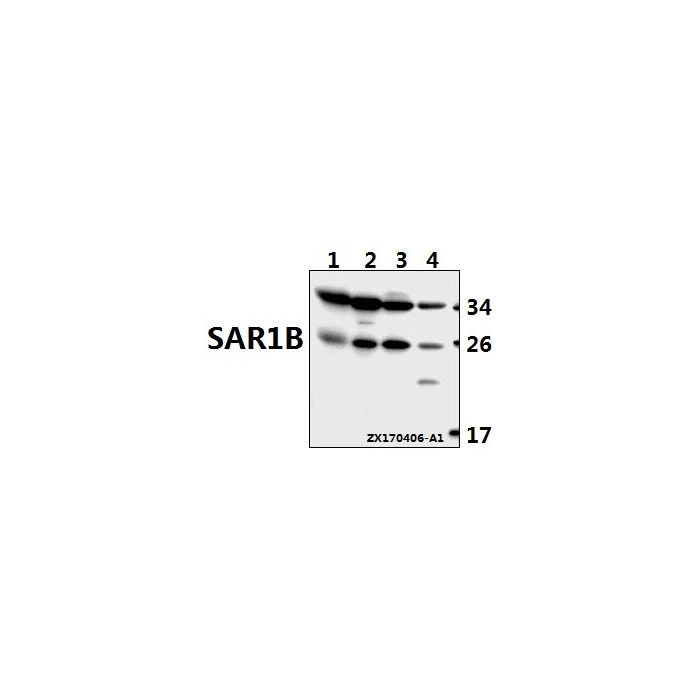
SAR1B polyclonal, anti-human, mouse, rat
€305.00
In stock
SKU
BS61634
Background:
There are a number of components involved in the secretory pathway of cells. Vesicular traffic within the early secretory pathway is mediated by COPI- and COPII-coated vesicles. The COPII vesicle coat protein promotes the formation of endoplasmic reticulum (ER) derived transport vesicles that carry secretory proteins to the Golgi complex. The SAR1 gene encodes two isoforms, Sar1a and Sar1B, in mammalian cells. These proteins are low-molecular-weight GTPases, which are essential for the formation of transport vesicles from the ER. Mutations in the SAR1 gene result in Anderson’s disease (and/or chylomicron retention disease CMRD), a rare, autosomal recessive lipid malabsorption disorder characterized by chronic diarrhea, failure to thrive and hypocholesterolemia in childhood.
Alternative Name:
GTP-binding protein B, GTBPB, GTP-binding protein SAR1b, SAR1B, SARA2, SARB
Application Dilution: WB: 1:500~1:1000
Specificity: SAR1B polyclonal antibody detects endogenous levels of SAR1B protein.
Immunogen:
Synthetic peptide, corresponding Human SAR1B.
MW: ~ 22 kDa
Swis Prot.: Q9Y6B6
Purification & Purity:
The antibody was affinity-purified from rabbit antiserum by affinity-chromatography using epitope-specific immunogen and the purity is > 95% (by SDS-PAGE).
Format:
1 mg/ml in Phosphate buffered saline (PBS) with 0.05% sodium azide, approx. pH 7.3.
Storage:
Store at 4°C short term. Aliquot and store at -20°C long term. Avoid freeze-thaw cycles.
For research use only, not for use in diagnostic procedure.
There are a number of components involved in the secretory pathway of cells. Vesicular traffic within the early secretory pathway is mediated by COPI- and COPII-coated vesicles. The COPII vesicle coat protein promotes the formation of endoplasmic reticulum (ER) derived transport vesicles that carry secretory proteins to the Golgi complex. The SAR1 gene encodes two isoforms, Sar1a and Sar1B, in mammalian cells. These proteins are low-molecular-weight GTPases, which are essential for the formation of transport vesicles from the ER. Mutations in the SAR1 gene result in Anderson’s disease (and/or chylomicron retention disease CMRD), a rare, autosomal recessive lipid malabsorption disorder characterized by chronic diarrhea, failure to thrive and hypocholesterolemia in childhood.
Alternative Name:
GTP-binding protein B, GTBPB, GTP-binding protein SAR1b, SAR1B, SARA2, SARB
Application Dilution: WB: 1:500~1:1000
Specificity: SAR1B polyclonal antibody detects endogenous levels of SAR1B protein.
Immunogen:
Synthetic peptide, corresponding Human SAR1B.
MW: ~ 22 kDa
Swis Prot.: Q9Y6B6
Purification & Purity:
The antibody was affinity-purified from rabbit antiserum by affinity-chromatography using epitope-specific immunogen and the purity is > 95% (by SDS-PAGE).
Format:
1 mg/ml in Phosphate buffered saline (PBS) with 0.05% sodium azide, approx. pH 7.3.
Storage:
Store at 4°C short term. Aliquot and store at -20°C long term. Avoid freeze-thaw cycles.
For research use only, not for use in diagnostic procedure.
| Is Featured? | No |
|---|
Write Your Own Review