
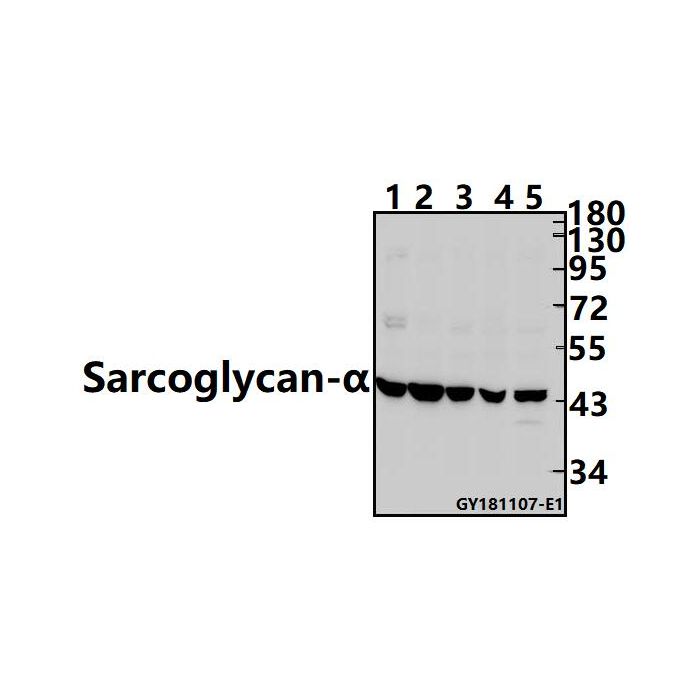
Sarcoglycan-α polyclonal, anti-human, mouse, rat
€305.00
In stock
SKU
BS5920
Background:
The sarcoglycan transmembrane proteins are members of the dystrophin complex. Sarcoglycans cluster together to form a complex, which is localized in the cell membrane of skeletal, cardiac, and smooth muscle fibers. Four sarcoglycan subunit proteins, designated α-, β-, γ- and δ-sarcoglycan, form a complex on the skeletal muscle cell surface membrane. A genetic defect in any one of these proteins causes the loss or marked decrease of the whole sarcoglycan complex, which is observed in the autosomal recessive muscular dystrophy, sarcoglycanopathy. In smooth muscle, β- and δ-sarcoglycans are associated with ε-sarcoglycan, a glycoprotein homologous to α-sarcoglycan. Additionally, a complete deficiency in δ-sarcoglycan is the cause of the Syrian hamster BIO.14 cardiomyopathy.
Alternative Name:
Alpha-sarcoglycan, Sarcoglycan α, α-Sarcoglycan, α-SG, SG-α, SGα, Alpha-SG, 50 kDa dystrophin-associated glycoprotein, 50DAG, Adhalin, Dystroglycan-2, Dystroglycan 2, Dystroglycan2, SGCA, ADL, DAG2,
Application Dilution: WB: 1:500~1:1000, ICC: 1:50~1:200, IP: 1:50~1:200
Specificity: Sarcoglycan-α polyclonal antibody detects endogenous levels of Sarcoglycan-α protein.
Immunogen:
Synthetic peptide, corresponding to amino acids 209-254 of Human Sarcoglycan-α.
MW: ~ 50 kDa
Swis Prot.: Q16586
Purification & Purity:
The antibody was affinity-purified from rabbit antiserum by affinity-chromatography using epitope-specific immunogen and the purity is > 95% (by SDS-PAGE).
Format:
1 mg/ml in Phosphate buffered saline (PBS) with 0.05% sodium azide, approx. pH 7.2.
Storage:
Store at 4°C short term. Aliquot and store at -20°C long term. Avoid freeze-thaw cycles.
For research use only, not for use in diagnostic procedure.
The sarcoglycan transmembrane proteins are members of the dystrophin complex. Sarcoglycans cluster together to form a complex, which is localized in the cell membrane of skeletal, cardiac, and smooth muscle fibers. Four sarcoglycan subunit proteins, designated α-, β-, γ- and δ-sarcoglycan, form a complex on the skeletal muscle cell surface membrane. A genetic defect in any one of these proteins causes the loss or marked decrease of the whole sarcoglycan complex, which is observed in the autosomal recessive muscular dystrophy, sarcoglycanopathy. In smooth muscle, β- and δ-sarcoglycans are associated with ε-sarcoglycan, a glycoprotein homologous to α-sarcoglycan. Additionally, a complete deficiency in δ-sarcoglycan is the cause of the Syrian hamster BIO.14 cardiomyopathy.
Alternative Name:
Alpha-sarcoglycan, Sarcoglycan α, α-Sarcoglycan, α-SG, SG-α, SGα, Alpha-SG, 50 kDa dystrophin-associated glycoprotein, 50DAG, Adhalin, Dystroglycan-2, Dystroglycan 2, Dystroglycan2, SGCA, ADL, DAG2,
Application Dilution: WB: 1:500~1:1000, ICC: 1:50~1:200, IP: 1:50~1:200
Specificity: Sarcoglycan-α polyclonal antibody detects endogenous levels of Sarcoglycan-α protein.
Immunogen:
Synthetic peptide, corresponding to amino acids 209-254 of Human Sarcoglycan-α.
MW: ~ 50 kDa
Swis Prot.: Q16586
Purification & Purity:
The antibody was affinity-purified from rabbit antiserum by affinity-chromatography using epitope-specific immunogen and the purity is > 95% (by SDS-PAGE).
Format:
1 mg/ml in Phosphate buffered saline (PBS) with 0.05% sodium azide, approx. pH 7.2.
Storage:
Store at 4°C short term. Aliquot and store at -20°C long term. Avoid freeze-thaw cycles.
For research use only, not for use in diagnostic procedure.
| Is Featured? | No |
|---|
Write Your Own Review