
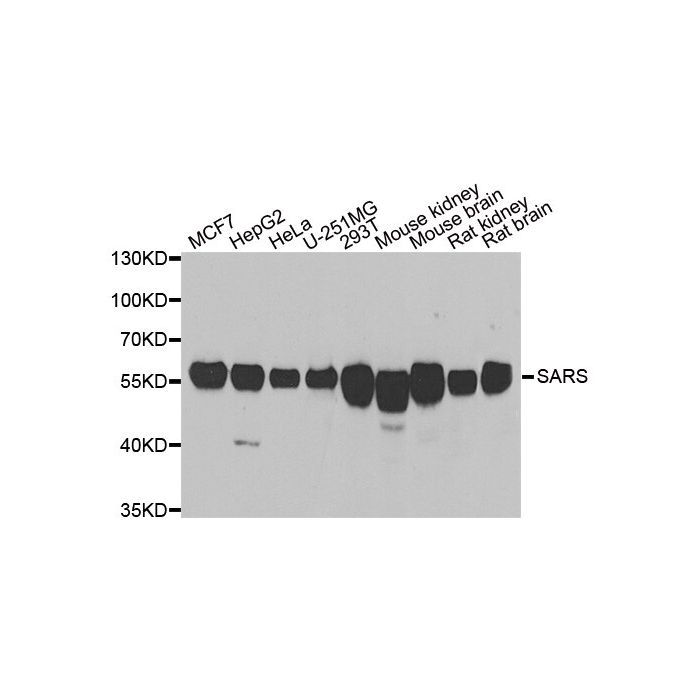
SARS polyclonal, anti-human, mouse, rat
€388.00
In stock
SKU
BS8393
Background:
Severe acute respiratory syndrome (SARS) coronavirus, a recently emergent infectious agent, shares little homology with previously known coronaviruses with respect to its genes and encoding proteins. Following this pattern, SARS nucleocapsid protein (SARS NC) only weakly resembles analogous proteins of the coronavirus family, and thus estimations of its function prove difficult. In fact, the region encoding SARS NC and other matrix and nucleocapsid proteins more closely resembles avian coronaviruses, while phylogenetic analyses indicate a mammalian origin for the replicase protein. SARS NC expression increases the binding of transcription factors to promotor sequences of c-Fos, ATF2, CREB-1, and FosB, all components of the AP-1 signaling pathway. Other signaling pathways, e.g. the NFκB pathway, are not affected, however, implying that pathway activation by SARS NC is selective, and thus possibly an important target in SARS functional studies.Most viral particles show the appearance of spike-like glycoprotein surface projections, giving rise to the virus' name, which is Latin for crown. These transmembrane spike glycoproteins protrude 20 nanometers from the surface.
Alternative Name:
Serine--tRNA ligase, cytoplasmic, Seryl-tRNA synthetase, SerRS, Seryl-tRNA(Ser/Sec) synthetase, SARS, SERS
Application Dilution: WB: 1:500~1:2000, IHC/IF: 1:50~1:200
Specificity: SARS polyclonal antibody detects endogenous levels of SARS protein.
Immunogen:
Recombinant full length Human SARS.
MW: ~ 59 kDa
Swis Prot.: P49591
Purification & Purity:
The antibody was affinity-purified from rabbit antiserum by affinity-chromatography using epitope-specific immunogen and the purity is > 95% (by SDS-PAGE).
Format:
1mg/ml in PBS with 0.1% Sodium Azide, 50% Glycerol.
Storage:
Store at 4°C short term. Aliquot and store at -20°C long term. Avoid freeze-thaw cycles.
For research use only, not for use in diagnostic procedure.
Severe acute respiratory syndrome (SARS) coronavirus, a recently emergent infectious agent, shares little homology with previously known coronaviruses with respect to its genes and encoding proteins. Following this pattern, SARS nucleocapsid protein (SARS NC) only weakly resembles analogous proteins of the coronavirus family, and thus estimations of its function prove difficult. In fact, the region encoding SARS NC and other matrix and nucleocapsid proteins more closely resembles avian coronaviruses, while phylogenetic analyses indicate a mammalian origin for the replicase protein. SARS NC expression increases the binding of transcription factors to promotor sequences of c-Fos, ATF2, CREB-1, and FosB, all components of the AP-1 signaling pathway. Other signaling pathways, e.g. the NFκB pathway, are not affected, however, implying that pathway activation by SARS NC is selective, and thus possibly an important target in SARS functional studies.Most viral particles show the appearance of spike-like glycoprotein surface projections, giving rise to the virus' name, which is Latin for crown. These transmembrane spike glycoproteins protrude 20 nanometers from the surface.
Alternative Name:
Serine--tRNA ligase, cytoplasmic, Seryl-tRNA synthetase, SerRS, Seryl-tRNA(Ser/Sec) synthetase, SARS, SERS
Application Dilution: WB: 1:500~1:2000, IHC/IF: 1:50~1:200
Specificity: SARS polyclonal antibody detects endogenous levels of SARS protein.
Immunogen:
Recombinant full length Human SARS.
MW: ~ 59 kDa
Swis Prot.: P49591
Purification & Purity:
The antibody was affinity-purified from rabbit antiserum by affinity-chromatography using epitope-specific immunogen and the purity is > 95% (by SDS-PAGE).
Format:
1mg/ml in PBS with 0.1% Sodium Azide, 50% Glycerol.
Storage:
Store at 4°C short term. Aliquot and store at -20°C long term. Avoid freeze-thaw cycles.
For research use only, not for use in diagnostic procedure.
| Is Featured? | No |
|---|
Write Your Own Review