
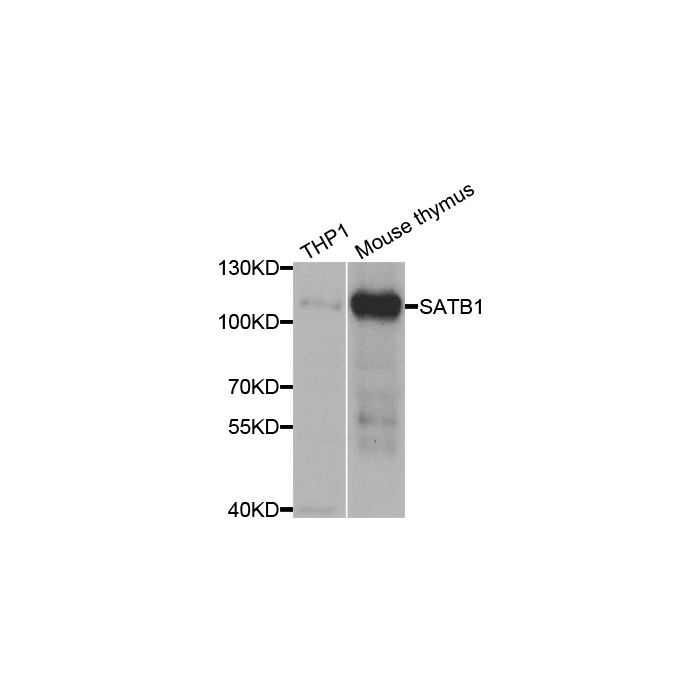
SATB1 polyclonal, anti-human, mouse, rat
€388.00
In stock
SKU
BS7867
Background:
The homeoproteins CCAAT displacement protein (CDP) and special AT-rich sequence binding protein 1 (SATB1) are transcriptional repressors of many cellular genes, and they participate in cell development and cell type differentiation. SATB1 is expressed primarily in thymocytes, and, like CDP, it also contains a distinct homeobox DNA-binding domain that is essential for DNA binding. SATB1 and CDP interact through these homeodomains and synergistically function as mediators of gene expression. SATB1 contains an additional domain that has a higher affinity for DNA and specifically facilitates the direct association between SATB1 and the nuclear matrix attachment regions (MARs) of DNA. MARs are specific DNA sequences that bind to the nuclear matrix and form the base of chromosomal loops that organize the chromosomes and regulate DNA transcription and replication within the nucleus. The association of SATB1 with the core unwinding element within the base-unpairing region of MARs requires both the MAR and homeobox binding domains of SATB1.
Alternative Name:
DNA binding protein SATB1, DNA-binding protein SATB1, SATB homeobox 1, SATB1, SATB1_HUMAN, Special AT rich sequence binding protein 1 (binds to nuclear matrix/scaffold associating DNA), Special AT rich sequence binding protein 1, Special AT-rich sequence-binding protein 1,
Application Dilution: WB: 1:500~1:2000, IHC: 1:50~1:200
Specificity: SATB1 polyclonal antibody detects endogenous levels of SATB1 protein.
Immunogen:
Recombinant full length Human SATB1.
MW: ~ 85 kDa
Swis Prot.: Q01826
Purification & Purity:
The antibody was affinity-purified from rabbit antiserum by affinity-chromatography using epitope-specific immunogen and the purity is > 95% (by SDS-PAGE).
Format:
1mg/ml in PBS with 0.1% Sodium Azide, 50% Glycerol.
Storage:
Store at 4°C short term. Aliquot and store at -20°C long term. Avoid freeze-thaw cycles.
For research use only, not for use in diagnostic procedure.
The homeoproteins CCAAT displacement protein (CDP) and special AT-rich sequence binding protein 1 (SATB1) are transcriptional repressors of many cellular genes, and they participate in cell development and cell type differentiation. SATB1 is expressed primarily in thymocytes, and, like CDP, it also contains a distinct homeobox DNA-binding domain that is essential for DNA binding. SATB1 and CDP interact through these homeodomains and synergistically function as mediators of gene expression. SATB1 contains an additional domain that has a higher affinity for DNA and specifically facilitates the direct association between SATB1 and the nuclear matrix attachment regions (MARs) of DNA. MARs are specific DNA sequences that bind to the nuclear matrix and form the base of chromosomal loops that organize the chromosomes and regulate DNA transcription and replication within the nucleus. The association of SATB1 with the core unwinding element within the base-unpairing region of MARs requires both the MAR and homeobox binding domains of SATB1.
Alternative Name:
DNA binding protein SATB1, DNA-binding protein SATB1, SATB homeobox 1, SATB1, SATB1_HUMAN, Special AT rich sequence binding protein 1 (binds to nuclear matrix/scaffold associating DNA), Special AT rich sequence binding protein 1, Special AT-rich sequence-binding protein 1,
Application Dilution: WB: 1:500~1:2000, IHC: 1:50~1:200
Specificity: SATB1 polyclonal antibody detects endogenous levels of SATB1 protein.
Immunogen:
Recombinant full length Human SATB1.
MW: ~ 85 kDa
Swis Prot.: Q01826
Purification & Purity:
The antibody was affinity-purified from rabbit antiserum by affinity-chromatography using epitope-specific immunogen and the purity is > 95% (by SDS-PAGE).
Format:
1mg/ml in PBS with 0.1% Sodium Azide, 50% Glycerol.
Storage:
Store at 4°C short term. Aliquot and store at -20°C long term. Avoid freeze-thaw cycles.
For research use only, not for use in diagnostic procedure.
| Is Featured? | No |
|---|
Write Your Own Review