
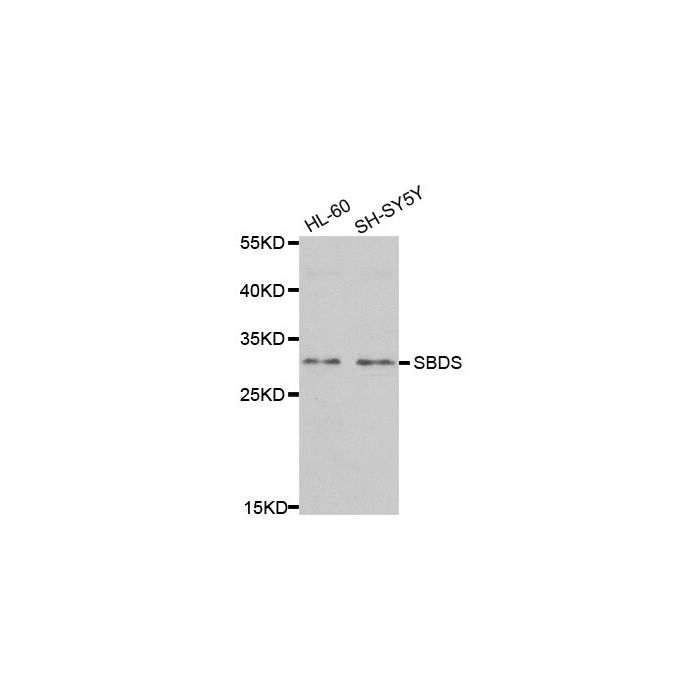
SBDS polyclonal, anti-human, mouse, rat
€388.00
In stock
SKU
BS8071
Background:
The 249 amino acid Shwachman-Bodian-Diamond syndrome (SBDS) protein belongs to the UPF0023 family. SBDS is widely expressed and may be involved in RNA metabolism. SBDS contains a C-terminal domain, a central domain and an N-terminal domain. The C-terminal domain has a ferredoxin-like fold and is structurally homologous with known RNA-binding domains. The central domain contains a three-helical bundle. The N-terminal domain consists of a three-dimensional a/b fold and is the most frequent target of disease-linked mutations. Mutations in the SBDS gene cause Shwachman-Diamond syndrome (SDS), an autosomal recessive marrow failure disorder marked by hematologic dysfunction, skeletal abnormalities and pancreatic exocrine insufficiency. SDS is also characterized by an increased risk of leukemia and myelodysplasia in as many as one third of affected individuals.
Alternative Name:
Ribosome maturation protein SBDS, Shwachman-Bodian-Diamond syndrome protein, SBDS, CGI-97
Application Dilution: WB: 1:500~1:2000, IHC/IF: 1:50~1:200
Specificity: SBDS polyclonal antibody detects endogenous levels of SBDS protein.
Immunogen:
Recombinant full length Human SBDS.
MW: ~ 29 kDa
Swis Prot.: Q9Y3A5
Purification & Purity:
The antibody was affinity-purified from rabbit antiserum by affinity-chromatography using epitope-specific immunogen and the purity is > 95% (by SDS-PAGE).
Format:
1mg/ml in PBS with 0.1% Sodium Azide, 50% Glycerol.
Storage:
Store at 4°C short term. Aliquot and store at -20°C long term. Avoid freeze-thaw cycles.
For research use only, not for use in diagnostic procedure.
The 249 amino acid Shwachman-Bodian-Diamond syndrome (SBDS) protein belongs to the UPF0023 family. SBDS is widely expressed and may be involved in RNA metabolism. SBDS contains a C-terminal domain, a central domain and an N-terminal domain. The C-terminal domain has a ferredoxin-like fold and is structurally homologous with known RNA-binding domains. The central domain contains a three-helical bundle. The N-terminal domain consists of a three-dimensional a/b fold and is the most frequent target of disease-linked mutations. Mutations in the SBDS gene cause Shwachman-Diamond syndrome (SDS), an autosomal recessive marrow failure disorder marked by hematologic dysfunction, skeletal abnormalities and pancreatic exocrine insufficiency. SDS is also characterized by an increased risk of leukemia and myelodysplasia in as many as one third of affected individuals.
Alternative Name:
Ribosome maturation protein SBDS, Shwachman-Bodian-Diamond syndrome protein, SBDS, CGI-97
Application Dilution: WB: 1:500~1:2000, IHC/IF: 1:50~1:200
Specificity: SBDS polyclonal antibody detects endogenous levels of SBDS protein.
Immunogen:
Recombinant full length Human SBDS.
MW: ~ 29 kDa
Swis Prot.: Q9Y3A5
Purification & Purity:
The antibody was affinity-purified from rabbit antiserum by affinity-chromatography using epitope-specific immunogen and the purity is > 95% (by SDS-PAGE).
Format:
1mg/ml in PBS with 0.1% Sodium Azide, 50% Glycerol.
Storage:
Store at 4°C short term. Aliquot and store at -20°C long term. Avoid freeze-thaw cycles.
For research use only, not for use in diagnostic procedure.
| Is Featured? | No |
|---|
Write Your Own Review