
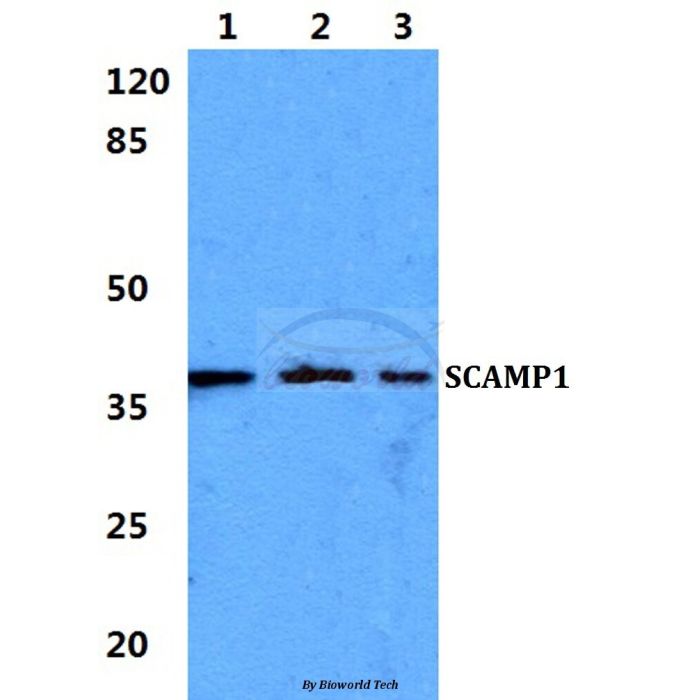
SCAMP1 polyclonal, anti-human, mouse, rat
€305.00
In stock
SKU
BS5921
Background:
Secretory carrier membrane proteins (SCAMPs) are components of the post Golgi membranes and are invovled in endocytosis, vesicle recycling and membrane trafficking. The structural features of SCAMPs include multiple N-terminal NPF repeats and four highly conserved transmembrane regions. These NPF repeats frequently interact with EH domain proteins and aid in the budding of transport vesicles from the plasma membrane or the Golgi complex. Endocytic budding at the plasma membrane and vesicle budding at the trans-Golgi complex facilitates binding of SCAMP proteins to EH domain proteins. SCAMPs exist as distinct but related proteins that include SCAMP1, SCAMP2, and SCAMP3. Tyrosine-phosphorylation by the epidermal growth factor-receptor of SCAMP1 and SCAMP3 suggests that SCAMPs are regulated by phosphorylation. Although SCAMPs are ubiquitously expressed throughout all tissue, in neural tissue the synaptic vesicles express a particularly high concentration of SCAMP1.
Alternative Name:
Secretory carrier-associated membrane protein 1, Secretory carrier membrane protein 1, SCAMP
Application Dilution: WB: 1:500~1:1000
Specificity: SCAMP1 polyclonal antibody detects endogenous levels of SCAMP1 protein.
Immunogen:
Synthetic peptide, corresponding to amino acids 293-338 of Human SCAMP1.
MW: ~ 37 kDa
Swis Prot.: O15126
Purification & Purity:
The antibody was affinity-purified from rabbit antiserum by affinity-chromatography using epitope-specific immunogen and the purity is > 95% (by SDS-PAGE).
Format:
1 mg/ml in Phosphate buffered saline (PBS) with 0.05% sodium azide, approx. pH 7.2.
Storage:
Store at 4°C short term. Aliquot and store at -20°C long term. Avoid freeze-thaw cycles.
For research use only, not for use in diagnostic procedure.
Secretory carrier membrane proteins (SCAMPs) are components of the post Golgi membranes and are invovled in endocytosis, vesicle recycling and membrane trafficking. The structural features of SCAMPs include multiple N-terminal NPF repeats and four highly conserved transmembrane regions. These NPF repeats frequently interact with EH domain proteins and aid in the budding of transport vesicles from the plasma membrane or the Golgi complex. Endocytic budding at the plasma membrane and vesicle budding at the trans-Golgi complex facilitates binding of SCAMP proteins to EH domain proteins. SCAMPs exist as distinct but related proteins that include SCAMP1, SCAMP2, and SCAMP3. Tyrosine-phosphorylation by the epidermal growth factor-receptor of SCAMP1 and SCAMP3 suggests that SCAMPs are regulated by phosphorylation. Although SCAMPs are ubiquitously expressed throughout all tissue, in neural tissue the synaptic vesicles express a particularly high concentration of SCAMP1.
Alternative Name:
Secretory carrier-associated membrane protein 1, Secretory carrier membrane protein 1, SCAMP
Application Dilution: WB: 1:500~1:1000
Specificity: SCAMP1 polyclonal antibody detects endogenous levels of SCAMP1 protein.
Immunogen:
Synthetic peptide, corresponding to amino acids 293-338 of Human SCAMP1.
MW: ~ 37 kDa
Swis Prot.: O15126
Purification & Purity:
The antibody was affinity-purified from rabbit antiserum by affinity-chromatography using epitope-specific immunogen and the purity is > 95% (by SDS-PAGE).
Format:
1 mg/ml in Phosphate buffered saline (PBS) with 0.05% sodium azide, approx. pH 7.2.
Storage:
Store at 4°C short term. Aliquot and store at -20°C long term. Avoid freeze-thaw cycles.
For research use only, not for use in diagnostic procedure.
| Is Featured? | No |
|---|
Write Your Own Review