
Septin 6 polyclonal, anti-human, mouse, rat
€305.00
In stock
SKU
BS5925
Background:
Septin 6, also known as SEPT6, is a 434 amino acid protein that belongs to the septin family. The highly conserved septin family of GTP-binding cytoskeletal proteins is implicated in membrane transport, apoptosis, cell polarity, cell cycle regulation, cytokinesis and other cellular functions. Septins polymerize into heterooligomeric protein complexes that form filaments, and can associate with cellular membranes, actin filaments and microtubules. Filaments are assembled from asymmetrical heterotrimers, composed of Septin 2, Septin 6 and Septin 7 that associate head-to-head to form a hexameric unit, however interaction with Septin 12 alters filament structure. Septin 6 shares 40% identity with CDC10 and contains an ATP/GTP-binding site motif. The Septin 6 protein demonstrates nearly ubiquitous expression, with highest level in thymus. The Septin 6 protein is phosphorylated upon DNA damage, probably by Atm or ATR.
Alternative Name:
Septin6, Septin-6, SEPT6, KIAA0128, SEP2
Application Dilution: WB: 1:500~1:1000, IHC: 1:50~1:200
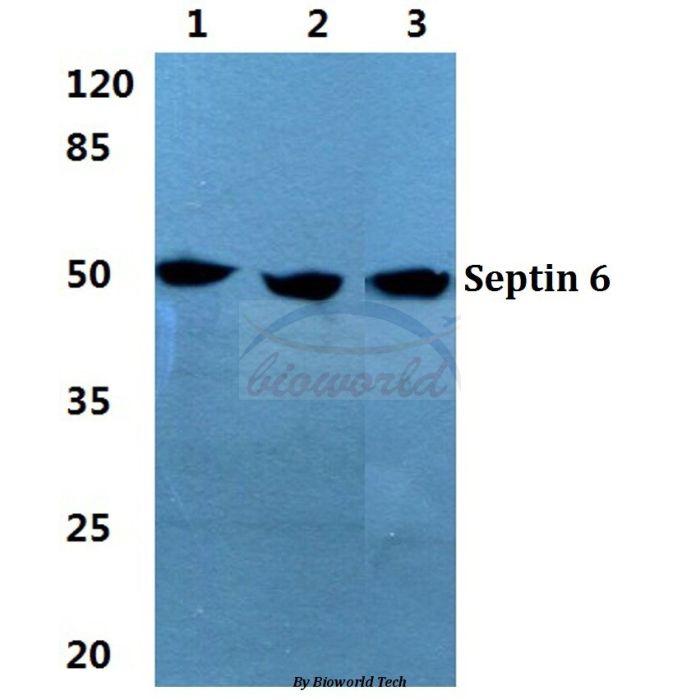
Specificity: Septin 6 polyclonal antibody detects endogenous levels of Septin 6 protein.
Immunogen:
Synthetic peptide, corresponding to amino acids 267-312 of Human Septin 6.
MW: ~ 50 kDa
Swis Prot.: Q14141
Purification & Purity:
The antibody was affinity-purified from rabbit antiserum by affinity-chromatography using epitope-specific immunogen and the purity is > 95% (by SDS-PAGE).
Format:
1mg/ml in PBS with 0.1% Sodium Azide, 50% Glycerol.
Storage:
Store at 4°C short term. Aliquot and store at -20°C long term. Avoid freeze-thaw cycles.
For research use only, not for use in diagnostic procedure.
Septin 6, also known as SEPT6, is a 434 amino acid protein that belongs to the septin family. The highly conserved septin family of GTP-binding cytoskeletal proteins is implicated in membrane transport, apoptosis, cell polarity, cell cycle regulation, cytokinesis and other cellular functions. Septins polymerize into heterooligomeric protein complexes that form filaments, and can associate with cellular membranes, actin filaments and microtubules. Filaments are assembled from asymmetrical heterotrimers, composed of Septin 2, Septin 6 and Septin 7 that associate head-to-head to form a hexameric unit, however interaction with Septin 12 alters filament structure. Septin 6 shares 40% identity with CDC10 and contains an ATP/GTP-binding site motif. The Septin 6 protein demonstrates nearly ubiquitous expression, with highest level in thymus. The Septin 6 protein is phosphorylated upon DNA damage, probably by Atm or ATR.
Alternative Name:
Septin6, Septin-6, SEPT6, KIAA0128, SEP2
Application Dilution: WB: 1:500~1:1000, IHC: 1:50~1:200
Specificity: Septin 6 polyclonal antibody detects endogenous levels of Septin 6 protein.
Immunogen:
Synthetic peptide, corresponding to amino acids 267-312 of Human Septin 6.
MW: ~ 50 kDa
Swis Prot.: Q14141
Purification & Purity:
The antibody was affinity-purified from rabbit antiserum by affinity-chromatography using epitope-specific immunogen and the purity is > 95% (by SDS-PAGE).
Format:
1mg/ml in PBS with 0.1% Sodium Azide, 50% Glycerol.
Storage:
Store at 4°C short term. Aliquot and store at -20°C long term. Avoid freeze-thaw cycles.
For research use only, not for use in diagnostic procedure.
| Is Featured? | No |
|---|
Write Your Own Review