
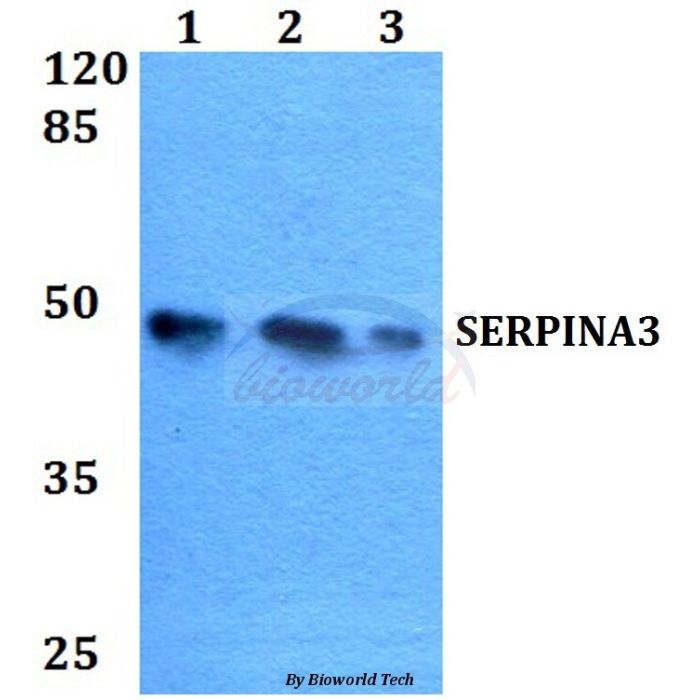
SERPINA3 polyclonal, anti-human, mouse, rat
€305.00
In stock
SKU
BS60098
Background:
The serine proteinase inhibitors (serpins) are a superfamily of proteins with a diverse set of functions, including the control of blood coagulation, complement activation, programmed cell death and development. The most abundant serpins in human plasma are a 1-antitrypsin (AAT) and a 1-antichymotrypsin (AACT). AACT (also called A1AC and SERPINA3) is a plasma protease inhibitor synthesized in the liver as a single glycopeptide chain. In human, the normal serum level of AACT is about one-tenth that of AAT, with which it shares nucleic acid and protein sequence homology. Both are major acute phase reactants; their concentrations in plasma increase in response to trauma, surgery and infection. Elevated levels of AACT are widely, but not universally, reported in the cerebrospinal fluid and plasma of AD patients. Prostate-specific antigen (PSA) and its SDS-stable complex with AACT are in widespread use as markers for the diagnosis of prostate cancer. AACT deficiency may also be a possible cause of chronic liver disease.
Alternative Name:
Alpha-1-antichymotrypsin, ACT, Cell growth-inhibiting gene 24/25 protein, Serpin A3, Cleaved into the following chain: Alpha-1-antichymotrypsin His-Pro-less, SERPINA3, AACT, GIG24, GIG25
Application Dilution: WB: 1:500~1:1000
Specificity: SERPINA3 polyclonal antibody detects endogenous levels of SERPINA3 protein.
Immunogen:
A synthetic peptide corresponding to residues in Human SERPINA3
MW: ~ 48 kDa
Swis Prot.: P01011
Purification & Purity:
The antibody was affinity-purified from rabbit antiserum by affinity-chromatography using epitope-specific immunogen and the purity is > 95% (by SDS-PAGE).
Format:
Storage:
Store at 4°C short term. Aliquot and store at -20°C long term. Avoid freeze-thaw cycles.
For research use only, not for use in diagnostic procedure.
The serine proteinase inhibitors (serpins) are a superfamily of proteins with a diverse set of functions, including the control of blood coagulation, complement activation, programmed cell death and development. The most abundant serpins in human plasma are a 1-antitrypsin (AAT) and a 1-antichymotrypsin (AACT). AACT (also called A1AC and SERPINA3) is a plasma protease inhibitor synthesized in the liver as a single glycopeptide chain. In human, the normal serum level of AACT is about one-tenth that of AAT, with which it shares nucleic acid and protein sequence homology. Both are major acute phase reactants; their concentrations in plasma increase in response to trauma, surgery and infection. Elevated levels of AACT are widely, but not universally, reported in the cerebrospinal fluid and plasma of AD patients. Prostate-specific antigen (PSA) and its SDS-stable complex with AACT are in widespread use as markers for the diagnosis of prostate cancer. AACT deficiency may also be a possible cause of chronic liver disease.
Alternative Name:
Alpha-1-antichymotrypsin, ACT, Cell growth-inhibiting gene 24/25 protein, Serpin A3, Cleaved into the following chain: Alpha-1-antichymotrypsin His-Pro-less, SERPINA3, AACT, GIG24, GIG25
Application Dilution: WB: 1:500~1:1000
Specificity: SERPINA3 polyclonal antibody detects endogenous levels of SERPINA3 protein.
Immunogen:
A synthetic peptide corresponding to residues in Human SERPINA3
MW: ~ 48 kDa
Swis Prot.: P01011
Purification & Purity:
The antibody was affinity-purified from rabbit antiserum by affinity-chromatography using epitope-specific immunogen and the purity is > 95% (by SDS-PAGE).
Format:
Storage:
Store at 4°C short term. Aliquot and store at -20°C long term. Avoid freeze-thaw cycles.
For research use only, not for use in diagnostic procedure.
| Is Featured? | No |
|---|
Write Your Own Review