
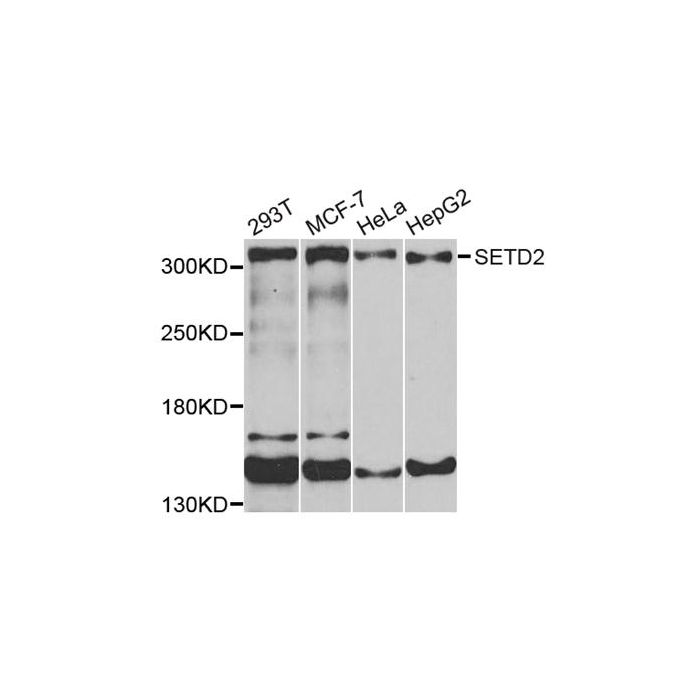
SETD2 polyclonal, anti-human, mouse, rat
€388.00
In stock
SKU
BS7519
Background:
Huntington's disease (HD), a neurodegenerative disorder characterized by loss of striatal neurons, is caused by an expansion of a polyglutamine tract in the HD protein huntingtin. This gene encodes a protein belonging to a class of huntingtin interacting proteins characterized by WW motifs. This protein is a histone methyltransferase that is specific for lysine-36 of histone H3, and methylation of this residue is associated with active chromatin. This protein also contains a novel transcriptional activation domain and has been found associated with hyperphosphorylated RNA polymerase II.
Alternative Name:
HBP231, HIF 1, HIF-1, HIF1, HIP-1, Histone lysine N methyltransferase SETD2, Histone-lysine N-methyltransferase SETD2, hSET2, HSPC069, Huntingtin interacting protein 1, Huntingtin interacting protein, Huntingtin interacting protein B, Huntingtin interacting protein HYPB, Huntingtin yeast partner B, Huntingtin-interacting protein 1, Huntingtin-interacting protein B, HYPB, KIAA1732, KMT3A, Lysine N methyltransferase 3A, Lysine N-methyltransferase 3A, p231HBP, SET domain containing 2, SET domain-containing protein 2, SET2, SETD2, SETD2_HUMAN,
Application Dilution: WB: 1:500 - 1:2000
Specificity: SETD2 polyclonal antibody detects endogenous levels of SETD2 protein.
Immunogen:
Recombinant full length Human SETD2.
MW: ~288 kDa
Swis Prot.: Q9BYW2
Purification & Purity:
The antibody was affinity-purified from rabbit antiserum by affinity-chromatography using epitope-specific immunogen and the purity is > 95% (by SDS-PAGE).
Format:
1mg/ml in PBS with 0.1% Sodium Azide, 50% Glycerol.
Storage:
Store at 4°C short term. Aliquot and store at -20°C long term. Avoid freeze-thaw cycles.
For research use only, not for use in diagnostic procedure.
Huntington's disease (HD), a neurodegenerative disorder characterized by loss of striatal neurons, is caused by an expansion of a polyglutamine tract in the HD protein huntingtin. This gene encodes a protein belonging to a class of huntingtin interacting proteins characterized by WW motifs. This protein is a histone methyltransferase that is specific for lysine-36 of histone H3, and methylation of this residue is associated with active chromatin. This protein also contains a novel transcriptional activation domain and has been found associated with hyperphosphorylated RNA polymerase II.
Alternative Name:
HBP231, HIF 1, HIF-1, HIF1, HIP-1, Histone lysine N methyltransferase SETD2, Histone-lysine N-methyltransferase SETD2, hSET2, HSPC069, Huntingtin interacting protein 1, Huntingtin interacting protein, Huntingtin interacting protein B, Huntingtin interacting protein HYPB, Huntingtin yeast partner B, Huntingtin-interacting protein 1, Huntingtin-interacting protein B, HYPB, KIAA1732, KMT3A, Lysine N methyltransferase 3A, Lysine N-methyltransferase 3A, p231HBP, SET domain containing 2, SET domain-containing protein 2, SET2, SETD2, SETD2_HUMAN,
Application Dilution: WB: 1:500 - 1:2000
Specificity: SETD2 polyclonal antibody detects endogenous levels of SETD2 protein.
Immunogen:
Recombinant full length Human SETD2.
MW: ~288 kDa
Swis Prot.: Q9BYW2
Purification & Purity:
The antibody was affinity-purified from rabbit antiserum by affinity-chromatography using epitope-specific immunogen and the purity is > 95% (by SDS-PAGE).
Format:
1mg/ml in PBS with 0.1% Sodium Azide, 50% Glycerol.
Storage:
Store at 4°C short term. Aliquot and store at -20°C long term. Avoid freeze-thaw cycles.
For research use only, not for use in diagnostic procedure.
| Is Featured? | No |
|---|
Write Your Own Review