
SFRP4 polyclonal, anti-human, mouse, rat
€388.00
In stock
SKU
BS8194
Background:
The frizzled gene, originally identified in Drosophila melanogaster, is involved in the development of tissue polarity. The mammalian homolog of frizzled as well as several secreted mammalian frizzled-related proteins, FRP-1 (also designated SARP2), FRP-2 (also designated SARP1), FRP-3, FRP-4 and SARP3 (also designated FRP-5), have been identified. The Frizzled proteins contain seven transmembrane domains, a cysteine-rich domain in the extracellular region and a carboxy terminal Ser/Thr-xxx-Val motif, and they function as receptors for Wnt. The Frizzled-1 gene maps to human chromosome 7q21 and is expressed in adult heart, placenta, lung, kidney, pancreas, prostate and ovary and in fetal lung and kidney. Frizzled-2 is expressed in adult heart and fetal brain, lung and kidney. The frizzled related proteins FRP-1, FRP-2, FRP-3, FRP-4 and SARP3 are secreted proteins that contain regions of homology to the cysteine-rich ligand-binding domain of frizzled and a conserved hydrophilic carboxy terminal. The gene encoding human SARP3 maps to chromosome 4q31.3 and is expressed in retinal pigment epithelium (RPE) and pancreas, while expression of FRP-1,2 and 4 is high in developing tissues. The FRPs/SARPs are involved in the Wnt signaling pathway by regulating the intracellular levels of b-catenin.
Alternative Name:
Secreted frizzled-related protein 4, sFRP-4, Frizzled protein, human endometrium, FrpHE, SFRP4, FRPHE
Application Dilution: WB: 1:500~1:2000, IHC/IF: 1:50~1:200
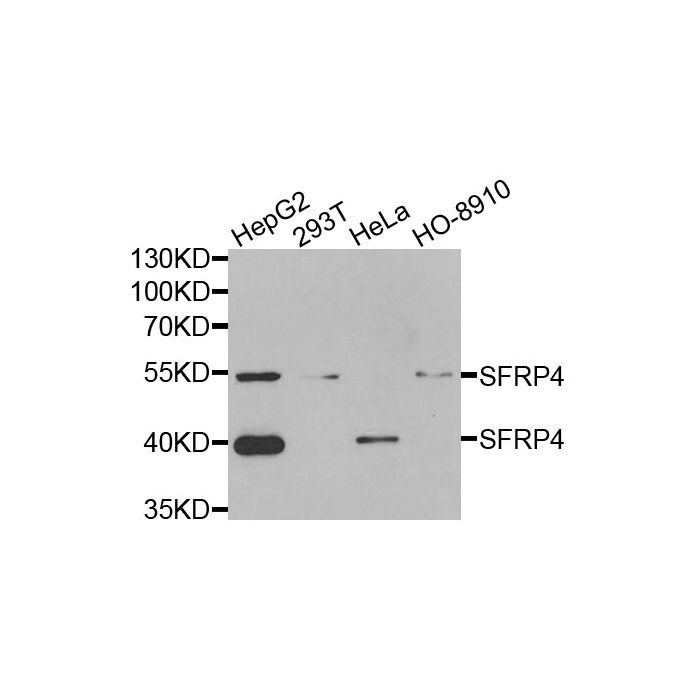
Specificity: SFRP4 polyclonal antibody detects endogenous levels of SFRP4 protein.
Immunogen:
Recombinant full length Human SFRP4.
MW: ~ 40 kDa
Swis Prot.: Q6FHJ7
Purification & Purity:
The antibody was affinity-purified from rabbit antiserum by affinity-chromatography using epitope-specific immunogen and the purity is > 95% (by SDS-PAGE).
Format:
1mg/ml in PBS with 0.1% Sodium Azide, 50% Glycerol.
Storage:
Store at 4°C short term. Aliquot and store at -20°C long term. Avoid freeze-thaw cycles.
For research use only, not for use in diagnostic procedure.
The frizzled gene, originally identified in Drosophila melanogaster, is involved in the development of tissue polarity. The mammalian homolog of frizzled as well as several secreted mammalian frizzled-related proteins, FRP-1 (also designated SARP2), FRP-2 (also designated SARP1), FRP-3, FRP-4 and SARP3 (also designated FRP-5), have been identified. The Frizzled proteins contain seven transmembrane domains, a cysteine-rich domain in the extracellular region and a carboxy terminal Ser/Thr-xxx-Val motif, and they function as receptors for Wnt. The Frizzled-1 gene maps to human chromosome 7q21 and is expressed in adult heart, placenta, lung, kidney, pancreas, prostate and ovary and in fetal lung and kidney. Frizzled-2 is expressed in adult heart and fetal brain, lung and kidney. The frizzled related proteins FRP-1, FRP-2, FRP-3, FRP-4 and SARP3 are secreted proteins that contain regions of homology to the cysteine-rich ligand-binding domain of frizzled and a conserved hydrophilic carboxy terminal. The gene encoding human SARP3 maps to chromosome 4q31.3 and is expressed in retinal pigment epithelium (RPE) and pancreas, while expression of FRP-1,2 and 4 is high in developing tissues. The FRPs/SARPs are involved in the Wnt signaling pathway by regulating the intracellular levels of b-catenin.
Alternative Name:
Secreted frizzled-related protein 4, sFRP-4, Frizzled protein, human endometrium, FrpHE, SFRP4, FRPHE
Application Dilution: WB: 1:500~1:2000, IHC/IF: 1:50~1:200
Specificity: SFRP4 polyclonal antibody detects endogenous levels of SFRP4 protein.
Immunogen:
Recombinant full length Human SFRP4.
MW: ~ 40 kDa
Swis Prot.: Q6FHJ7
Purification & Purity:
The antibody was affinity-purified from rabbit antiserum by affinity-chromatography using epitope-specific immunogen and the purity is > 95% (by SDS-PAGE).
Format:
1mg/ml in PBS with 0.1% Sodium Azide, 50% Glycerol.
Storage:
Store at 4°C short term. Aliquot and store at -20°C long term. Avoid freeze-thaw cycles.
For research use only, not for use in diagnostic procedure.
| Is Featured? | No |
|---|
Write Your Own Review