
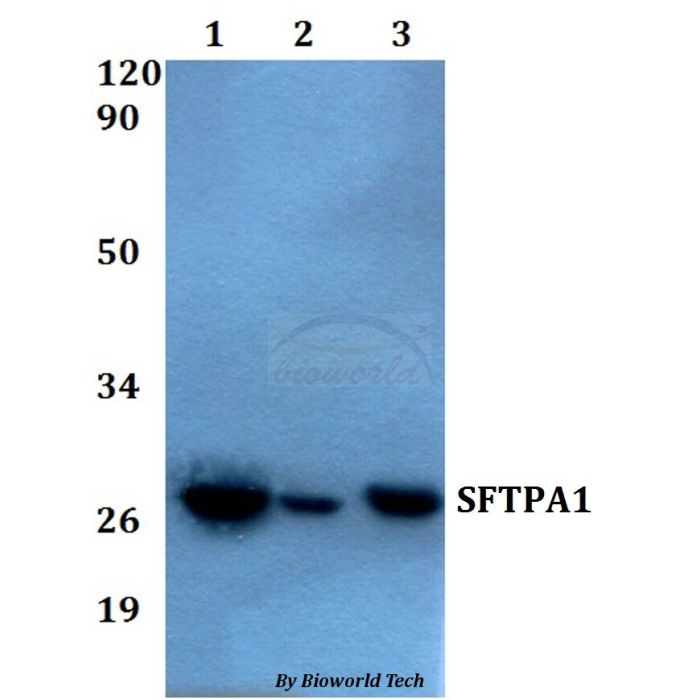
SFTPA1 polyclonal, anti-human, mouse, rat
€305.00
In stock
SKU
BS60561
Background:
Pulmonary surfactant is primarily responsible for lowering the surface tension at the air-liquid interface in the alveoli, a process that is essential for normal respiration. Pulmonary surfactant is a mixture of phospholipids and proteins, including four distinct surfactant-associated proteins (SPs), SP-A, SP-B, SP-C, SP-D. SP-B and SP-C are predominantly hydrophobic proteins that associate with lipids to promote the absorption of surfactant phospholipids and to reduce the surface tension in the alveoli. SP-A and SP-D are large multimeric proteins belonging to the family of calcium-dependent lectins, designated collectins, which contribute to the innate immune system. Both SP-A and SP-D have been shown to protect against microbial challenge through binding to the lipid components of the bacterial cell wall and facilitating the rapid removal of microbials. In humans, there are four SFTPA genes localized on chromosome 10. Research indicates that the SFTPA genes are differentially regulated by glucocorticoids, insulin, and cAMP. Expression of two highly similar SP-A proteins, SP-A1 and SP-A2 has been confirmed.
Alternative Name:
Pulmonary surfactant-associated protein A1, PSP-A, PSPA, SP-A, SP-A1, 35 kDa pulmonary surfactant-associated protein, Alveolar proteinosis protein, Collectin-4, SFTPA1, COLEC4, PSAP, SFTP1, SFTPA, SFTPA1B
Application Dilution: WB: 1:500~1:1000
Specificity: SFTPA1 polyclonal antibody detects endogenous levels of SFTPA1 protein.
Immunogen:
A synthetic peptide corresponding to residues in Human SFTPA1
MW: ~ 26 kDa
Swis Prot.: Q8IWL2
Purification & Purity:
The antibody was affinity-purified from rabbit antiserum by affinity-chromatography using epitope-specific immunogen and the purity is > 95% (by SDS-PAGE).
Format:
1 mg/ml in Phosphate buffered saline (PBS) with 15 mM sodium azide, approx. pH 7.2.
Storage:
Store at 4°C short term. Aliquot and store at -20°C long term. Avoid freeze-thaw cycles.
For research use only, not for use in diagnostic procedure.
Pulmonary surfactant is primarily responsible for lowering the surface tension at the air-liquid interface in the alveoli, a process that is essential for normal respiration. Pulmonary surfactant is a mixture of phospholipids and proteins, including four distinct surfactant-associated proteins (SPs), SP-A, SP-B, SP-C, SP-D. SP-B and SP-C are predominantly hydrophobic proteins that associate with lipids to promote the absorption of surfactant phospholipids and to reduce the surface tension in the alveoli. SP-A and SP-D are large multimeric proteins belonging to the family of calcium-dependent lectins, designated collectins, which contribute to the innate immune system. Both SP-A and SP-D have been shown to protect against microbial challenge through binding to the lipid components of the bacterial cell wall and facilitating the rapid removal of microbials. In humans, there are four SFTPA genes localized on chromosome 10. Research indicates that the SFTPA genes are differentially regulated by glucocorticoids, insulin, and cAMP. Expression of two highly similar SP-A proteins, SP-A1 and SP-A2 has been confirmed.
Alternative Name:
Pulmonary surfactant-associated protein A1, PSP-A, PSPA, SP-A, SP-A1, 35 kDa pulmonary surfactant-associated protein, Alveolar proteinosis protein, Collectin-4, SFTPA1, COLEC4, PSAP, SFTP1, SFTPA, SFTPA1B
Application Dilution: WB: 1:500~1:1000
Specificity: SFTPA1 polyclonal antibody detects endogenous levels of SFTPA1 protein.
Immunogen:
A synthetic peptide corresponding to residues in Human SFTPA1
MW: ~ 26 kDa
Swis Prot.: Q8IWL2
Purification & Purity:
The antibody was affinity-purified from rabbit antiserum by affinity-chromatography using epitope-specific immunogen and the purity is > 95% (by SDS-PAGE).
Format:
1 mg/ml in Phosphate buffered saline (PBS) with 15 mM sodium azide, approx. pH 7.2.
Storage:
Store at 4°C short term. Aliquot and store at -20°C long term. Avoid freeze-thaw cycles.
For research use only, not for use in diagnostic procedure.
| Is Featured? | No |
|---|
Write Your Own Review