
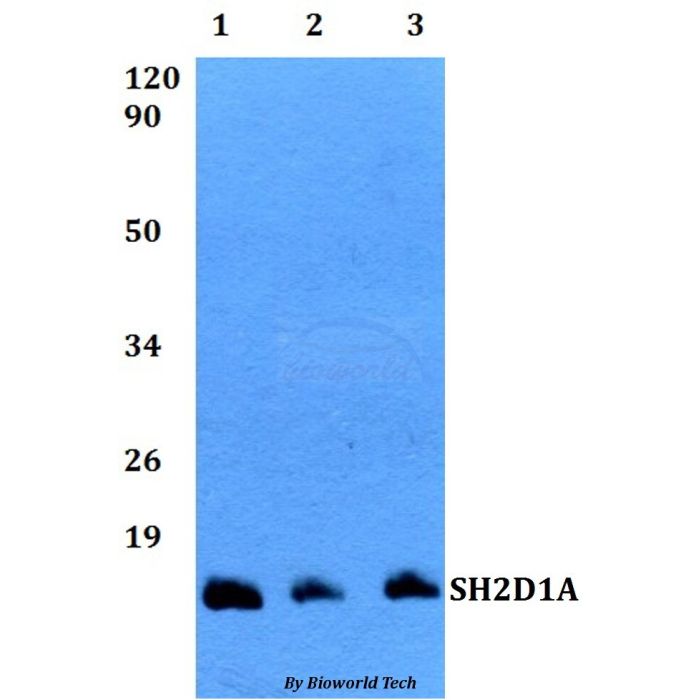
SH2D1A polyclonal, anti-human, mouse, rat
€305.00
In stock
SKU
BS60496
Background:
SH2D1A, also SH2 domain protein 1A, SAP and CD150/SLAM (signaling lymphocyte activation molecule)-associated protein, influences signaling pathways involving SLAM molecules at the interface between T and B cells. SH2D1A modulates SLAM by blocking the recruitment of tyrosine phosphatase SHP2 to the phosphorylated cytoplasmic domain of SLAM. SLAM activation mediates expansion of activated T cells during immune responses, induces production of interferon-© and changes the functional profile of subsets of T cells. SH2D1A is a hydrophilic, 128 amino acid protein that is 96% homologous to the mouse protein in both SH2 and tail domains. SH2D1A is present in all major subsets of T cells, including CD4+, CD45RO+, CD45RA+ and CD8+, but not in B cells. SH2D1A can interact via an SH2 domain with a motif (TIYXXV) present in the cytoplasmic tail of cell-surface receptors SLAM (CD150), CD84, CD229 (LY9) and CD244 (2B4).
Alternative Name:
SH2 domain-containing protein 1A, Alternative name(s): Duncan disease SH2-protein, Signaling lymphocytic activation molecule-associated proteinShort name:SLAM-associated proteinT-cell signal transduction molecule SAP, Gene namesi Name:SH2D1A, DSHP, SAP
Application Dilution: WB: 1:500~1:1000
Specificity: SH2D1A polyclonal antibody detects endogenous levels of SH2D1A protein.
Immunogen:
A synthetic peptide corresponding to residues in Human SH2D1A.
MW: ~ 14 kDa
Swis Prot.: O60880
Purification & Purity:
The antibody was affinity-purified from rabbit antiserum by affinity-chromatography using epitope-specific immunogen and the purity is > 95% (by SDS-PAGE).
Format:
1 mg/ml in Phosphate buffered saline (PBS) with 15 mM sodium azide, approx. pH 7.2.
Storage:
Store at 4°C short term. Aliquot and store at -20°C long term. Avoid freeze-thaw cycles.
For research use only, not for use in diagnostic procedure.
SH2D1A, also SH2 domain protein 1A, SAP and CD150/SLAM (signaling lymphocyte activation molecule)-associated protein, influences signaling pathways involving SLAM molecules at the interface between T and B cells. SH2D1A modulates SLAM by blocking the recruitment of tyrosine phosphatase SHP2 to the phosphorylated cytoplasmic domain of SLAM. SLAM activation mediates expansion of activated T cells during immune responses, induces production of interferon-© and changes the functional profile of subsets of T cells. SH2D1A is a hydrophilic, 128 amino acid protein that is 96% homologous to the mouse protein in both SH2 and tail domains. SH2D1A is present in all major subsets of T cells, including CD4+, CD45RO+, CD45RA+ and CD8+, but not in B cells. SH2D1A can interact via an SH2 domain with a motif (TIYXXV) present in the cytoplasmic tail of cell-surface receptors SLAM (CD150), CD84, CD229 (LY9) and CD244 (2B4).
Alternative Name:
SH2 domain-containing protein 1A, Alternative name(s): Duncan disease SH2-protein, Signaling lymphocytic activation molecule-associated proteinShort name:SLAM-associated proteinT-cell signal transduction molecule SAP, Gene namesi Name:SH2D1A, DSHP, SAP
Application Dilution: WB: 1:500~1:1000
Specificity: SH2D1A polyclonal antibody detects endogenous levels of SH2D1A protein.
Immunogen:
A synthetic peptide corresponding to residues in Human SH2D1A.
MW: ~ 14 kDa
Swis Prot.: O60880
Purification & Purity:
The antibody was affinity-purified from rabbit antiserum by affinity-chromatography using epitope-specific immunogen and the purity is > 95% (by SDS-PAGE).
Format:
1 mg/ml in Phosphate buffered saline (PBS) with 15 mM sodium azide, approx. pH 7.2.
Storage:
Store at 4°C short term. Aliquot and store at -20°C long term. Avoid freeze-thaw cycles.
For research use only, not for use in diagnostic procedure.
| Is Featured? | No |
|---|
Write Your Own Review