
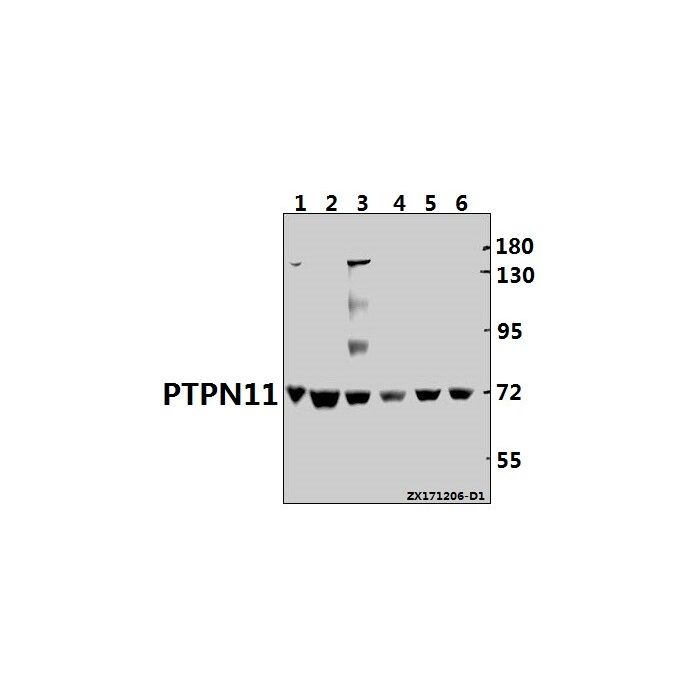
SHP-2/PTPN11 polyclonal, anti-human, rat
€305.00
In stock
SKU
BS61795
Background:
SHP-2 (PTPN11) is a ubiquitously expressed, nonreceptor protein tyrosine phosphatase (PTP). It participates in signaling events downstream of receptors for growth factors, cytokines, hormones, antigens, and extracellular matrices in the control of cell growth, differentiation, migration, and death. Activation of SHP-2 and its association with Gab1 is critical for sustained Erk activation downstream of several growth factor receptors and cytokines. In addition to its role in Gab1-mediated Erk activation, SHP-2 attenuates EGF-dependent PI3 kinase activation by dephosphorylating Gab1 at p85 binding sites. SHP-2 becomes phosphorylated at Tyr542 and Tyr580 in its carboxy-terminus in response to growth factor receptor activation. These phosphorylation events are thought to relieve basal inhibition and stimulate SHP-2 tyrosine phosphatase activity. Mutations in the corresponding gene result in a pair of clinically similar disorders (Noonan syndrome and LEOPARD syndrome) that may result from abnormal MAPK regulation.
Alternative Name:
Tyrosine-protein phosphatase non-receptor type 11, Protein-tyrosine phosphatase 1D, PTP-1D, Protein-tyrosine phosphatase 2C, PTP-2C, SH-PTP2, SHP-2, Shp2, SH-PTP3, PTPN11, PTP2C, SHPTP2
Application Dilution: WB: 1:500~1:2000
Specificity: PTPN11 pAb detects endogenous levels of PTPN11 protein.
Immunogen:
Synthetic peptide, corresponding Human PTPN11.
MW: ~ 72 kDa
Swis Prot.: Q06124
Purification & Purity:
The antibody was affinity-purified from rabbit antiserum by affinity-chromatography using epitope-specific immunogen and the purity is > 95% (by SDS-PAGE).
Format:
1 mg/ml in Phosphate buffered saline (PBS) with 0.05% sodium azide, approx. pH 7.3.
Storage:
Store at 4°C short term. Aliquot and store at -20°C long term. Avoid freeze-thaw cycles.
For research use only, not for use in diagnostic procedure.
SHP-2 (PTPN11) is a ubiquitously expressed, nonreceptor protein tyrosine phosphatase (PTP). It participates in signaling events downstream of receptors for growth factors, cytokines, hormones, antigens, and extracellular matrices in the control of cell growth, differentiation, migration, and death. Activation of SHP-2 and its association with Gab1 is critical for sustained Erk activation downstream of several growth factor receptors and cytokines. In addition to its role in Gab1-mediated Erk activation, SHP-2 attenuates EGF-dependent PI3 kinase activation by dephosphorylating Gab1 at p85 binding sites. SHP-2 becomes phosphorylated at Tyr542 and Tyr580 in its carboxy-terminus in response to growth factor receptor activation. These phosphorylation events are thought to relieve basal inhibition and stimulate SHP-2 tyrosine phosphatase activity. Mutations in the corresponding gene result in a pair of clinically similar disorders (Noonan syndrome and LEOPARD syndrome) that may result from abnormal MAPK regulation.
Alternative Name:
Tyrosine-protein phosphatase non-receptor type 11, Protein-tyrosine phosphatase 1D, PTP-1D, Protein-tyrosine phosphatase 2C, PTP-2C, SH-PTP2, SHP-2, Shp2, SH-PTP3, PTPN11, PTP2C, SHPTP2
Application Dilution: WB: 1:500~1:2000
Specificity: PTPN11 pAb detects endogenous levels of PTPN11 protein.
Immunogen:
Synthetic peptide, corresponding Human PTPN11.
MW: ~ 72 kDa
Swis Prot.: Q06124
Purification & Purity:
The antibody was affinity-purified from rabbit antiserum by affinity-chromatography using epitope-specific immunogen and the purity is > 95% (by SDS-PAGE).
Format:
1 mg/ml in Phosphate buffered saline (PBS) with 0.05% sodium azide, approx. pH 7.3.
Storage:
Store at 4°C short term. Aliquot and store at -20°C long term. Avoid freeze-thaw cycles.
For research use only, not for use in diagnostic procedure.
| Is Featured? | No |
|---|
Write Your Own Review