
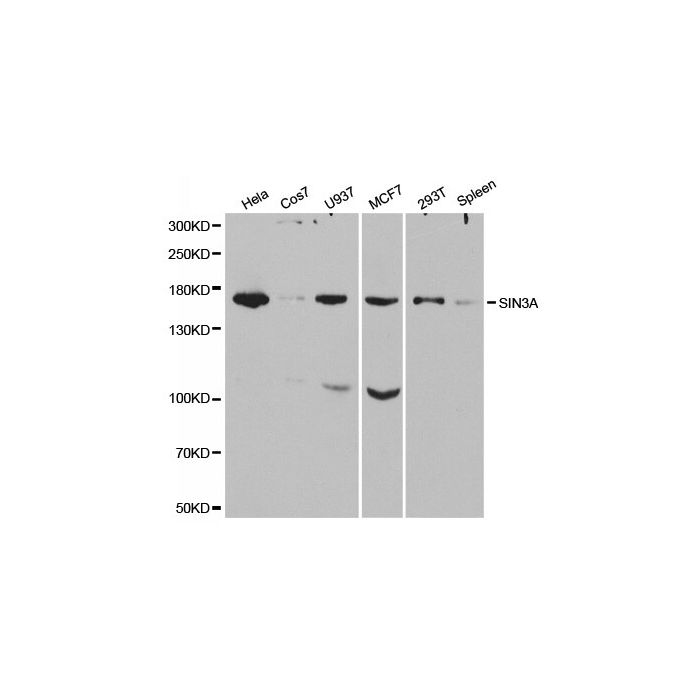
SIN3A polyclonal, anti-human, mouse
€388.00
In stock
SKU
BS7283
Background:
SIN3 was originally identified as a negative regulator of transcription in budding yeast (1,2). Since then, three isoforms of the SIN3 proteins have been identified in mammalian cells, as products of two different genes, SIN3A and SIN3B (3,4). Both SIN3A and SIN3B are nuclear proteins that function as scaffolding subunits for the multi-subunit SIN3 transcriptional repressor complex, containing SIN3A or SIN3B, HDAC1, HDAC2, SDS3, RBBP4/RBAP48, RBBP7/RBAP46, SAP30, and SAP18 (3,4). SIN3 proteins contain four paired amphipathic alpha-helix (PAH) motifs that function in the recruitment of the SIN3 complex to target genes by binding a multitude of DNA-binding transcriptional repressor proteins, including Mad1, p53, E2F4, HCF-1, AML1, Elk-1, NRSF, CTCF, ERα, and MeCP2 (3,4). In addition, SIN3 proteins contain an HDAC interaction domain (HID), which mediates binding of HDAC1 and HDAC2 via the SDS3 bridging protein, and a highly conserved region (HCR) at the carboxy terminus, which contributes to repressor protein binding (3,4). RBBP4 and RBBP7 proteins also bind to SDS3 and contribute to nucleosome binding of the complex. The SIN3 complex functions to repress transcription, in part, by deacetylating histones at target gene promoters (3,4). In addition, recent studies have shown that SIN3 is recruited to the coding regions of repressed and active genes, where it deacetylates histones and suppresses spurious transcription by RNA polymerase II (3,5). In addition to histone deacetylase activity, the SIN3 complex associates with histone methyltransferase (ESET), histone demethylase (JARID1A/RBP2), ATP-dependent chromatin remodeling (SWI/SNF), methylcytosine dioxygenase (TET1), and O-GlcNAc transferase (OGT) activities, all of which appear to contribute to the regulation of target genes (5-9). The SIN3 complex is critical for proper regulation of embryonic development, cell growth and proliferation, apoptosis, DNA replication, DNA repair, and DNA methylation (imprinting and X-chromosome inactivation) (3,4).
Alternative Name:
Histone deacetylase complex subunit Sin 3a, Histone deacetylase complex subunit Sin3a, KIAA0700, Kiaa4126, mKIAA4126, Paired amphipathic helix protein Sin 3a, Paired amphipathic helix protein Sin3a, Sin 3a, SIN3 homolog A, SIN3 homolog A transcription regulator (yeast), SIN3 homolog A transcription regulator, SIN3 transcription regulator homolog A, Sin3a, SIN3A protein, SIN3A_HUMAN, Transcriptional co repressor Sin 3A, Transcriptional co repressor Sin3A, Transcriptional corepressor Sin3a, Transcriptional regulator SIN3A,
Application Dilution: WB: 1:500~1:2000, IF: 1:50~1:200, IP/CHIP: 1:50~1:200
Specificity: SIN3A polyclonal antibody detects endogenous levels of SIN3A protein.
Immunogen:
Recombinant full length Human SIN3A.
MW: ~ 145 kDa
Swis Prot.: Q96ST3
Purification & Purity:
The antibody was affinity-purified from rabbit antiserum by affinity-chromatography using epitope-specific immunogen and the purity is > 95% (by SDS-PAGE).
Format:
1mg/ml in PBS with 0.1% Sodium Azide, 50% Glycerol.
Storage:
Store at 4°C short term. Aliquot and store at -20°C long term. Avoid freeze-thaw cycles.
For research use only, not for use in diagnostic procedure.
SIN3 was originally identified as a negative regulator of transcription in budding yeast (1,2). Since then, three isoforms of the SIN3 proteins have been identified in mammalian cells, as products of two different genes, SIN3A and SIN3B (3,4). Both SIN3A and SIN3B are nuclear proteins that function as scaffolding subunits for the multi-subunit SIN3 transcriptional repressor complex, containing SIN3A or SIN3B, HDAC1, HDAC2, SDS3, RBBP4/RBAP48, RBBP7/RBAP46, SAP30, and SAP18 (3,4). SIN3 proteins contain four paired amphipathic alpha-helix (PAH) motifs that function in the recruitment of the SIN3 complex to target genes by binding a multitude of DNA-binding transcriptional repressor proteins, including Mad1, p53, E2F4, HCF-1, AML1, Elk-1, NRSF, CTCF, ERα, and MeCP2 (3,4). In addition, SIN3 proteins contain an HDAC interaction domain (HID), which mediates binding of HDAC1 and HDAC2 via the SDS3 bridging protein, and a highly conserved region (HCR) at the carboxy terminus, which contributes to repressor protein binding (3,4). RBBP4 and RBBP7 proteins also bind to SDS3 and contribute to nucleosome binding of the complex. The SIN3 complex functions to repress transcription, in part, by deacetylating histones at target gene promoters (3,4). In addition, recent studies have shown that SIN3 is recruited to the coding regions of repressed and active genes, where it deacetylates histones and suppresses spurious transcription by RNA polymerase II (3,5). In addition to histone deacetylase activity, the SIN3 complex associates with histone methyltransferase (ESET), histone demethylase (JARID1A/RBP2), ATP-dependent chromatin remodeling (SWI/SNF), methylcytosine dioxygenase (TET1), and O-GlcNAc transferase (OGT) activities, all of which appear to contribute to the regulation of target genes (5-9). The SIN3 complex is critical for proper regulation of embryonic development, cell growth and proliferation, apoptosis, DNA replication, DNA repair, and DNA methylation (imprinting and X-chromosome inactivation) (3,4).
Alternative Name:
Histone deacetylase complex subunit Sin 3a, Histone deacetylase complex subunit Sin3a, KIAA0700, Kiaa4126, mKIAA4126, Paired amphipathic helix protein Sin 3a, Paired amphipathic helix protein Sin3a, Sin 3a, SIN3 homolog A, SIN3 homolog A transcription regulator (yeast), SIN3 homolog A transcription regulator, SIN3 transcription regulator homolog A, Sin3a, SIN3A protein, SIN3A_HUMAN, Transcriptional co repressor Sin 3A, Transcriptional co repressor Sin3A, Transcriptional corepressor Sin3a, Transcriptional regulator SIN3A,
Application Dilution: WB: 1:500~1:2000, IF: 1:50~1:200, IP/CHIP: 1:50~1:200
Specificity: SIN3A polyclonal antibody detects endogenous levels of SIN3A protein.
Immunogen:
Recombinant full length Human SIN3A.
MW: ~ 145 kDa
Swis Prot.: Q96ST3
Purification & Purity:
The antibody was affinity-purified from rabbit antiserum by affinity-chromatography using epitope-specific immunogen and the purity is > 95% (by SDS-PAGE).
Format:
1mg/ml in PBS with 0.1% Sodium Azide, 50% Glycerol.
Storage:
Store at 4°C short term. Aliquot and store at -20°C long term. Avoid freeze-thaw cycles.
For research use only, not for use in diagnostic procedure.
| Is Featured? | No |
|---|
Write Your Own Review