
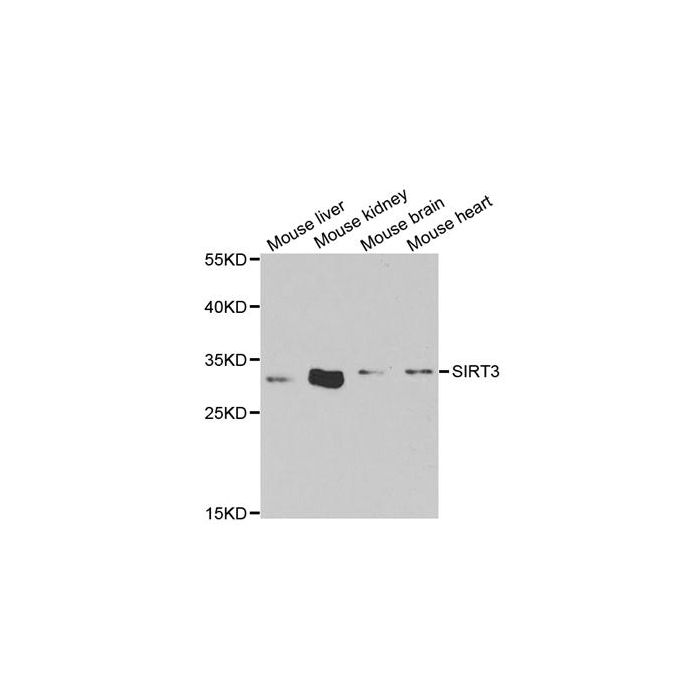
SIRT3 polyclonal, anti-human, mouse, rat
€388.00
In stock
SKU
BS7772
Background:
The Silent Information Regulator (SIR2) family of genes are highly conserved from prokaryotes to eukaryotes and are involved in diverse processes, including transcriptional regulation, cell cycle progression, DNA-damage repair and aging. In S. cerevisiae, Sir2p deacetylates histones in an NAD-dependent manner, which regulates silencing at the telomeric, rDNA and silent mating-type loci. Sir2p is the founding member of a large family, designated sirtuins, which contain a conserved catalytic domain. The human homologues, which include SIRT1-7, are divided into four main branches: SIRT1-3 are class I, SIRT4 is class II, SIRT5 is class III and SIRT6-7 are class IV. SIRT3 is a NAD-dependent deacetylase that contains one deacetylase sirtuin-type domain. The SIRT3 protein is widely expressed and localizes to the mitochondira where it is processed by mitochondrial processing peptidase (MPP) to yield a final product. This processing is most-likely necessary for its enzymatic activity.
Alternative Name:
hSIRT 3, hSIRT3, Mitochondrial nicotinamide adenine dinucleotide dependent deacetylase, NAD dependent deacetylase sirtuin 3 mitochondrial, NAD-dependent protein deacetylase sirtuin-3, mitochondrial, Regulatory protein SIR2 homolog 3, Silent mating type information regulation 2 S.cerevisiae homolog 3, Sir 2 like 3, SIR 2 like protein 3, SIR 3, SIR2 L3, Sir2 like 3, SIR2 like protein 3, SIR2-like protein 3, SIR2L3, SIR3_HUMAN, SIRT 3, SIRT3, Sirtuin 3, Sirtuin silent mating type information regulation 2 homolog 3 (S. cerevisiae), Sirtuin type 3, Sirtuin3,
Application Dilution: WB: 1:500~1:2000, IHC: 1:50~1:200, IF: 1:50~1:200
Specificity: SIRT3 polyclonal antibody detects endogenous levels of SIRT3 protein.
Immunogen:
Recombinant full length Human SIRT3.
MW: ~ 37, 44 kDa
Swis Prot.: Q9NTG7
Purification & Purity:
The antibody was affinity-purified from rabbit antiserum by affinity-chromatography using epitope-specific immunogen and the purity is > 95% (by SDS-PAGE).
Format:
1mg/ml in PBS with 0.1% Sodium Azide, 50% Glycerol.
Storage:
Store at 4°C short term. Aliquot and store at -20°C long term. Avoid freeze-thaw cycles.
For research use only, not for use in diagnostic procedure.
The Silent Information Regulator (SIR2) family of genes are highly conserved from prokaryotes to eukaryotes and are involved in diverse processes, including transcriptional regulation, cell cycle progression, DNA-damage repair and aging. In S. cerevisiae, Sir2p deacetylates histones in an NAD-dependent manner, which regulates silencing at the telomeric, rDNA and silent mating-type loci. Sir2p is the founding member of a large family, designated sirtuins, which contain a conserved catalytic domain. The human homologues, which include SIRT1-7, are divided into four main branches: SIRT1-3 are class I, SIRT4 is class II, SIRT5 is class III and SIRT6-7 are class IV. SIRT3 is a NAD-dependent deacetylase that contains one deacetylase sirtuin-type domain. The SIRT3 protein is widely expressed and localizes to the mitochondira where it is processed by mitochondrial processing peptidase (MPP) to yield a final product. This processing is most-likely necessary for its enzymatic activity.
Alternative Name:
hSIRT 3, hSIRT3, Mitochondrial nicotinamide adenine dinucleotide dependent deacetylase, NAD dependent deacetylase sirtuin 3 mitochondrial, NAD-dependent protein deacetylase sirtuin-3, mitochondrial, Regulatory protein SIR2 homolog 3, Silent mating type information regulation 2 S.cerevisiae homolog 3, Sir 2 like 3, SIR 2 like protein 3, SIR 3, SIR2 L3, Sir2 like 3, SIR2 like protein 3, SIR2-like protein 3, SIR2L3, SIR3_HUMAN, SIRT 3, SIRT3, Sirtuin 3, Sirtuin silent mating type information regulation 2 homolog 3 (S. cerevisiae), Sirtuin type 3, Sirtuin3,
Application Dilution: WB: 1:500~1:2000, IHC: 1:50~1:200, IF: 1:50~1:200
Specificity: SIRT3 polyclonal antibody detects endogenous levels of SIRT3 protein.
Immunogen:
Recombinant full length Human SIRT3.
MW: ~ 37, 44 kDa
Swis Prot.: Q9NTG7
Purification & Purity:
The antibody was affinity-purified from rabbit antiserum by affinity-chromatography using epitope-specific immunogen and the purity is > 95% (by SDS-PAGE).
Format:
1mg/ml in PBS with 0.1% Sodium Azide, 50% Glycerol.
Storage:
Store at 4°C short term. Aliquot and store at -20°C long term. Avoid freeze-thaw cycles.
For research use only, not for use in diagnostic procedure.
| Is Featured? | No |
|---|
Write Your Own Review