
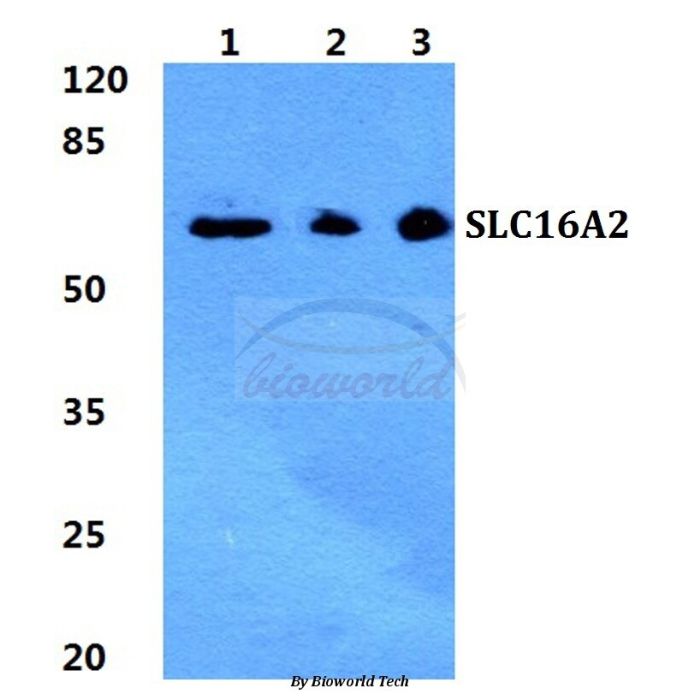
SLC16A2 polyclonal, anti-human, mouse, rat
€305.00
In stock
SKU
BS5793
Background:
Monocarboxylates, such as lactate and pyruvate, play an integral role in cellular metabolism. Lactic acid is produced in large quantities as a result of glycolysis, which provides the majority of ATP to cells under normal physiological conditions. However, accumulation of lactic acid leads to a decrease in intracellular pH and cessation of glycolysis. In order for glycolysis to continue at a high rate, lactic acid must be transported out of the cell. This transport process is carried out by a family of monocarboxylate transporters (MCTs), which function as proton symports and are stereoselective for L-lactate. The MCT family consists of at least eight members, MCT 1-8, which contain between 10-12 transmembrane-helical (TM) domains, with the amino and carboxy termini located in the cytoplasm. Defects in the gene encoding for MCT8, SLC16A2, can cause monocarboxylate transporter 8 deficiencey (MCT8 deficiency), a defect in cellular hormone transport causing a severe form of X-linked psychomotor retardation and abnormal thyroid levels.
Alternative Name:
Monocarboxylate transporter 8, MCT 8, Monocarboxylate transporter 7, MCT 7, MCT7, Solute carrier family 16 member 2, X-linked PEST-containing transporter, MCT8, XPCT
Application Dilution: WB: 1:500~1:1000
Specificity: SLC16A2 polyclonal antibody detects endogenous levels of SLC16A2 protein.
Immunogen:
Synthetic peptide, corresponding to amino acids 152-197 of Human SLC16A2.
MW: ~ 63 kDa
Swis Prot.: P36021
Purification & Purity:
The antibody was affinity-purified from rabbit antiserum by affinity-chromatography using epitope-specific immunogen and the purity is > 95% (by SDS-PAGE).
Format:
1 mg/ml in Phosphate buffered saline (PBS) with 0.05% sodium azide, approx. pH 7.2.
Storage:
Store at 4°C short term. Aliquot and store at -20°C long term. Avoid freeze-thaw cycles.
For research use only, not for use in diagnostic procedure.
Monocarboxylates, such as lactate and pyruvate, play an integral role in cellular metabolism. Lactic acid is produced in large quantities as a result of glycolysis, which provides the majority of ATP to cells under normal physiological conditions. However, accumulation of lactic acid leads to a decrease in intracellular pH and cessation of glycolysis. In order for glycolysis to continue at a high rate, lactic acid must be transported out of the cell. This transport process is carried out by a family of monocarboxylate transporters (MCTs), which function as proton symports and are stereoselective for L-lactate. The MCT family consists of at least eight members, MCT 1-8, which contain between 10-12 transmembrane-helical (TM) domains, with the amino and carboxy termini located in the cytoplasm. Defects in the gene encoding for MCT8, SLC16A2, can cause monocarboxylate transporter 8 deficiencey (MCT8 deficiency), a defect in cellular hormone transport causing a severe form of X-linked psychomotor retardation and abnormal thyroid levels.
Alternative Name:
Monocarboxylate transporter 8, MCT 8, Monocarboxylate transporter 7, MCT 7, MCT7, Solute carrier family 16 member 2, X-linked PEST-containing transporter, MCT8, XPCT
Application Dilution: WB: 1:500~1:1000
Specificity: SLC16A2 polyclonal antibody detects endogenous levels of SLC16A2 protein.
Immunogen:
Synthetic peptide, corresponding to amino acids 152-197 of Human SLC16A2.
MW: ~ 63 kDa
Swis Prot.: P36021
Purification & Purity:
The antibody was affinity-purified from rabbit antiserum by affinity-chromatography using epitope-specific immunogen and the purity is > 95% (by SDS-PAGE).
Format:
1 mg/ml in Phosphate buffered saline (PBS) with 0.05% sodium azide, approx. pH 7.2.
Storage:
Store at 4°C short term. Aliquot and store at -20°C long term. Avoid freeze-thaw cycles.
For research use only, not for use in diagnostic procedure.
| Is Featured? | No |
|---|
Write Your Own Review