
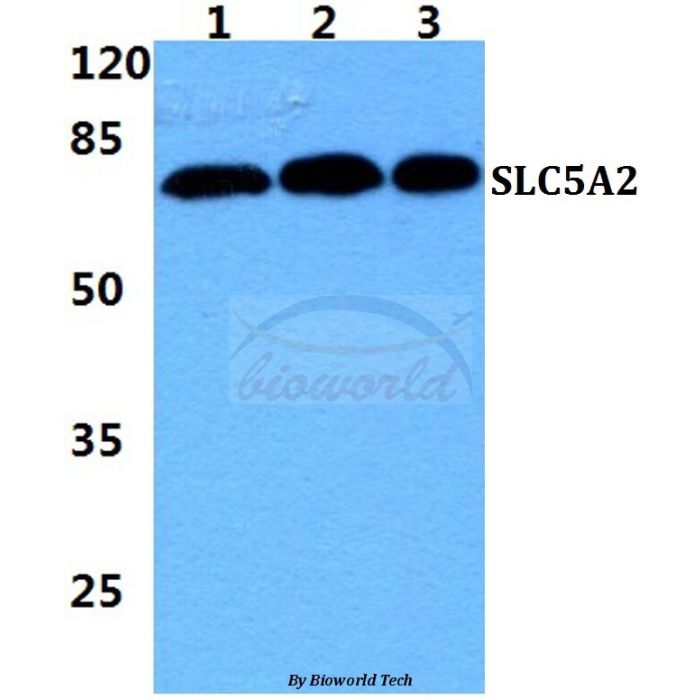
SLC5A2 polyclonal, anti-human, mouse, rat
€305.00
In stock
SKU
BS5929
Background:
Glucose is the main source of energy for mammalian cells and its entry is mediated by various transporters. This process involves seven facilitative (GLUT-1 to -7) and 2 concentrative glucose transporters (SGLT-1, SGLT-2) and a sensor (SGLT-3). The SGLT family members use the electrochemical gradient of two sodium ions to transport one glucose molecule. The mRNA of SGLTs increase steadily from the fetal period to maturity along with an increase in their functional activity. SGLT-1 is responsible for the uptake of the dietary sugars glucose and galactose from the intestinal lumen, while SGLT-3 is involved in the detection of luminal glucose only. Both the sodium glucose co-transporters SGLT-1 and SGLT-2 are expressed in kidneys. Mutations in the gene encoding SGLT-2 result in familial renal glucosuria (FRG), an isolated disorder of proximal tubular glucose transport, characterized by abnormal urinary glucose excretion in the presence of normal blood glucose levels.
Alternative Name:
Sodium/glucose cotransporter 2, Na(+)/glucose cotransporter 2, Low affinity sodium-glucose cotransporter, Solute carrier family 5 member 2, SGLT2, SGLT-2
Application Dilution: WB: 1:500~1:1000
Specificity: SLC5A2 polyclonal antibody detects endogenous levels of SLC5A2 protein.
Immunogen:
Synthetic peptide, corresponding to amino acids 151-196 of Human SLC5A2.
MW: ~ 73 kDa
Swis Prot.: P31639
Purification & Purity:
The antibody was affinity-purified from rabbit antiserum by affinity-chromatography using epitope-specific immunogen and the purity is > 95% (by SDS-PAGE).
Format:
1 mg/ml in Phosphate buffered saline (PBS) with 0.05% sodium azide, approx. pH 7.2.
Storage:
Store at 4°C short term. Aliquot and store at -20°C long term. Avoid freeze-thaw cycles.
For research use only, not for use in diagnostic procedure.
Glucose is the main source of energy for mammalian cells and its entry is mediated by various transporters. This process involves seven facilitative (GLUT-1 to -7) and 2 concentrative glucose transporters (SGLT-1, SGLT-2) and a sensor (SGLT-3). The SGLT family members use the electrochemical gradient of two sodium ions to transport one glucose molecule. The mRNA of SGLTs increase steadily from the fetal period to maturity along with an increase in their functional activity. SGLT-1 is responsible for the uptake of the dietary sugars glucose and galactose from the intestinal lumen, while SGLT-3 is involved in the detection of luminal glucose only. Both the sodium glucose co-transporters SGLT-1 and SGLT-2 are expressed in kidneys. Mutations in the gene encoding SGLT-2 result in familial renal glucosuria (FRG), an isolated disorder of proximal tubular glucose transport, characterized by abnormal urinary glucose excretion in the presence of normal blood glucose levels.
Alternative Name:
Sodium/glucose cotransporter 2, Na(+)/glucose cotransporter 2, Low affinity sodium-glucose cotransporter, Solute carrier family 5 member 2, SGLT2, SGLT-2
Application Dilution: WB: 1:500~1:1000
Specificity: SLC5A2 polyclonal antibody detects endogenous levels of SLC5A2 protein.
Immunogen:
Synthetic peptide, corresponding to amino acids 151-196 of Human SLC5A2.
MW: ~ 73 kDa
Swis Prot.: P31639
Purification & Purity:
The antibody was affinity-purified from rabbit antiserum by affinity-chromatography using epitope-specific immunogen and the purity is > 95% (by SDS-PAGE).
Format:
1 mg/ml in Phosphate buffered saline (PBS) with 0.05% sodium azide, approx. pH 7.2.
Storage:
Store at 4°C short term. Aliquot and store at -20°C long term. Avoid freeze-thaw cycles.
For research use only, not for use in diagnostic procedure.
| Is Featured? | No |
|---|
Write Your Own Review