
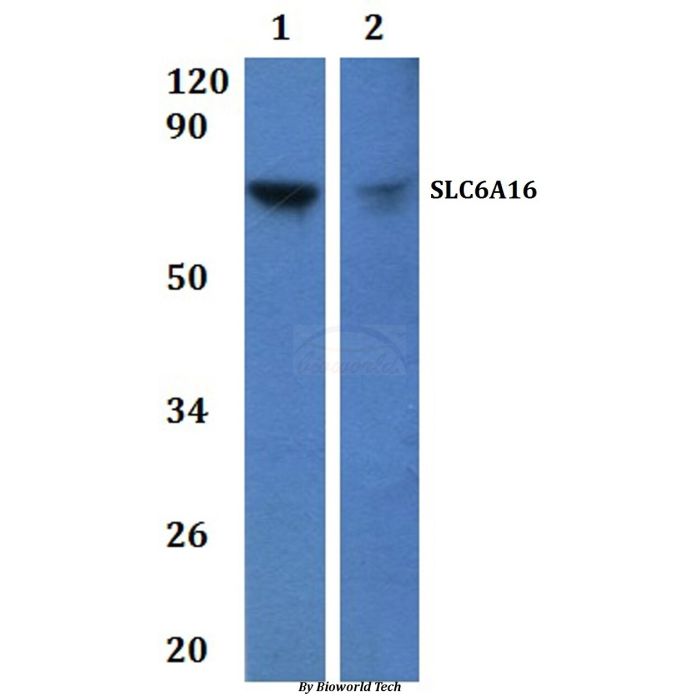
SLC6A16 polyclonal, anti-human, rat
€305.00
In stock
SKU
BS61231
Background:
NTT5, also known as SLC6A16 (solute carrier family 6 member 16), is a 736 amino acid multi-pass membrane protein that belongs to the sodium:neurotransmitter symporter (SNF) family and the SLC6A16 subfamily. NTT5 is highly expressed in peripheral tissues, particularly in testis, pancreas and prostate. Showing structural characteristics of a Na+- and Cl-- dependent neurotransmitter transporter, NTT5 consists of twelve transmembrane domains, intracellular N and C termini and large extracellular loops containing multiple N-glycosylation sites. The gene that encodes NTT5 consists of approximately 35,586 bases and maps to human chromosome 19q13. Chromosome 19 consists of over 63 million bases, houses approximately 1,400 genes and is recognized for having the greatest gene density of the human chromosomes. It is the genetic home for a number of immunoglobulin (Ig) superfamily members, including the killer cell and leukocyte Ig-like receptors, a number of ICAMs, the CEACAM and PSG families and Fc receptors (FcRs).
Alternative Name:
Orphan sodium- and chloride-dependent neurotransmitter transporter NTT5, Solute carrier family 6 member 16, SLC6A16, NTT5
Application Dilution: WB: 1:500~1:1000
Specificity: SLC6A16 polyclonal antibody detects endogenous levels of SLC6A16 protein.
Immunogen:
A synthetic peptide corresponding to residues in Human SLC6A16.
MW: ~ 73 kDa
Swis Prot.: Q9GZN6
Purification & Purity:
The antibody was affinity-purified from rabbit antiserum by affinity-chromatography using epitope-specific immunogen and the purity is > 95% (by SDS-PAGE).
Format:
1 mg/ml in Phosphate buffered saline (PBS) with 0.05% sodium azide, approx. pH 7.3.
Storage:
Store at 4°C short term. Aliquot and store at -20°C long term. Avoid freeze-thaw cycles.
For research use only, not for use in diagnostic procedure.
NTT5, also known as SLC6A16 (solute carrier family 6 member 16), is a 736 amino acid multi-pass membrane protein that belongs to the sodium:neurotransmitter symporter (SNF) family and the SLC6A16 subfamily. NTT5 is highly expressed in peripheral tissues, particularly in testis, pancreas and prostate. Showing structural characteristics of a Na+- and Cl-- dependent neurotransmitter transporter, NTT5 consists of twelve transmembrane domains, intracellular N and C termini and large extracellular loops containing multiple N-glycosylation sites. The gene that encodes NTT5 consists of approximately 35,586 bases and maps to human chromosome 19q13. Chromosome 19 consists of over 63 million bases, houses approximately 1,400 genes and is recognized for having the greatest gene density of the human chromosomes. It is the genetic home for a number of immunoglobulin (Ig) superfamily members, including the killer cell and leukocyte Ig-like receptors, a number of ICAMs, the CEACAM and PSG families and Fc receptors (FcRs).
Alternative Name:
Orphan sodium- and chloride-dependent neurotransmitter transporter NTT5, Solute carrier family 6 member 16, SLC6A16, NTT5
Application Dilution: WB: 1:500~1:1000
Specificity: SLC6A16 polyclonal antibody detects endogenous levels of SLC6A16 protein.
Immunogen:
A synthetic peptide corresponding to residues in Human SLC6A16.
MW: ~ 73 kDa
Swis Prot.: Q9GZN6
Purification & Purity:
The antibody was affinity-purified from rabbit antiserum by affinity-chromatography using epitope-specific immunogen and the purity is > 95% (by SDS-PAGE).
Format:
1 mg/ml in Phosphate buffered saline (PBS) with 0.05% sodium azide, approx. pH 7.3.
Storage:
Store at 4°C short term. Aliquot and store at -20°C long term. Avoid freeze-thaw cycles.
For research use only, not for use in diagnostic procedure.
| Is Featured? | No |
|---|
Write Your Own Review