
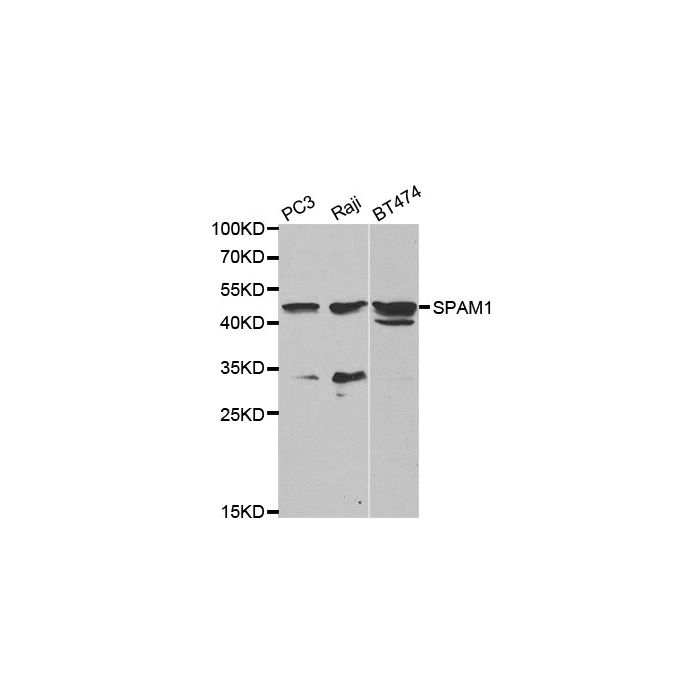
SPAM1 polyclonal, anti-human, mouse, rat
€388.00
In stock
SKU
BS6737
Background:
Hyaluronidases (HAases or HYALs) are a family of lysosomal enzymes that are crucial for the spread of bacterial infections and of toxins present in a variety of venoms. HYALs may also be involved in the progression of cancer. In humans, six members of the hyaluronidase family have been identified. These proteins are significant in the degradation of hyaluronic acid (HA), which is present in body fluids, tissues and the extracellular matrix of vertebrate tissues. HA keeps tissues hydrated, maintains osmotic balance and promotes cell proliferation, differentiation and metastasis. HA is also an important structural component of cartilage and other tissues and acts as a lubricant in joints. SPAM1 (sperm adhesion molecule 1), also designated Hyal-PH20 or sperm surface protein PH-20, was formerly referred to as HYAL1 (HYA1). The current nomenclature references the functional hyaluronidase activity of SPAM1 to permit acrosome-intact sperm to penetrate through the HA-rich cumulus cell layer surrounding the oocyte. SPAM1 is also implicated in intracellular signaling and zona pellucida binding. SPAM1 is found in the epididymis and in testis, more specifically in plasma and acrosomal membranes of sperm. SPAM1 is a structurally unique hyaluronidase in that it is a GPI-anchored protein.
Alternative Name:
Hyaluronidase PH-20, Hyal-PH20, Hyaluronoglucosaminidase PH-20, Sperm adhesion molecule 1, Sperm surface protein PH-20, SPAM1, HYAL3, PH20
Application Dilution: WB: 1:500~1:2000, IF: 1:50~1:200
Specificity: SPAM1 polyclonal antibody detects endogenous levels of SPAM1 protein.
Immunogen:
Recombinant full length Human SPAM1.
MW: ~ 57 kDa
Swis Prot.: P38567
Purification & Purity:
The antibody was affinity-purified from rabbit antiserum by affinity-chromatography using epitope-specific immunogen and the purity is > 95% (by SDS-PAGE).
Format:
1mg/ml in PBS with 0.1% Sodium Azide, 50% Glycerol.
Storage:
Store at 4°C short term. Aliquot and store at -20°C long term. Avoid freeze-thaw cycles.
For research use only, not for use in diagnostic procedure.
Hyaluronidases (HAases or HYALs) are a family of lysosomal enzymes that are crucial for the spread of bacterial infections and of toxins present in a variety of venoms. HYALs may also be involved in the progression of cancer. In humans, six members of the hyaluronidase family have been identified. These proteins are significant in the degradation of hyaluronic acid (HA), which is present in body fluids, tissues and the extracellular matrix of vertebrate tissues. HA keeps tissues hydrated, maintains osmotic balance and promotes cell proliferation, differentiation and metastasis. HA is also an important structural component of cartilage and other tissues and acts as a lubricant in joints. SPAM1 (sperm adhesion molecule 1), also designated Hyal-PH20 or sperm surface protein PH-20, was formerly referred to as HYAL1 (HYA1). The current nomenclature references the functional hyaluronidase activity of SPAM1 to permit acrosome-intact sperm to penetrate through the HA-rich cumulus cell layer surrounding the oocyte. SPAM1 is also implicated in intracellular signaling and zona pellucida binding. SPAM1 is found in the epididymis and in testis, more specifically in plasma and acrosomal membranes of sperm. SPAM1 is a structurally unique hyaluronidase in that it is a GPI-anchored protein.
Alternative Name:
Hyaluronidase PH-20, Hyal-PH20, Hyaluronoglucosaminidase PH-20, Sperm adhesion molecule 1, Sperm surface protein PH-20, SPAM1, HYAL3, PH20
Application Dilution: WB: 1:500~1:2000, IF: 1:50~1:200
Specificity: SPAM1 polyclonal antibody detects endogenous levels of SPAM1 protein.
Immunogen:
Recombinant full length Human SPAM1.
MW: ~ 57 kDa
Swis Prot.: P38567
Purification & Purity:
The antibody was affinity-purified from rabbit antiserum by affinity-chromatography using epitope-specific immunogen and the purity is > 95% (by SDS-PAGE).
Format:
1mg/ml in PBS with 0.1% Sodium Azide, 50% Glycerol.
Storage:
Store at 4°C short term. Aliquot and store at -20°C long term. Avoid freeze-thaw cycles.
For research use only, not for use in diagnostic procedure.
| Is Featured? | No |
|---|
Write Your Own Review