
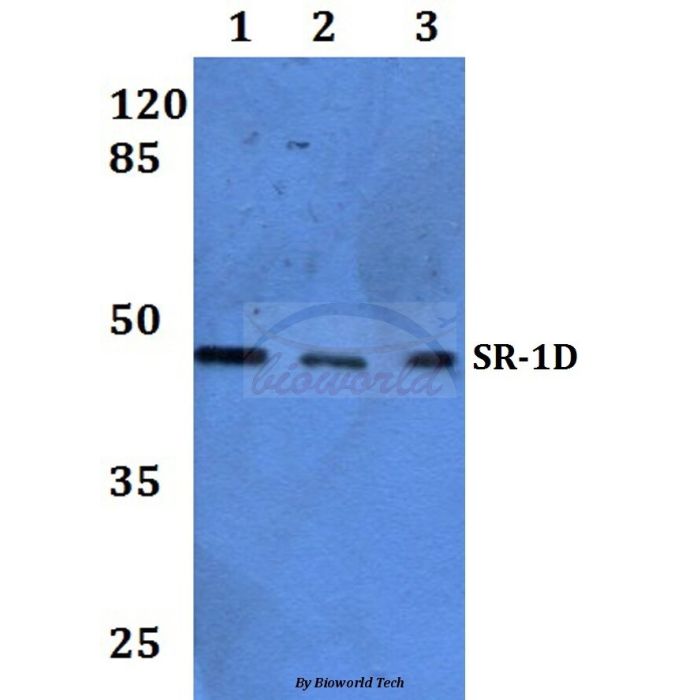
SR-1D polyclonal, anti-human, mouse, rat
€305.00
In stock
SKU
BS60073
Background:
The members of the G-protein-coupled receptor family are distinguished by their slow transmitting response to ligand binding. These seven transmembrane proteins include the adrenergic, serotonin and dopamine receptors. The effect of the signaling molecule can be excitatory or inhibitory depending on the type of receptor to which it binds. beta-adrenergic bound to adrenaline activates adenylyl cyclase, while alpha2-adrenergic receptor bound to adrenaline inhibits adenylyl cyclase. Like the alpha2-adrenergic receptor, serotonin receptor functions are also mediated by G proteins that inhibit the activity of adenylyl cyclase. The serotonin receptors have been classified into several categories, designated SR-1–7 (5HT1–7). Subtypes within the SR-1 group include SR-1A, -1B, -1D, -1E and -1F.
Alternative Name:
5-hydroxytryptamine receptor 1D, 5-HT-1D, 5-HT1D, Serotonin 1D alpha receptor, 5-HT-1D-alpha, Serotonin receptor 1D, HTR1D, HTR1DA, HTRL
Application Dilution: WB: 1:500~1:1000
Specificity: SR-1D polyclonal antibody detects endogenous levels of SR-1D protein.
Immunogen:
A synthetic peptide corresponding to residues in Human SR-1D.
MW: ~ 42-45 kDa
Swis Prot.: P28221
Purification & Purity:
The antibody was affinity-purified from rabbit antiserum by affinity-chromatography using epitope-specific immunogen and the purity is > 95% (by SDS-PAGE).
Format:
1mg/ml in PBS with 0.1% Sodium Azide, 50% Glycerol.
Storage:
Store at 4°C short term. Aliquot and store at -20°C long term. Avoid freeze-thaw cycles.
For research use only, not for use in diagnostic procedure.
The members of the G-protein-coupled receptor family are distinguished by their slow transmitting response to ligand binding. These seven transmembrane proteins include the adrenergic, serotonin and dopamine receptors. The effect of the signaling molecule can be excitatory or inhibitory depending on the type of receptor to which it binds. beta-adrenergic bound to adrenaline activates adenylyl cyclase, while alpha2-adrenergic receptor bound to adrenaline inhibits adenylyl cyclase. Like the alpha2-adrenergic receptor, serotonin receptor functions are also mediated by G proteins that inhibit the activity of adenylyl cyclase. The serotonin receptors have been classified into several categories, designated SR-1–7 (5HT1–7). Subtypes within the SR-1 group include SR-1A, -1B, -1D, -1E and -1F.
Alternative Name:
5-hydroxytryptamine receptor 1D, 5-HT-1D, 5-HT1D, Serotonin 1D alpha receptor, 5-HT-1D-alpha, Serotonin receptor 1D, HTR1D, HTR1DA, HTRL
Application Dilution: WB: 1:500~1:1000
Specificity: SR-1D polyclonal antibody detects endogenous levels of SR-1D protein.
Immunogen:
A synthetic peptide corresponding to residues in Human SR-1D.
MW: ~ 42-45 kDa
Swis Prot.: P28221
Purification & Purity:
The antibody was affinity-purified from rabbit antiserum by affinity-chromatography using epitope-specific immunogen and the purity is > 95% (by SDS-PAGE).
Format:
1mg/ml in PBS with 0.1% Sodium Azide, 50% Glycerol.
Storage:
Store at 4°C short term. Aliquot and store at -20°C long term. Avoid freeze-thaw cycles.
For research use only, not for use in diagnostic procedure.
| Is Featured? | No |
|---|
Write Your Own Review