
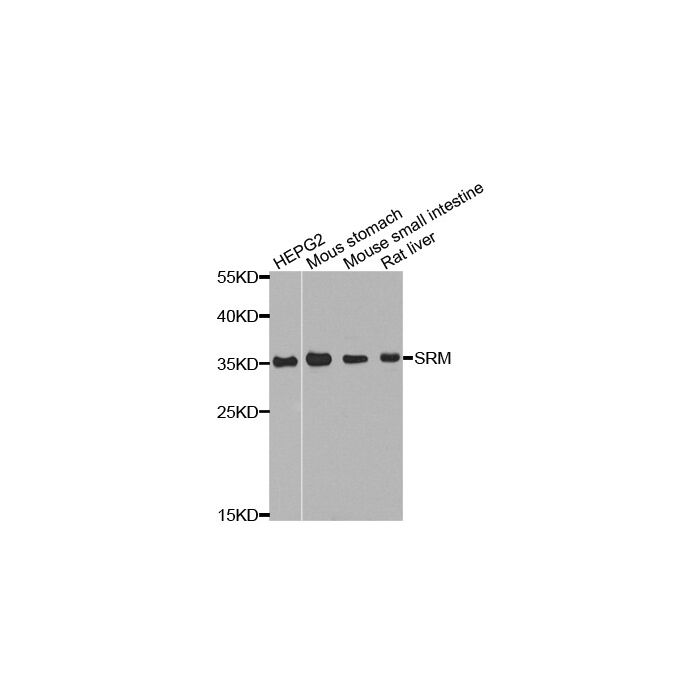
SRM polyclonal, anti-human, mouse, rat
€388.00
In stock
SKU
BS71103
Background:
The polyamines putrescine, spermine, and spermidine are ubiquitous polycationic mediators of cell growth and differentiation. Spermidine synthase is one of four enzymes in the polyamine-biosynthetic pathway and carries out the final step of spermidine biosynthesis. This enzyme catalyzes the conversion of putrescine to spermidine using decarboxylated S-adenosylmethionine as the cofactor.
Alternative Name:
PAPT, SPS1, SPDSY, SRML1,
Application Dilution: WB: 1:500 - 1:2000
Specificity: SRM polyclonal antibody detects endogenous levels of SRM protein.
Immunogen:
Recombinant protein of human SRM.
MW: ~ 34 kDa
Swis Prot.: P19623
Purification & Purity:
The antibody was affinity-purified from rabbit antiserum by affinity-chromatography using epitope-specific immunogen and the purity is > 95% (by SDS-PAGE).
Format:
1mg/ml in PBS with 0.02% sodium azide, 50% glycerol, pH7.3.
Storage:
Store at 4°C short term. Aliquot and store at -20°C long term. Avoid freeze-thaw cycles.
For research use only, not for use in diagnostic procedure.
The polyamines putrescine, spermine, and spermidine are ubiquitous polycationic mediators of cell growth and differentiation. Spermidine synthase is one of four enzymes in the polyamine-biosynthetic pathway and carries out the final step of spermidine biosynthesis. This enzyme catalyzes the conversion of putrescine to spermidine using decarboxylated S-adenosylmethionine as the cofactor.
Alternative Name:
PAPT, SPS1, SPDSY, SRML1,
Application Dilution: WB: 1:500 - 1:2000
Specificity: SRM polyclonal antibody detects endogenous levels of SRM protein.
Immunogen:
Recombinant protein of human SRM.
MW: ~ 34 kDa
Swis Prot.: P19623
Purification & Purity:
The antibody was affinity-purified from rabbit antiserum by affinity-chromatography using epitope-specific immunogen and the purity is > 95% (by SDS-PAGE).
Format:
1mg/ml in PBS with 0.02% sodium azide, 50% glycerol, pH7.3.
Storage:
Store at 4°C short term. Aliquot and store at -20°C long term. Avoid freeze-thaw cycles.
For research use only, not for use in diagnostic procedure.
| Is Featured? | No |
|---|
Write Your Own Review