
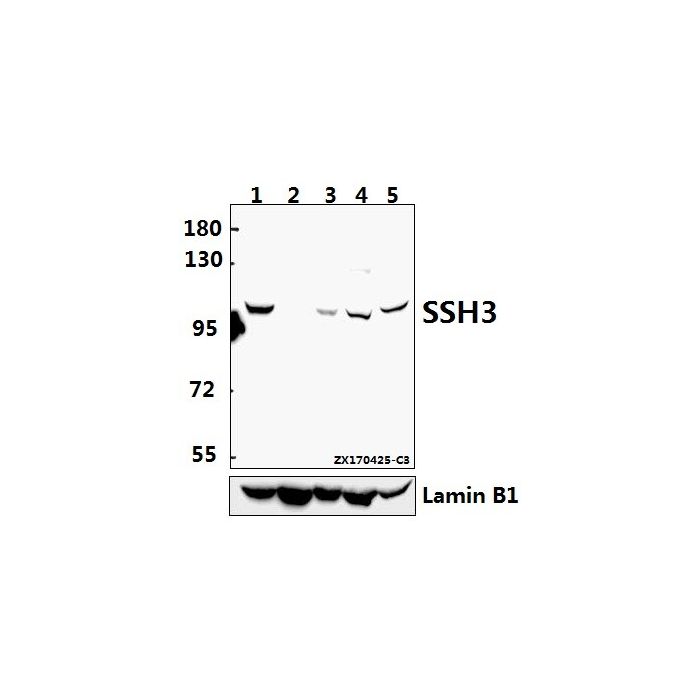
SSH3 polyclonal, anti-human, mouse, rat
€305.00
In stock
SKU
BS61653
Background:
Slingshot homolog 3 (SSH3) is a protein phosphatase that modifies actin cytoskeleton dynamics via cofilin dephosphorylation. Cofilin is an evolutionarily conserved, actin-binding protein that severs actin filaments during processes that rely on actin filament dynamics, including cytokinesis, cell migration, invasion, and neuronal development. Actin severing and filament depolymerization are regulated through the controlled cycling of cofilin between the phosphorylated and dephosphorylated forms. The kinases LIMK and TESK inactivate cofilin by phosphorylating it at Ser3. The slingshot homologs (SSH1, SSH2, and, to a lesser extent, SSH3) and chronophin/PDXP phosphatases remove phosphate from cofilin at Ser3, enabling cofilin binding to actin and filament depolymerization. SSH3 is widely expressed in epithelial tissues, and has been found to be non-essential for viability and fertility in knockout mice. While its biological function remains elusive, phosphorylation at Ser37 of SSH3 has been identified in several phosphoproteomic studies.
Alternative Name:
Protein phosphatase Slingshot homolog 3, SSH-like protein 3, SSH-3L, hSSH-3L, SSH3, SSH3L
Application Dilution: WB: 1:500~1:1000
Specificity: SSH3 polyclonal antibody detects endogenous levels of SSH3 protein.
Immunogen:
Synthetic peptide, corresponding Human SSH3.
MW: ~ 90 kDa
Swis Prot.: Q8TE77
Purification & Purity:
The antibody was affinity-purified from rabbit antiserum by affinity-chromatography using epitope-specific immunogen and the purity is > 95% (by SDS-PAGE).
Format:
1 mg/ml in Phosphate buffered saline (PBS) with 0.05% sodium azide, approx. pH 7.3.
Storage:
Store at 4°C short term. Aliquot and store at -20°C long term. Avoid freeze-thaw cycles.
For research use only, not for use in diagnostic procedure.
Slingshot homolog 3 (SSH3) is a protein phosphatase that modifies actin cytoskeleton dynamics via cofilin dephosphorylation. Cofilin is an evolutionarily conserved, actin-binding protein that severs actin filaments during processes that rely on actin filament dynamics, including cytokinesis, cell migration, invasion, and neuronal development. Actin severing and filament depolymerization are regulated through the controlled cycling of cofilin between the phosphorylated and dephosphorylated forms. The kinases LIMK and TESK inactivate cofilin by phosphorylating it at Ser3. The slingshot homologs (SSH1, SSH2, and, to a lesser extent, SSH3) and chronophin/PDXP phosphatases remove phosphate from cofilin at Ser3, enabling cofilin binding to actin and filament depolymerization. SSH3 is widely expressed in epithelial tissues, and has been found to be non-essential for viability and fertility in knockout mice. While its biological function remains elusive, phosphorylation at Ser37 of SSH3 has been identified in several phosphoproteomic studies.
Alternative Name:
Protein phosphatase Slingshot homolog 3, SSH-like protein 3, SSH-3L, hSSH-3L, SSH3, SSH3L
Application Dilution: WB: 1:500~1:1000
Specificity: SSH3 polyclonal antibody detects endogenous levels of SSH3 protein.
Immunogen:
Synthetic peptide, corresponding Human SSH3.
MW: ~ 90 kDa
Swis Prot.: Q8TE77
Purification & Purity:
The antibody was affinity-purified from rabbit antiserum by affinity-chromatography using epitope-specific immunogen and the purity is > 95% (by SDS-PAGE).
Format:
1 mg/ml in Phosphate buffered saline (PBS) with 0.05% sodium azide, approx. pH 7.3.
Storage:
Store at 4°C short term. Aliquot and store at -20°C long term. Avoid freeze-thaw cycles.
For research use only, not for use in diagnostic procedure.
| Is Featured? | No |
|---|
Write Your Own Review