
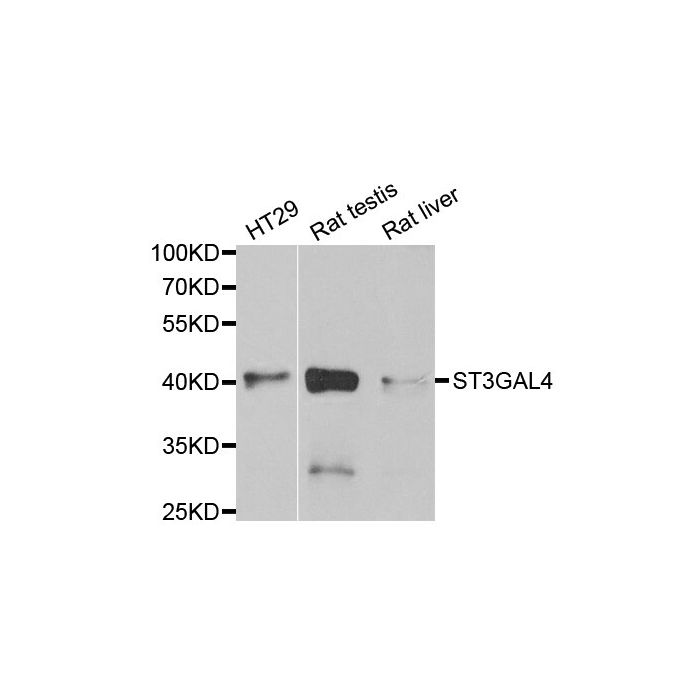
ST3GAL4 polyclonal, anti-human, rat
€388.00
In stock
SKU
BS8119
Background:
Cell type-specific expression of unique carbohydrate structures on cell surface glycoproteins and glycolipids provides information relevant to cell-cell interactions in developing and adult organisms. Sialyltransferases contribute to the diversity of carbohydrate structures through their attachment of sialic acid in various terminal positions on glycolipid and on glycoprotein (N-linked and O-linked) carbohydrate groups. The alpha2,3 sialyltransferase (ST3Gal-IV), also known as SIAT4-C and SI4C, shows elevated expression in brain tissues. Sialyltransferase genes are dispersed throughout the human genome. The human SIAT4C gene maps to human chromosome 11q24.2 and encodes St3Gal-IV. Multiple ST3Gal sialyltransferases, including St3Gal-IV, contribute to selectin ligand formation. Selectin ligands are glycan structures that participate in leukocyte trafficking and inflammation. ST3Gal IV expression is down-regulated in human renal cell carcinoma (RCC) and may be one of the factors associated with the malignant progression of human RCC.
Alternative Name:
CMP-N-acetylneuraminate-beta-galactosamide-alpha-2, 3-sialyltransferase 4, Alpha 2, 3-ST 4, Beta-galactoside alpha-2, 3-sialyltransferase 4, Alpha 2, 3-sialyltransferase IV, Gal-NAc6S, Gal-beta-1, 4-GalNAc-alpha-2, 3-sialyltransferase, SAT-3, ST-4, ST3Gal IV, ST3GalIV, ST3GalA.2, STZ, Sialyltransferase 4C, SIAT4-C, ST3GAL4, CGS23, NANTA3, SIAT4C, STZ
Application Dilution: WB: 1:500~1:2000, IF: 1:50~1:200
Specificity: ST3GAL4 polyclonal antibody detects endogenous levels of ST3GAL4 protein.
Immunogen:
Recombinant full length Human ST3GAL4.
MW: ~ 38 kDa
Swis Prot.: Q11206
Purification & Purity:
The antibody was affinity-purified from rabbit antiserum by affinity-chromatography using epitope-specific immunogen and the purity is > 95% (by SDS-PAGE).
Format:
1mg/ml in PBS with 0.1% Sodium Azide, 50% Glycerol.
Storage:
Store at 4°C short term. Aliquot and store at -20°C long term. Avoid freeze-thaw cycles.
For research use only, not for use in diagnostic procedure.
Cell type-specific expression of unique carbohydrate structures on cell surface glycoproteins and glycolipids provides information relevant to cell-cell interactions in developing and adult organisms. Sialyltransferases contribute to the diversity of carbohydrate structures through their attachment of sialic acid in various terminal positions on glycolipid and on glycoprotein (N-linked and O-linked) carbohydrate groups. The alpha2,3 sialyltransferase (ST3Gal-IV), also known as SIAT4-C and SI4C, shows elevated expression in brain tissues. Sialyltransferase genes are dispersed throughout the human genome. The human SIAT4C gene maps to human chromosome 11q24.2 and encodes St3Gal-IV. Multiple ST3Gal sialyltransferases, including St3Gal-IV, contribute to selectin ligand formation. Selectin ligands are glycan structures that participate in leukocyte trafficking and inflammation. ST3Gal IV expression is down-regulated in human renal cell carcinoma (RCC) and may be one of the factors associated with the malignant progression of human RCC.
Alternative Name:
CMP-N-acetylneuraminate-beta-galactosamide-alpha-2, 3-sialyltransferase 4, Alpha 2, 3-ST 4, Beta-galactoside alpha-2, 3-sialyltransferase 4, Alpha 2, 3-sialyltransferase IV, Gal-NAc6S, Gal-beta-1, 4-GalNAc-alpha-2, 3-sialyltransferase, SAT-3, ST-4, ST3Gal IV, ST3GalIV, ST3GalA.2, STZ, Sialyltransferase 4C, SIAT4-C, ST3GAL4, CGS23, NANTA3, SIAT4C, STZ
Application Dilution: WB: 1:500~1:2000, IF: 1:50~1:200
Specificity: ST3GAL4 polyclonal antibody detects endogenous levels of ST3GAL4 protein.
Immunogen:
Recombinant full length Human ST3GAL4.
MW: ~ 38 kDa
Swis Prot.: Q11206
Purification & Purity:
The antibody was affinity-purified from rabbit antiserum by affinity-chromatography using epitope-specific immunogen and the purity is > 95% (by SDS-PAGE).
Format:
1mg/ml in PBS with 0.1% Sodium Azide, 50% Glycerol.
Storage:
Store at 4°C short term. Aliquot and store at -20°C long term. Avoid freeze-thaw cycles.
For research use only, not for use in diagnostic procedure.
| Is Featured? | No |
|---|
Write Your Own Review