
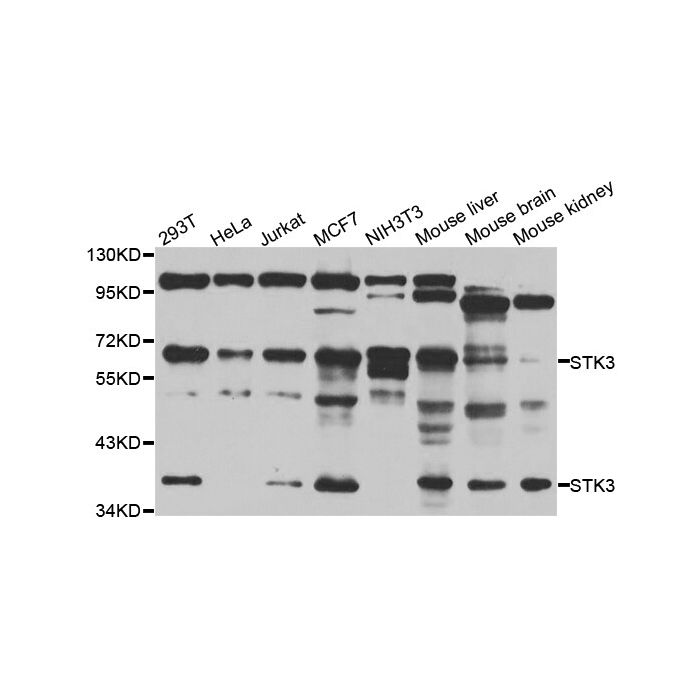
STK3 polyclonal, anti-human, mouse, rat
€388.00
In stock
SKU
BS8633
Background:
Sterile-20 (Ste20) is a serine/threonine kinase in Saccharomyces cerevisiae that is involved in relaying signals from G protein-coupled receptors to cyto-solic MAP kinase cascades. Mammalian protein kinases that display sequence similarity to Ste20 are divided into two groups, the PAK subfamily and the GCK subfamily. The PAK subfamily members contain a C-terminal catalytic domain and an N-terminal regulatory domain with a p21Rac/Cdc42-binding site, and these kinases can activate both p38 MAPK and JNK. The GCK subfamily members contain a C-terminal regulatory domain and an N-terminal catalytic domain, and they have diverse roles in many pathways, including the activation of ERK, JNK, p38 MAPK, and caspase-3. The mammalian Ste20-like kinases (MST kinases), also known as Krs proteins, are members of the GCK subfamily. Ksr-1 (MST-2) and Ksr-2 (MST-1) are both direct substrates of caspase-3 that accelerate caspase-3 activation. MST-3 is ubiquitously expressed in mammalian tissue and can phosphorylate exogenous substrates as well as itself. MST-4 is highly expressed in placenta, thymus, and peripheral blood leukocytes, and it specifically activates ERK.
Alternative Name:
Serine/threonine-protein kinase 3, Mammalian STE20-like protein kinase 2, MST-2, STE20-like kinase MST2, Serine/threonine-protein kinase Krs-1, Serine/threonine-protein kinase 3 36kDa subunit, MST2/N, Serine/threonine-protein kinase 3 20kDa subunit, MST2/C, KRS1, MST2
Application Dilution: WB: 1:500~1:2000, IHC: 1:50~1:200
Specificity: STK3 polyclonal antibody detects endogenous levels of STK3 protein.
Immunogen:
Recombinant full length Human STK3.
MW: ~ 56kDa
Swis Prot.: Q13188
Purification & Purity:
The antibody was affinity-purified from rabbit antiserum by affinity-chromatography using epitope-specific immunogen and the purity is > 95% (by SDS-PAGE).
Format:
1mg/ml in PBS with 0.1% Sodium Azide, 50% Glycerol.
Storage:
Store at 4°C short term. Aliquot and store at -20°C long term. Avoid freeze-thaw cycles.
For research use only, not for use in diagnostic procedure.
Sterile-20 (Ste20) is a serine/threonine kinase in Saccharomyces cerevisiae that is involved in relaying signals from G protein-coupled receptors to cyto-solic MAP kinase cascades. Mammalian protein kinases that display sequence similarity to Ste20 are divided into two groups, the PAK subfamily and the GCK subfamily. The PAK subfamily members contain a C-terminal catalytic domain and an N-terminal regulatory domain with a p21Rac/Cdc42-binding site, and these kinases can activate both p38 MAPK and JNK. The GCK subfamily members contain a C-terminal regulatory domain and an N-terminal catalytic domain, and they have diverse roles in many pathways, including the activation of ERK, JNK, p38 MAPK, and caspase-3. The mammalian Ste20-like kinases (MST kinases), also known as Krs proteins, are members of the GCK subfamily. Ksr-1 (MST-2) and Ksr-2 (MST-1) are both direct substrates of caspase-3 that accelerate caspase-3 activation. MST-3 is ubiquitously expressed in mammalian tissue and can phosphorylate exogenous substrates as well as itself. MST-4 is highly expressed in placenta, thymus, and peripheral blood leukocytes, and it specifically activates ERK.
Alternative Name:
Serine/threonine-protein kinase 3, Mammalian STE20-like protein kinase 2, MST-2, STE20-like kinase MST2, Serine/threonine-protein kinase Krs-1, Serine/threonine-protein kinase 3 36kDa subunit, MST2/N, Serine/threonine-protein kinase 3 20kDa subunit, MST2/C, KRS1, MST2
Application Dilution: WB: 1:500~1:2000, IHC: 1:50~1:200
Specificity: STK3 polyclonal antibody detects endogenous levels of STK3 protein.
Immunogen:
Recombinant full length Human STK3.
MW: ~ 56kDa
Swis Prot.: Q13188
Purification & Purity:
The antibody was affinity-purified from rabbit antiserum by affinity-chromatography using epitope-specific immunogen and the purity is > 95% (by SDS-PAGE).
Format:
1mg/ml in PBS with 0.1% Sodium Azide, 50% Glycerol.
Storage:
Store at 4°C short term. Aliquot and store at -20°C long term. Avoid freeze-thaw cycles.
For research use only, not for use in diagnostic procedure.
| Is Featured? | No |
|---|
Write Your Own Review