
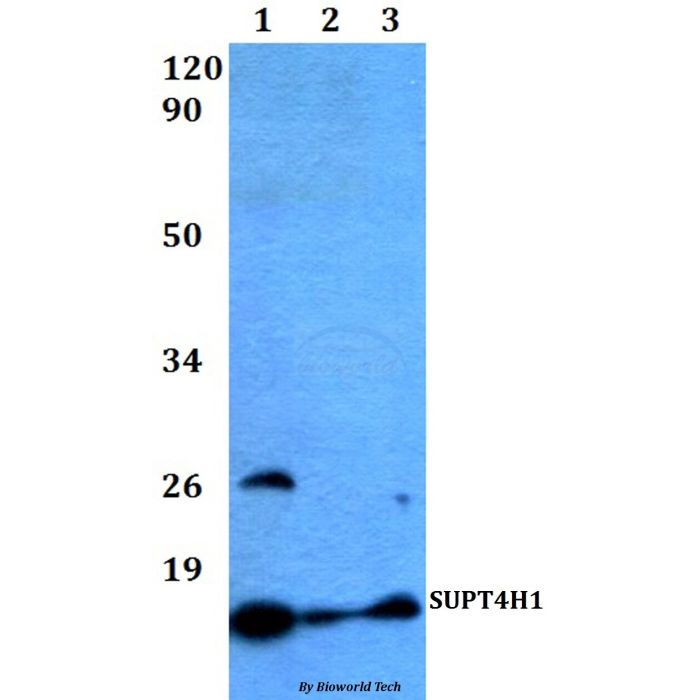
SUPT4H1 polyclonal, anti-human, mouse, rat
€305.00
In stock
SKU
BS60490
Background:
SPT4 (also designated Suppressor of Ty4 and p14) and SPT5 (also designated DSIF p160) are highly conserved proteins from yeast to humans. Nuclear SPT4 and SPT5 are involved in both DRB (5,6-dichloro-1-beta-D-ribofuranosylbenzimidazole)-mediated transcriptional inhibition as well as the activation of transcriptional elongation by the HIV-1 protein Tat. SPT4 binds SPT5 to form the DSIF (DRB-sensitivity-inducing factor) complex, which binds RNA polymerase II and directly regulates elongation. However, SPT5 protein in mitotic HeLa cells migrates more slowly on SDS-PAGE than does SPT5 isolated from interphase cells, as a result of enhanced SPT5 phosphorylation. The C-terminal CTR1 domain of SPT5 is the substrate for P-TEFb phosphorylation, which is critical for SPT5 function as a regulator of transcriptional elongation.
Alternative Name:
Transcription elongation factor SPT4, hSPT4, DRB sensitivity-inducing factor 14 kDa subunit, DSIF p14, DRB sensitivity-inducing factor small subunit, DSIF small subunit, SUPT4H1, SPT4H, SUPT4H
Application Dilution: WB: 1:500~1:1000
Specificity: SUPT4H1 polyclonal antibody detects endogenous levels of SUPT4H1 protein.
Immunogen:
A synthetic peptide corresponding to residues in Human SUPT4H1.
MW: ~ 13 kDa
Swis Prot.: P63272
Purification & Purity:
The antibody was affinity-purified from rabbit antiserum by affinity-chromatography using epitope-specific immunogen and the purity is > 95% (by SDS-PAGE).
Format:
1 mg/ml in Phosphate buffered saline (PBS) with 15 mM sodium azide, approx. pH 7.2.
Storage:
Store at 4°C short term. Aliquot and store at -20°C long term. Avoid freeze-thaw cycles.
For research use only, not for use in diagnostic procedure.
SPT4 (also designated Suppressor of Ty4 and p14) and SPT5 (also designated DSIF p160) are highly conserved proteins from yeast to humans. Nuclear SPT4 and SPT5 are involved in both DRB (5,6-dichloro-1-beta-D-ribofuranosylbenzimidazole)-mediated transcriptional inhibition as well as the activation of transcriptional elongation by the HIV-1 protein Tat. SPT4 binds SPT5 to form the DSIF (DRB-sensitivity-inducing factor) complex, which binds RNA polymerase II and directly regulates elongation. However, SPT5 protein in mitotic HeLa cells migrates more slowly on SDS-PAGE than does SPT5 isolated from interphase cells, as a result of enhanced SPT5 phosphorylation. The C-terminal CTR1 domain of SPT5 is the substrate for P-TEFb phosphorylation, which is critical for SPT5 function as a regulator of transcriptional elongation.
Alternative Name:
Transcription elongation factor SPT4, hSPT4, DRB sensitivity-inducing factor 14 kDa subunit, DSIF p14, DRB sensitivity-inducing factor small subunit, DSIF small subunit, SUPT4H1, SPT4H, SUPT4H
Application Dilution: WB: 1:500~1:1000
Specificity: SUPT4H1 polyclonal antibody detects endogenous levels of SUPT4H1 protein.
Immunogen:
A synthetic peptide corresponding to residues in Human SUPT4H1.
MW: ~ 13 kDa
Swis Prot.: P63272
Purification & Purity:
The antibody was affinity-purified from rabbit antiserum by affinity-chromatography using epitope-specific immunogen and the purity is > 95% (by SDS-PAGE).
Format:
1 mg/ml in Phosphate buffered saline (PBS) with 15 mM sodium azide, approx. pH 7.2.
Storage:
Store at 4°C short term. Aliquot and store at -20°C long term. Avoid freeze-thaw cycles.
For research use only, not for use in diagnostic procedure.
| Is Featured? | No |
|---|
Write Your Own Review