
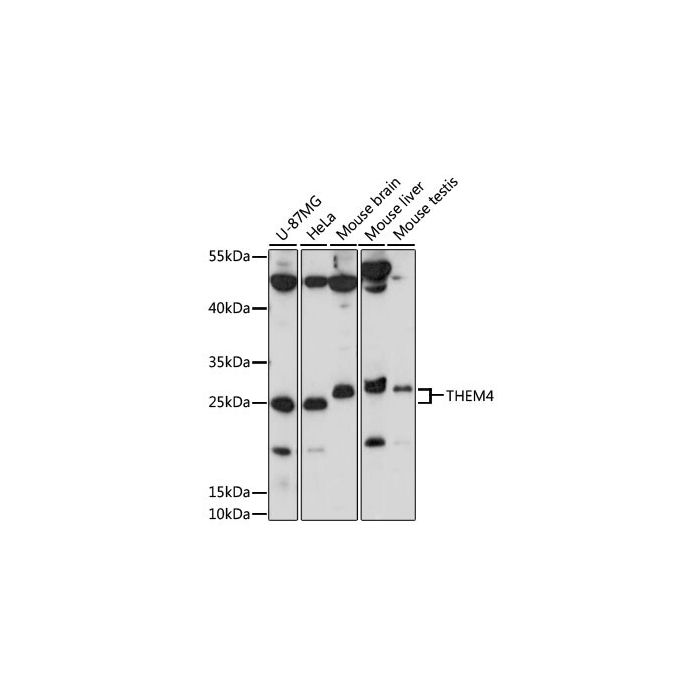
THEM4 polyclonal, anti-human, mouse
€388.00
In stock
SKU
BS72806
Background:
Protein kinase B (PKB) is a major downstream target of receptor tyrosine kinases that signal via phosphatidylinositol 3-kinase. Upon cell stimulation, PKB is translocated to the plasma membrane, where it is phosphorylated in the C-terminal regulatory domain. The protein encoded by this gene negatively regulates PKB activity by inhibiting phosphorylation. Transcription of this gene is commonly downregulated in glioblastomas.
Alternative Name:
CTMP
Application Dilution: WB: 1:500 - 1:2000
Specificity: THEM4 polyclonal antibody detects endogenous levels of THEM4 protein.
Immunogen:
Recombinant protein of human THEM4
MW: 25kDa/27kDa
Swis Prot.: Q5T1C6
Purification & Purity:
The antibody was affinity-purified from rabbit antiserum by affinity-chromatography using epitope-specific immunogen and the purity is > 95% (by SDS-PAGE).
Format:
1mg/ml in PBS, 50% glycerol, pH7.3.
Storage:
Store at 4°C short term. Aliquot and store at -20°C long term. Avoid freeze-thaw cycles.
For research use only, not for use in diagnostic procedure.
Protein kinase B (PKB) is a major downstream target of receptor tyrosine kinases that signal via phosphatidylinositol 3-kinase. Upon cell stimulation, PKB is translocated to the plasma membrane, where it is phosphorylated in the C-terminal regulatory domain. The protein encoded by this gene negatively regulates PKB activity by inhibiting phosphorylation. Transcription of this gene is commonly downregulated in glioblastomas.
Alternative Name:
CTMP
Application Dilution: WB: 1:500 - 1:2000
Specificity: THEM4 polyclonal antibody detects endogenous levels of THEM4 protein.
Immunogen:
Recombinant protein of human THEM4
MW: 25kDa/27kDa
Swis Prot.: Q5T1C6
Purification & Purity:
The antibody was affinity-purified from rabbit antiserum by affinity-chromatography using epitope-specific immunogen and the purity is > 95% (by SDS-PAGE).
Format:
1mg/ml in PBS, 50% glycerol, pH7.3.
Storage:
Store at 4°C short term. Aliquot and store at -20°C long term. Avoid freeze-thaw cycles.
For research use only, not for use in diagnostic procedure.
| Is Featured? | No |
|---|
Write Your Own Review