
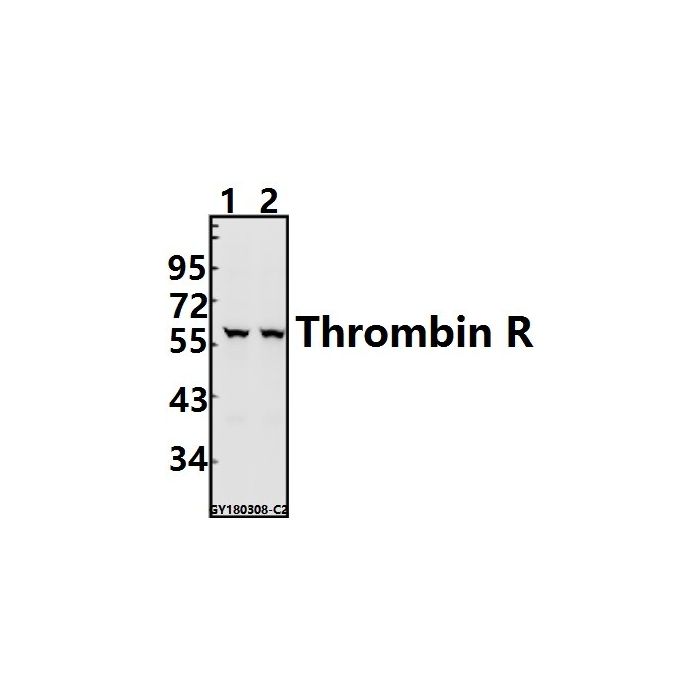
Thrombin R (S42) polyclonal, anti-human, mouse, rat
€305.00
In stock
SKU
BS7067
Background:
Thrombin receptor (also designated protease-activated receptor-1 or PAR-1), PAR-2 and PAR-3 compose a distinct class of G protein-coupled receptors activated by proteolysis. Cleavage of these receptors by proteases occurs within the amino-terminal extracellular domain. Thrombin, a serine protease involved in platelet aggregation and blood coagulation, activates the thrombin receptor, resulting in elevated intracellular calcium levels in platelets. Thrombin also cleaves PAR-3 in vitro, suggesting that PAR-3 may be involved in thrombosis or mitogenesis. Thrombin receptor and PAR-4 appear to account for most thrombin signaling in platelets. Activation of PAR-2 in vitro is induced by trypsin, suggesting that PAR-2 is not an alternative thrombin receptor. Cytokines including TNF-α and IL-1β increase PAR-2 expression, indicating PAR-2 involvement in the acute inflammatory response.
Alternative Name:
Proteinase-activated receptor 1, PAR-1, Coagulation factor II receptor, Thrombin receptor, F2R, CF2R, PAR1, TR
Application Dilution: WB: 1:500~1:1000
Specificity: Thrombin R (S42) polyclonal antibody detects endogenous levels of Thrombin R protein.
Immunogen:
Synthetic peptide, corresponding to amino acids 12-60 of Human Thrombin R.
MW: ~ 48 kDa
Swis Prot.: P25116
Purification & Purity:
The antibody was affinity-purified from rabbit antiserum by affinity-chromatography using epitope-specific immunogen and the purity is > 95% (by SDS-PAGE).
Format:
1 mg/ml in Phosphate buffered saline (PBS) with 15 mM sodium azide, approx. pH 7.2.
Storage:
Store at 4°C short term. Aliquot and store at -20°C long term. Avoid freeze-thaw cycles.
For research use only, not for use in diagnostic procedure.
Thrombin receptor (also designated protease-activated receptor-1 or PAR-1), PAR-2 and PAR-3 compose a distinct class of G protein-coupled receptors activated by proteolysis. Cleavage of these receptors by proteases occurs within the amino-terminal extracellular domain. Thrombin, a serine protease involved in platelet aggregation and blood coagulation, activates the thrombin receptor, resulting in elevated intracellular calcium levels in platelets. Thrombin also cleaves PAR-3 in vitro, suggesting that PAR-3 may be involved in thrombosis or mitogenesis. Thrombin receptor and PAR-4 appear to account for most thrombin signaling in platelets. Activation of PAR-2 in vitro is induced by trypsin, suggesting that PAR-2 is not an alternative thrombin receptor. Cytokines including TNF-α and IL-1β increase PAR-2 expression, indicating PAR-2 involvement in the acute inflammatory response.
Alternative Name:
Proteinase-activated receptor 1, PAR-1, Coagulation factor II receptor, Thrombin receptor, F2R, CF2R, PAR1, TR
Application Dilution: WB: 1:500~1:1000
Specificity: Thrombin R (S42) polyclonal antibody detects endogenous levels of Thrombin R protein.
Immunogen:
Synthetic peptide, corresponding to amino acids 12-60 of Human Thrombin R.
MW: ~ 48 kDa
Swis Prot.: P25116
Purification & Purity:
The antibody was affinity-purified from rabbit antiserum by affinity-chromatography using epitope-specific immunogen and the purity is > 95% (by SDS-PAGE).
Format:
1 mg/ml in Phosphate buffered saline (PBS) with 15 mM sodium azide, approx. pH 7.2.
Storage:
Store at 4°C short term. Aliquot and store at -20°C long term. Avoid freeze-thaw cycles.
For research use only, not for use in diagnostic procedure.
| Is Featured? | No |
|---|
Write Your Own Review