
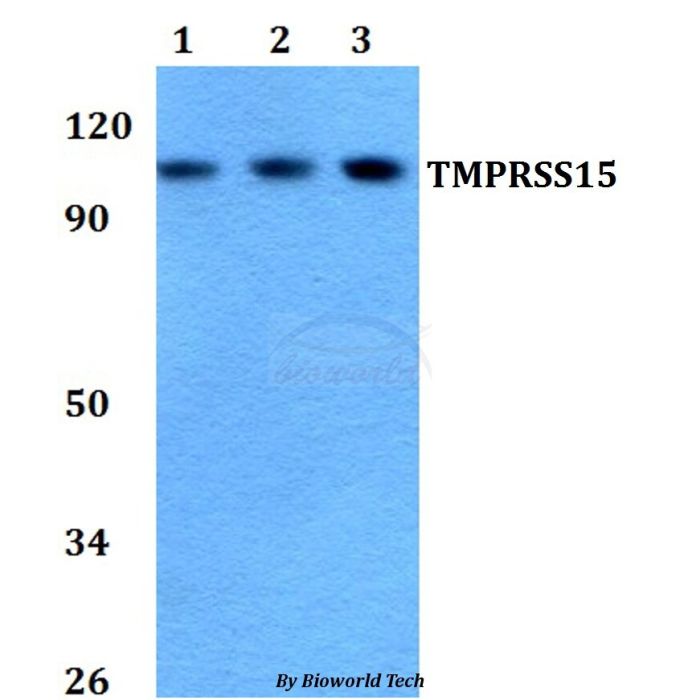
TMPRSS15 polyclonal, anti-human, mouse, rat
€305.00
In stock
SKU
BS60752
Background:
Enterokinase, also known as enteropeptidase or serine protease 7, belongs to the peptidase S1 family and localizes to the intestinal brush border in the proximal small intestine. It exists as a heterodimer of a catalytic light chain (LC) and a non-catalytic heavy chain (HC) linked together by a disulfide bond. Enterokinase HC plays a role in macromolecular substrate recognition and specificity. Duodenase is the serine protease responsible for the release and activation of Enterokinase from its inactive precursor. Active Enterokinase recognizes the target sequence, Asp-Asp-Asp-Asp-Lys, and is responsible for catalyzing the conversion of pancreatic trypsinogen to activated trypsin. Activated trypsin then further activates digestive enzymes such as chymotrypsin, carboxypeptidases, elastases and lipases, releasing them from their inactive precursors. Enterokinase is important for proper digestion of proteins. Improper functioning of Enterokinase may result in congenital enteropeptidase deficiency. This recessively inherited disorder leads to severe protein malabsorption and can result in low serum protein, chronic diarrhea and, in infants, a failure to thrive.
Alternative Name:
Enteropeptidase, Enterokinase, Serine protease 7, Transmembrane protease serine 15, TMPRSS15, ENTK, PRSS7
Application Dilution: WB: 1:500~1:1000
Specificity: TMPRSS15 polyclonal antibody detects endogenous levels of TMPRSS15 protein.
Immunogen:
A synthetic peptide corresponding to residues in Human TMPRSS15
MW: ~ 113 kDa
Swis Prot.: P98073
Purification & Purity:
The antibody was affinity-purified from rabbit antiserum by affinity-chromatography using epitope-specific immunogen and the purity is > 95% (by SDS-PAGE).
Format:
1 mg/ml in Phosphate buffered saline (PBS) with 15 mM sodium azide, approx. pH 7.2.
Storage:
Store at 4°C short term. Aliquot and store at -20°C long term. Avoid freeze-thaw cycles.
For research use only, not for use in diagnostic procedure.
Enterokinase, also known as enteropeptidase or serine protease 7, belongs to the peptidase S1 family and localizes to the intestinal brush border in the proximal small intestine. It exists as a heterodimer of a catalytic light chain (LC) and a non-catalytic heavy chain (HC) linked together by a disulfide bond. Enterokinase HC plays a role in macromolecular substrate recognition and specificity. Duodenase is the serine protease responsible for the release and activation of Enterokinase from its inactive precursor. Active Enterokinase recognizes the target sequence, Asp-Asp-Asp-Asp-Lys, and is responsible for catalyzing the conversion of pancreatic trypsinogen to activated trypsin. Activated trypsin then further activates digestive enzymes such as chymotrypsin, carboxypeptidases, elastases and lipases, releasing them from their inactive precursors. Enterokinase is important for proper digestion of proteins. Improper functioning of Enterokinase may result in congenital enteropeptidase deficiency. This recessively inherited disorder leads to severe protein malabsorption and can result in low serum protein, chronic diarrhea and, in infants, a failure to thrive.
Alternative Name:
Enteropeptidase, Enterokinase, Serine protease 7, Transmembrane protease serine 15, TMPRSS15, ENTK, PRSS7
Application Dilution: WB: 1:500~1:1000
Specificity: TMPRSS15 polyclonal antibody detects endogenous levels of TMPRSS15 protein.
Immunogen:
A synthetic peptide corresponding to residues in Human TMPRSS15
MW: ~ 113 kDa
Swis Prot.: P98073
Purification & Purity:
The antibody was affinity-purified from rabbit antiserum by affinity-chromatography using epitope-specific immunogen and the purity is > 95% (by SDS-PAGE).
Format:
1 mg/ml in Phosphate buffered saline (PBS) with 15 mM sodium azide, approx. pH 7.2.
Storage:
Store at 4°C short term. Aliquot and store at -20°C long term. Avoid freeze-thaw cycles.
For research use only, not for use in diagnostic procedure.
| Is Featured? | No |
|---|
Write Your Own Review