
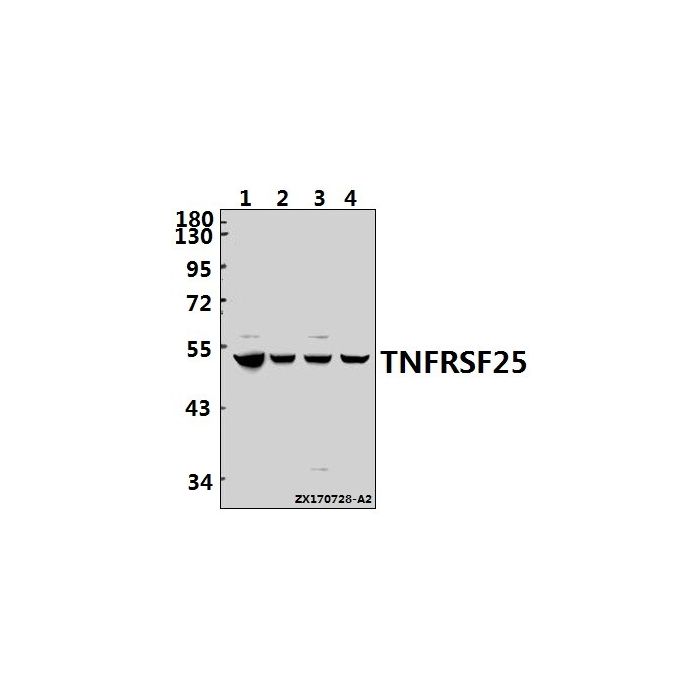
TNFRSF25 polyclonal, anti-human
€305.00
In stock
SKU
BS61774
Background:
The tumor necrosis factor receptor family, which includes TNF-RI, Fas, DR3, DR4, DR5, and DR6, plays an important role in the regulation of apoptosis in various physiological systems. The receptors are activated by a family of cytokines that include TNF, FasL, and TRAIL. They are characterized by a highly conserved extracellular region containing cysteine-rich repeats and a conserved intracellular region of about 80 amino acids termed the death domain (DD). The DD is important for transducing the death signal by recruiting other DD containing adaptor proteins (FADD, TRADD, RIP) to the death-inducing signaling complex (DISC), resulting in activation of caspases. DR3/WSL-1/Apo-3/TRAMP/LARD is a TNFR family member containing the characteristic extracellular cysteine-repeats, transmembrane region, and an intracellular DD. DR3 is activated by its ligand Apo-3L/TWEAK to induce apoptosis and activation of NF-κB. Like TNF-R1, DR3 binds to the DD adaptor protein TRADD, which can then associate with other DD proteins like FADD and RIP as well as members of the TRAF family. Tissue expression of DR3 is very restricted, primarily seen on the surface of activated thymocytes and lymphocytes and plays an important role in thymocyte negative selection. Studies have also indicated an association with DR3 and rheumatoid arthritis.
Alternative Name:
Tumor necrosis factor receptor superfamily member 25, Apo-3, Apoptosis-inducing receptor AIR, Apoptosis-mediating receptor DR3, Apoptosis-mediating receptor TRAMP, Death receptor 3, Lymphocyte-associated receptor of deat, LARD, Protein WSL, Protein WSL-1, TNFRSF25, APO3, DDR3, DR3, TNFRSF12, WSL, WSL1, UNQ455, PRO779
Application Dilution: WB: 1:500~1:1000
Specificity: TNFRSF25 polyclonal antibody detects endogenous levels of TNFRSF25 protein.
Immunogen:
Synthetic peptide, corresponding to amino acids 250-300 of Human TNFRSF25.
MW: ~ 55 kDa
Swis Prot.: Q93038
Purification & Purity:
The antibody was affinity-purified from rabbit antiserum by affinity-chromatography using epitope-specific immunogen and the purity is > 95% (by SDS-PAGE).
Format:
1 mg/ml in Phosphate buffered saline (PBS) with 0.05% sodium azide, approx. pH 7.3.
Storage:
Store at 4°C short term. Aliquot and store at -20°C long term. Avoid freeze-thaw cycles.
For research use only, not for use in diagnostic procedure.
The tumor necrosis factor receptor family, which includes TNF-RI, Fas, DR3, DR4, DR5, and DR6, plays an important role in the regulation of apoptosis in various physiological systems. The receptors are activated by a family of cytokines that include TNF, FasL, and TRAIL. They are characterized by a highly conserved extracellular region containing cysteine-rich repeats and a conserved intracellular region of about 80 amino acids termed the death domain (DD). The DD is important for transducing the death signal by recruiting other DD containing adaptor proteins (FADD, TRADD, RIP) to the death-inducing signaling complex (DISC), resulting in activation of caspases. DR3/WSL-1/Apo-3/TRAMP/LARD is a TNFR family member containing the characteristic extracellular cysteine-repeats, transmembrane region, and an intracellular DD. DR3 is activated by its ligand Apo-3L/TWEAK to induce apoptosis and activation of NF-κB. Like TNF-R1, DR3 binds to the DD adaptor protein TRADD, which can then associate with other DD proteins like FADD and RIP as well as members of the TRAF family. Tissue expression of DR3 is very restricted, primarily seen on the surface of activated thymocytes and lymphocytes and plays an important role in thymocyte negative selection. Studies have also indicated an association with DR3 and rheumatoid arthritis.
Alternative Name:
Tumor necrosis factor receptor superfamily member 25, Apo-3, Apoptosis-inducing receptor AIR, Apoptosis-mediating receptor DR3, Apoptosis-mediating receptor TRAMP, Death receptor 3, Lymphocyte-associated receptor of deat, LARD, Protein WSL, Protein WSL-1, TNFRSF25, APO3, DDR3, DR3, TNFRSF12, WSL, WSL1, UNQ455, PRO779
Application Dilution: WB: 1:500~1:1000
Specificity: TNFRSF25 polyclonal antibody detects endogenous levels of TNFRSF25 protein.
Immunogen:
Synthetic peptide, corresponding to amino acids 250-300 of Human TNFRSF25.
MW: ~ 55 kDa
Swis Prot.: Q93038
Purification & Purity:
The antibody was affinity-purified from rabbit antiserum by affinity-chromatography using epitope-specific immunogen and the purity is > 95% (by SDS-PAGE).
Format:
1 mg/ml in Phosphate buffered saline (PBS) with 0.05% sodium azide, approx. pH 7.3.
Storage:
Store at 4°C short term. Aliquot and store at -20°C long term. Avoid freeze-thaw cycles.
For research use only, not for use in diagnostic procedure.
| Is Featured? | No |
|---|
Write Your Own Review