
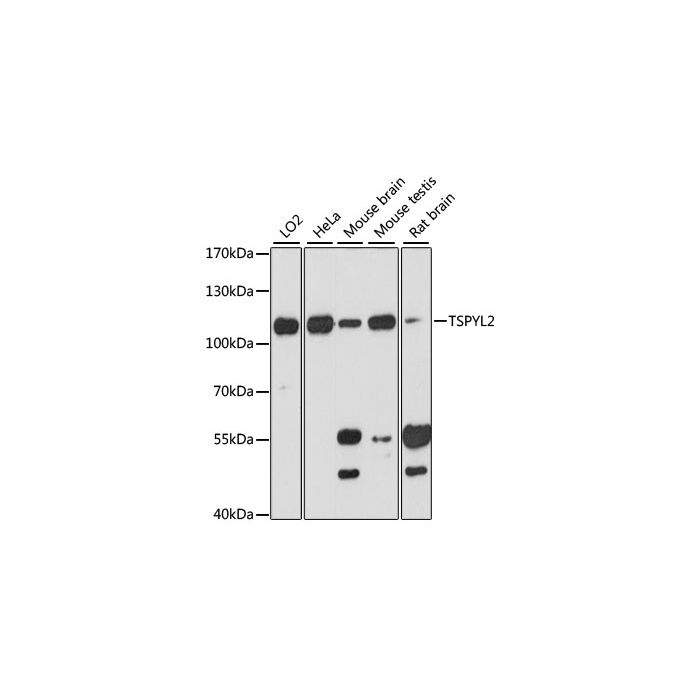
TSPYL2 polyclonal, anti-human, mouse, rat
€388.00
In stock
SKU
BS72430
Background:
This gene encodes a member of the testis-specific protein Y-encoded, TSPY-like/SET/nucleosome assembly protein-1 superfamily. The encoded protein is localized to the nucleolus where it functions in chromatin remodeling and as an inhibitor of cell-cycle progression. This protein may play a role in the suppression of tumor growth.
Alternative Name:
CDA1,CINAP,CTCL,DENTT,HRIHFB2216,NP79,SE204,TSPX
Application Dilution: WB: 1:1000 - 1:2000
Specificity: TSPYL2 polyclonal antibody detects endogenous levels of TSPYL2 protein.
Immunogen:
Recombinant protein of human TSPYL2
MW: ~ 110 kDa
Swis Prot.: Q9H2G4
Purification & Purity:
The antibody was affinity-purified from rabbit antiserum by affinity-chromatography using epitope-specific immunogen and the purity is > 95% (by SDS-PAGE).
Format:
1 mg/ml in Phosphate buffered saline (PBS) with 0.05% sodium azide, approx. pH 7.2.
Storage:
Store at 4°C short term. Aliquot and store at -20°C long term. Avoid freeze-thaw cycles.
For research use only, not for use in diagnostic procedure.
This gene encodes a member of the testis-specific protein Y-encoded, TSPY-like/SET/nucleosome assembly protein-1 superfamily. The encoded protein is localized to the nucleolus where it functions in chromatin remodeling and as an inhibitor of cell-cycle progression. This protein may play a role in the suppression of tumor growth.
Alternative Name:
CDA1,CINAP,CTCL,DENTT,HRIHFB2216,NP79,SE204,TSPX
Application Dilution: WB: 1:1000 - 1:2000
Specificity: TSPYL2 polyclonal antibody detects endogenous levels of TSPYL2 protein.
Immunogen:
Recombinant protein of human TSPYL2
MW: ~ 110 kDa
Swis Prot.: Q9H2G4
Purification & Purity:
The antibody was affinity-purified from rabbit antiserum by affinity-chromatography using epitope-specific immunogen and the purity is > 95% (by SDS-PAGE).
Format:
1 mg/ml in Phosphate buffered saline (PBS) with 0.05% sodium azide, approx. pH 7.2.
Storage:
Store at 4°C short term. Aliquot and store at -20°C long term. Avoid freeze-thaw cycles.
For research use only, not for use in diagnostic procedure.
| Is Featured? | No |
|---|
Write Your Own Review