
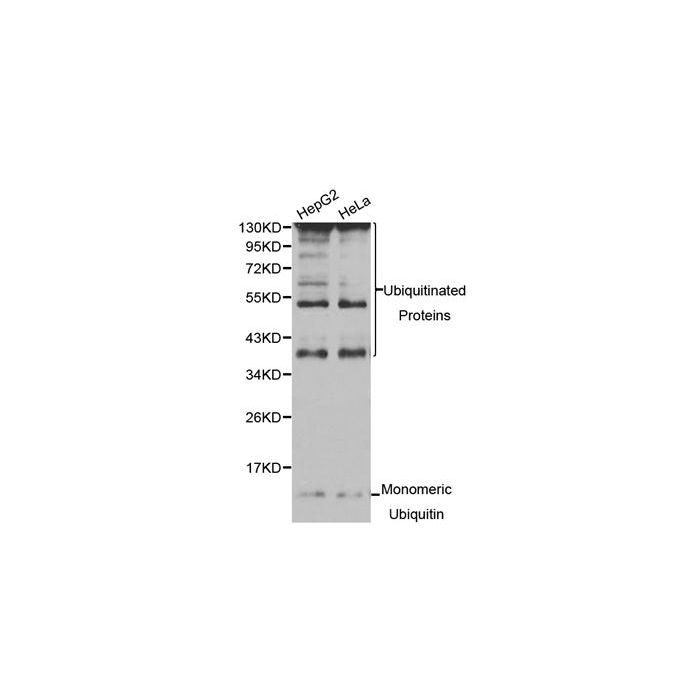
UBC polyclonal, anti-human, mouse, rat
€388.00
In stock
SKU
BS70529
Background:
Ubiquitin can be covalently linked to many cellular proteins by the ubiquitination process, which targets proteins for degradation by the 26S proteasome. Three components are involved in the target protein-ubiquitin conjugation process. Ubiquitin is first activated by forming a thiolester complex with the ubiquitin-activating enzyme (UBE1 or E1). The activated ubiquitin is subsequently transferred to the ubiquitin-carrier protein E2, and then from E2 to ubiquitin ligase E3 for final delivery to the ε-amino group of the target protein lysine residue (1-3). Combinatorial interactions of different E2 and E3 proteins result in substrate specificity (4). UBE1 has two isofoms: UBE1a is a nuclear protein of 117 kDa while UBE1b is a nuclear and cytoplasmic protein of 110 kDa (5).
Alternative Name:
UBC, HMG20, Ubiquitin,
Application Dilution: WB: 1:1000 - 1:4000, IHC/IF: 1:50 - 1:200
Specificity: UBC polyclonal antibody detects endogenous levels of UBC protein.
Immunogen:
A synthetic peptide of human UBC.
MW: ~ 8 kDa
Swis Prot.: P0CG48
Purification & Purity:
The antibody was affinity-purified from rabbit antiserum by affinity-chromatography using epitope-specific immunogen and the purity is > 95% (by SDS-PAGE).
Format:
1mg/ml in PBS with 0.02% sodium azide, 50% glycerol, pH7.3.
Storage:
Store at 4°C short term. Aliquot and store at -20°C long term. Avoid freeze-thaw cycles.
For research use only, not for use in diagnostic procedure.
Ubiquitin can be covalently linked to many cellular proteins by the ubiquitination process, which targets proteins for degradation by the 26S proteasome. Three components are involved in the target protein-ubiquitin conjugation process. Ubiquitin is first activated by forming a thiolester complex with the ubiquitin-activating enzyme (UBE1 or E1). The activated ubiquitin is subsequently transferred to the ubiquitin-carrier protein E2, and then from E2 to ubiquitin ligase E3 for final delivery to the ε-amino group of the target protein lysine residue (1-3). Combinatorial interactions of different E2 and E3 proteins result in substrate specificity (4). UBE1 has two isofoms: UBE1a is a nuclear protein of 117 kDa while UBE1b is a nuclear and cytoplasmic protein of 110 kDa (5).
Alternative Name:
UBC, HMG20, Ubiquitin,
Application Dilution: WB: 1:1000 - 1:4000, IHC/IF: 1:50 - 1:200
Specificity: UBC polyclonal antibody detects endogenous levels of UBC protein.
Immunogen:
A synthetic peptide of human UBC.
MW: ~ 8 kDa
Swis Prot.: P0CG48
Purification & Purity:
The antibody was affinity-purified from rabbit antiserum by affinity-chromatography using epitope-specific immunogen and the purity is > 95% (by SDS-PAGE).
Format:
1mg/ml in PBS with 0.02% sodium azide, 50% glycerol, pH7.3.
Storage:
Store at 4°C short term. Aliquot and store at -20°C long term. Avoid freeze-thaw cycles.
For research use only, not for use in diagnostic procedure.
| Is Featured? | No |
|---|
Write Your Own Review