
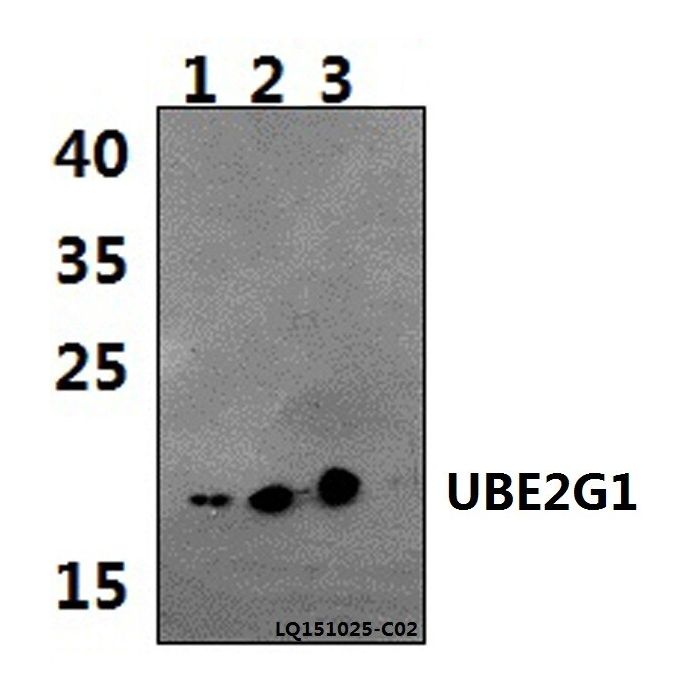
UBE2G1 polyclonal, anti-human, mouse, rat
€305.00
In stock
SKU
BS61475
Background:
Ubiquitin is an abundant, highly conserved protein found in all eukaryotic cells either free or covalently attached to cellular proteins. The primary function of ubiquitin in mammalian systems is to clear abnormal, foreign, and improperly folded proteins by targeting them for proteosome degradation. In Saccharomyces cerevisiae, ubiquitin-like proteins include Rub1, Ula1, Uba3, Smt3, Ubc2, Ubc12 and Ubc9. Rub1 shares 53% homology with ubiquitin and requires activation via the E2 proteins, including Ula1, Uba3 and Ubc12 in order to conjugate to substrates directed to different proteolytic systems. Ubc4 catalyzes ubiquitination of IkBa in a phosphorylation and SCFB-TRCP dependent manner. In this particular reaction, E1 first transfers ubiquitin to the E2 component Ubc4, and Ubc4 then associates with E3 ligase, which conjugates the poly-ubiquitin chain on a target protein. In this fashion, the chain tags the IkBa for degradation by a proteasome thus lifting the inhibitory effect of IkBa on NFkB and allowing NFkB to enter the nucleus.
Alternative Name:
Ubiquitin-conjugating enzyme E2 G1, E2 ubiquitin-conjugating enzyme G1, E217K, UBC7, Ubiquitin carrier protein G1, Ubiquitin-protein ligase G1, UBE2G1, UBE2G
Application Dilution: WB: 1:500~1:1000
Specificity: UBE2G1 polyclonal antibody detects endogenous levels of UBE2G1 protein.
Immunogen:
Synthetic peptide, corresponding to amino acids 63-108 of Human UBE2G1.
MW: ~ 19 kDa
Swis Prot.: P62253
Purification & Purity:
The antibody was affinity-purified from rabbit antiserum by affinity-chromatography using epitope-specific immunogen and the purity is > 95% (by SDS-PAGE).
Format:
1 mg/ml in Phosphate buffered saline (PBS) with 0.05% sodium azide, approx. pH 7.3.
Storage:
Store at 4°C short term. Aliquot and store at -20°C long term. Avoid freeze-thaw cycles.
For research use only, not for use in diagnostic procedure.
Ubiquitin is an abundant, highly conserved protein found in all eukaryotic cells either free or covalently attached to cellular proteins. The primary function of ubiquitin in mammalian systems is to clear abnormal, foreign, and improperly folded proteins by targeting them for proteosome degradation. In Saccharomyces cerevisiae, ubiquitin-like proteins include Rub1, Ula1, Uba3, Smt3, Ubc2, Ubc12 and Ubc9. Rub1 shares 53% homology with ubiquitin and requires activation via the E2 proteins, including Ula1, Uba3 and Ubc12 in order to conjugate to substrates directed to different proteolytic systems. Ubc4 catalyzes ubiquitination of IkBa in a phosphorylation and SCFB-TRCP dependent manner. In this particular reaction, E1 first transfers ubiquitin to the E2 component Ubc4, and Ubc4 then associates with E3 ligase, which conjugates the poly-ubiquitin chain on a target protein. In this fashion, the chain tags the IkBa for degradation by a proteasome thus lifting the inhibitory effect of IkBa on NFkB and allowing NFkB to enter the nucleus.
Alternative Name:
Ubiquitin-conjugating enzyme E2 G1, E2 ubiquitin-conjugating enzyme G1, E217K, UBC7, Ubiquitin carrier protein G1, Ubiquitin-protein ligase G1, UBE2G1, UBE2G
Application Dilution: WB: 1:500~1:1000
Specificity: UBE2G1 polyclonal antibody detects endogenous levels of UBE2G1 protein.
Immunogen:
Synthetic peptide, corresponding to amino acids 63-108 of Human UBE2G1.
MW: ~ 19 kDa
Swis Prot.: P62253
Purification & Purity:
The antibody was affinity-purified from rabbit antiserum by affinity-chromatography using epitope-specific immunogen and the purity is > 95% (by SDS-PAGE).
Format:
1 mg/ml in Phosphate buffered saline (PBS) with 0.05% sodium azide, approx. pH 7.3.
Storage:
Store at 4°C short term. Aliquot and store at -20°C long term. Avoid freeze-thaw cycles.
For research use only, not for use in diagnostic procedure.
| Is Featured? | No |
|---|
Write Your Own Review