
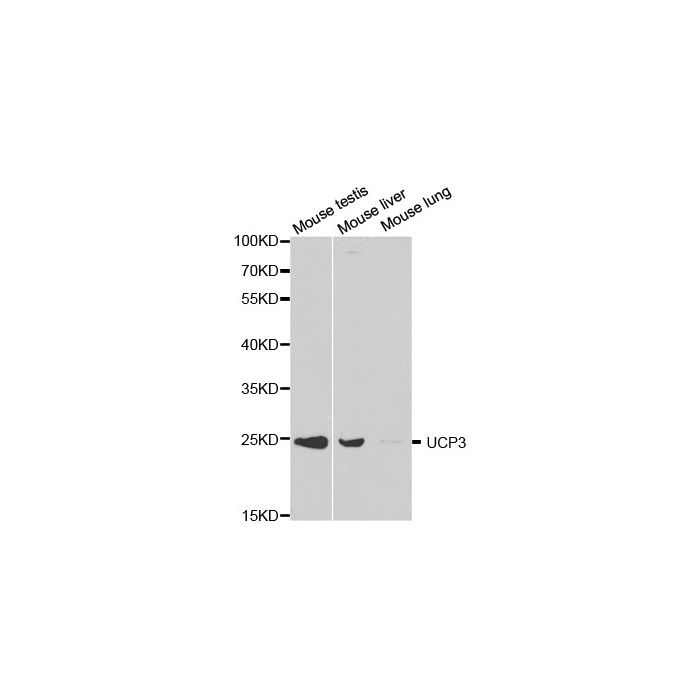
UCP3 polyclonal, anti-human, mouse
€388.00
In stock
SKU
BS6757
Background:
The uncoupling protein UCP1 (formerly designated UCP) is an integral membrane protein unique to brown adipose tissue mitochondria. UCP1 forms a dimer that acts as a proton channel, which can uncouple oxidative phosphorylation by dissipating the electrochemical potential across the inner mitochondrial membrane. This process induces heat production in brown adipose tissue and is involved in regulation of body temperature and glucose metabolism. UCP2 is a structurally related protein that also uncouples mitochondrial respiration. It is more widely expressed in human and mouse tissues, including white adipose tissue and muscle, than is UCP1. UCP2 is thought to play a role in body weight regulation. An additional UCP family member, UCP3, is highly muscle specific and is possibly involved in the uncoupling of oxidative phosphorylation in skeletal muscle.
Alternative Name:
Mitochondrial uncoupling protein 3, Mitochondrial uncoupling protein 3, SLC25A9, Solute carrier family 25 member 9, UCP 3, UCP3, UCP3, Uncoupling protein 3, Uncoupling protein 3 mitochondrial proton carrier,
Application Dilution: WB: 1:500 - 1:2000
Specificity: UCP3 polyclonal antibody detects endogenous levels of UCP3 protein.
Immunogen:
Recombinant full length Human UCP3.
MW: ~ 35 kDa
Swis Prot.: P55916
Purification & Purity:
The antibody was affinity-purified from rabbit antiserum by affinity-chromatography using epitope-specific immunogen and the purity is > 95% (by SDS-PAGE).
Format:
1mg/ml in PBS with 0.1% Sodium Azide, 50% Glycerol.
Storage:
Store at 4°C short term. Aliquot and store at -20°C long term. Avoid freeze-thaw cycles.
For research use only, not for use in diagnostic procedure.
The uncoupling protein UCP1 (formerly designated UCP) is an integral membrane protein unique to brown adipose tissue mitochondria. UCP1 forms a dimer that acts as a proton channel, which can uncouple oxidative phosphorylation by dissipating the electrochemical potential across the inner mitochondrial membrane. This process induces heat production in brown adipose tissue and is involved in regulation of body temperature and glucose metabolism. UCP2 is a structurally related protein that also uncouples mitochondrial respiration. It is more widely expressed in human and mouse tissues, including white adipose tissue and muscle, than is UCP1. UCP2 is thought to play a role in body weight regulation. An additional UCP family member, UCP3, is highly muscle specific and is possibly involved in the uncoupling of oxidative phosphorylation in skeletal muscle.
Alternative Name:
Mitochondrial uncoupling protein 3, Mitochondrial uncoupling protein 3, SLC25A9, Solute carrier family 25 member 9, UCP 3, UCP3, UCP3, Uncoupling protein 3, Uncoupling protein 3 mitochondrial proton carrier,
Application Dilution: WB: 1:500 - 1:2000
Specificity: UCP3 polyclonal antibody detects endogenous levels of UCP3 protein.
Immunogen:
Recombinant full length Human UCP3.
MW: ~ 35 kDa
Swis Prot.: P55916
Purification & Purity:
The antibody was affinity-purified from rabbit antiserum by affinity-chromatography using epitope-specific immunogen and the purity is > 95% (by SDS-PAGE).
Format:
1mg/ml in PBS with 0.1% Sodium Azide, 50% Glycerol.
Storage:
Store at 4°C short term. Aliquot and store at -20°C long term. Avoid freeze-thaw cycles.
For research use only, not for use in diagnostic procedure.
| Is Featured? | No |
|---|
Write Your Own Review